Total Pageviews

Showing posts with label fantasy. Show all posts

Friday, 6 June 2025

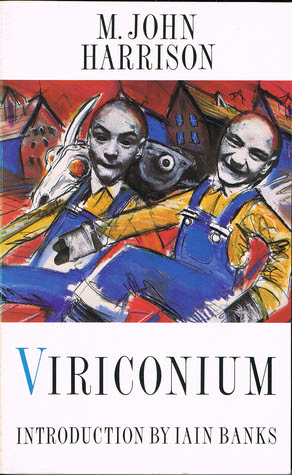
Viriconium - M John Harrison


 Discovering the work of M John Harrison over the last year or so has been a profound experience.   He is by far the best of his genre, though that poses the question: what exactly is his genre?   I'll take a stab at dark imaginative fiction.   It doesn't matter if it has a sci fi setting, an imagined world outside time, or a neglected corner of this world, Harrison always goes further, adding a sense of the inexplicable, which is pure Harrison.

This Unwin paperback from the mid-80s combines two books of the Viriconium series, the novel In Viriconium (1982) and the short stories and associated pieces collected as Viriconium Nights (1984).   There are other Viriconium works, notably The Pastel City and A Storm of Wings.

Viriconium is everywhere and nowhere.   It is not always Viriconium; sometimes it is Uroconium, or Vrico.   It is medieval and sometimes it is fin de siecle Paris.   There is an Artists' Quarter, a High City, and heathland.   The totem of the city, though, is the Mari Lwyd, immortalised by Dylan Thomas's friend Vernon Watkins.  

Characters come and reappear in different contexts.   They have wondrous names and titles.  Ardwick Crome, the Grand Cairo, Morgante who is also Rotgob and sometimes Kiss-O-Suck, Mammy Vooley, Ignace Retz and Dissolution Khan.   One story, 'A Young Man's Journey to Viriconium', is absolutely set in contemporary York and is about how one gets from here to the mystic city via a mirror "in the lavatory og the Merrie England cafe, a little further down New Street than the El Greco, between Ramsden Street junction and Imperial Arcade" in, I think, Huddersfield.   Which feels exactly right.

In Virconium is the most satisfying piece, a sort of love story set in the Artists Quarter during a time of plague.   In this period a pair of demi-gods called the Barley Brothers (Matey and Gog) rampage through the city until they are defeated by the painter Ashlyme.   The stories of Virconium Nights are, by definition, more fragmentary but each has incredible depth, compelling the reader to ask questions and make connections, not all of which are necessarily there.

Fascinating, enthralling, often startling.   M John Harrison is giving my all-time favourite author (the late E L Doctorow) a run for his money.

Thursday, 22 May 2025

Heroes and Villains - Angela Carter


 Angela Carter has been an inspiration to me, from her radio plays to her arcane fairy tales and her novels, some of which I have reviewed on this blog.   The Bloody Chamber and Nights at the Circus must have been read before I started the blog.   Thankfully Carter managed a significant output before her early death.

Heroes and Villains was published in 1969, which would place it about midway in her truncated career.   She seems to have been in full possession of all her powers.   I found it a masterful piece of writing, beguiling and shocking in equal measure.   As always in her best work, it centres on a young woman discovering her sexuality.

The setting is Britain post apocalypse.   The survivors have grouped into three known clusters, the Professors, the Barbarians and the Out People.   The Professors are the remnants of civilisation who now literally occupy ivory towers.   Barbarians descend from gypsies and travellers.   The Out People occupy the fallen cities and because they hunkered out the blast are often hideously mutated.   The three peoples attack and loot one another.

Marianne is the daughter of a Professor.   As a young child she watched her brother die during a Barbarian raid.   At sixteen she leaves her sanctuary and is promptly captured by the Barbarian Jewel Lee Bradley, the same Barbarian who cut down Marianne's brother, who carries her off to his camp.   As a Bradley Jewel is Barbarian aristocracy, along with his numerous brothers.   Their foster mother Mrs Green was also once a Professor's daughter.   Another Professor who has crossed over is the shaman Donally, who has tutored Jewel.   Donally is so decadent that he keeps his son chained up and beats him.   He fancies himself the last remaining artist and has tattooed the story of Adam accepting the apple from Eve on Jewel's back.

Jewel casually takes Marianne's virginity as a gesture of ownership.   Marriage then becomes inevitable.   Neither much wants it, despite being mutually attracted.   But they come to terms - which is really what the book is about: the accommodations we all make in order to move forward in life.

It is beautifully done.  Carter conjures up an English arcadia re-growing from the blasted ruins.   Her characters are vivid, perverse, compelling.   Her proses sizzles.   Her masterstroke is to leave the story halfway through.   By which I mean, there is a decisive climax, but so many strands cry out for resolution.   We are desperate to find out what happens next.   Our minds inevitably run on - and only the very best of books let that happen.

Tuesday, 11 February 2025

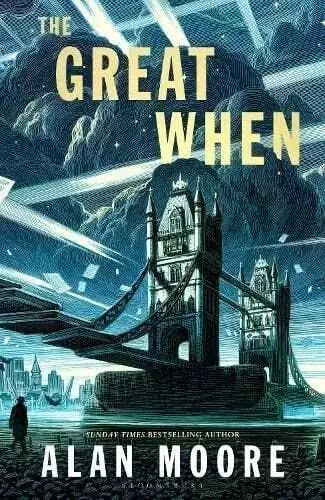
The Great When - Alan Moore


A novel by the great master of serious graphic novels.   A novel in the psychogeographical footsteps of Iain Sinclair with the imaginative spin of Michael Moorcock's Mother London.   What could be further up my street?   What could be better?   Nothing could be either: The Great When is a rush of thrills and delight from start to finish.

It is the coming of age of Dennis Knuckleyard, an orphaned teenager in 1949, working and lodging in the premises of second-hand bookseller and former starlet Coffin Ada.   Ada sends him to buy a set of books by Arthur Machen.   Dennis gets them for a snip.   But the box contains a book that shouldn't be there - a book Machen made up in two of his weird works.   Ada wants shut of it - immediately.   Dennis tries to return it to the vendor - only to find him being carried off to the morgue.

The next thing he knows, Dennis is being pursued through nighttime London by two of gangster Jack Spot's henchmen.   Down one backstreet Dennis stumbles against a crate which turns out to be a gate, a portal into a very different London.   This is Long London, a richer, more vibrant, more magical version - and somewhat more dangerous.

Back in the duller world of reality Dennis tracks down artist and mage Austin Osman Spare, former disciple of Aleister Crowley, who we met in the prologue.  Spare gets much inspiration from Long London, which he visits often.   He agrees to go there with Dennis to return the book which shouldn't exist.   First they go drinking in London's postwar Bohemia, beloved of Dylan Thomas and Andrew Sinclair (who also wrote of an alternate London in his Gog and Magog, which I sadly found unreadable).  Dennis soon meets his own Gog, Gog Blincoe, a wooden man from Long London who hangs round with a street vendor and art enthusiast called Ironfoot Jack Neave.   These are the good guys, who help Dennis rescue teenage prostitute Grace Shilling from the notorious Spot.

Spot wants to be introduced to the embodiment of all London villains, Harry Lud, a manifestation from the other London.   This doesn't go well for Spot but it seems to cure all Dennis's problems.   Jack, however, has one last visit to make, one last enemy to overcome...

Brilliantly written, every sentence brimming over with life and arcane knowledge.   I cannot wait for the next Long London novel, due out later this year.

Friday, 10 January 2025

Dark Magic - Mike Ashley (ed)


 Another Mammoth anthology edited by the great Mike Ashley.   This one errs more towards fantasy than my usual horror preference, but there are nevertheless some cracking stories here.  There are examples from the genre greats like Clark Ashton Smith and Michael Moorcock - a particularly fine one by Ursula K Le Guin - and really interesting contributions from contemporary writers I'm unfamiliar with but who I am now interested in reading more from.   In this category I'm especially enthused by Peter Crowther, James Bibby and Esther M Friesner.   There are one two duds, but that's a matter of taste and inevitable in any big collection.   That said, there is no bad writing.

Sunday, 19 May 2024

The Sunken Land Begins to Rise Again - M John Harrison


 Now this was a discovery for me.   I admit, I'd not heard of Harrison, notwithstanding he was a pillar of British sci fi fantasy in the Sixties and Seventies, despite the fact he was associated with Michael Moorcock, that China Mieville is a fan, and that he qualifies (sort of, originally) as a local author.   But I know him now.   And I was blown away by this, his novel from 2020.

It's a contemporary tale of two peripheral people: Shaw, whose first name never becomes clear (it's probably Alex), and Victoria Norman.   They drift into one another's orbit in London, then drift apart again.   Victoria inherits her mother's house in Shrewsbury and Shaw gets a gig economy job, working for, in wh Tim, who keeps an office on a barge in Brent and who might possibly live next door to Shaw in the subdivided HMO in Wharf Street.   Tim has self-published a book and keeps a blog about ancient DNA.   Shaw meanwhile seeks a sort of therapy from a medium called Annie Swann, who seems to be Tim's sister.  Tim gets Shaw to record his sessions with Annie to use as material for his blog.

In Shrewsbury, Victoria gets local tradesmen in to do up the house.   They are very local - they might live next door - and are very tribal.   One of them, the roofer, is incredibly keen on The Water Babies, even keener that Victoria should read it.   Victoria makes a new friend in Pearl, who runs a cafe and turns out to be the daughter of Chris (who prefers to be called Ossie) and is the one who apparently lives next door to Victoria.   The building containing Pearl's cafe is another HMO, in which some very strange people dwell, including all the tradesmen Ossie coralled into working on Victoria's house.   Pearl disappears - Victoria sees her do it, and it is very strange.

The novel is very strange and compelling.   Harrison plays on the littoral nature of his settings and luxuriates in their psychogeography.   Despite being hopeless failures in life - because they fail to engage with life - Shaw and Victoria are characters we get to like and trust.   The secondary characters like Shaw's mum in the care home and her colourful marital backstory, Pearl and Tim and especially, all have their charm which is coupled with threat.  The fantasy element is crucial, yet downplayed.   It doesn't need to be explained, it just needs to be there.

I would have probably passed had it not been for the eyecatching cover image by Micaela Alcaino, which was right up my street, so I picked up the book, which was absolutely 100% what I'd been looking for.   An object lesson, there, in the importance of cover art.

Thursday, 16 February 2023

Railsea - China Mieville


 In a post-apocalyptic world life revolves around the Railsea, a nexus of railway lines populated by mole-trains, navy trains, pirate trains and salvage trains.   Sham ap Soorap is an apprentice doctor's assistant aboard the mole-train Medes.   Giant feral animals burrow the wasteland between the rail lines of the Railsea and Captain Naphi of the Medes is obsessed with a giant mole, a Great Southern Moldywarpe known as Mocker-Jack, which she claims bit off her arm.   Mocker-Jack is Naphi's obsession; all captains have them, just as salvagers have their specialisms, the junk they know best.   Whenever a train docks, the cities buy their produce and sell them rumour.

Sham is not content with his life aboard the Medes.   He rather fancies himself as a salvager, but a chance find sends him to the Shroake siblings in Manihiki, and they, eventually, lead him on a quest for the legendary end of the line.

I love Mieville's writing style, a sort of techno-baroque.   He endows his characters with endless cheerful eccentricities.   Even the pirates here have their good sides.   He handles action like a master.   Railsea is a quest novel and a good one.   The world imagined here is convincing and the book rather peters out when the object is attained.   The object, of course, has to be obtained otherwise the whole narrative is pointless, and the good thing is that Mieville has the taste and discrimination to leave it there, without tying up every loose end as lesser authors might.

Thursday, 19 November 2020

The Model - Robert Aickman


The Model is a novella, left by Aickman when he died in 1981 and published in 1988.  It is now a Faber Find and I got the ebook.  Aickman told a friend he thought it was his best work.  I wouldn't go that far but it is different and it is always great to see a dying man branching out into a new field.

What we have is a grim fairy tale, set in Tsarist Russia sometime in the second half of the Nineteenth Century.  Elena is a young girl who lives a very sheltered life in a remote town.  Her mother is an invalid, her father the local lawyer.  A visiting couple leave her a book about ballet which inspires Elena to build a model theatre.  A very strange man then pays a flying visit and gives her toy dancers.

Elena is on the verge of puberty and her parents start pressing her to look to the future.  Her mother wants her to become a nun which, she has been told by God Himself, will keep the mother alive a little longer.  Her father, however, wants Elena to become the 'companion' to the local nobleman's mysterious son and, all being well, to marry him.  But Elena is set on becoming a ballerina and takes herself off to the nearest town with an opera house.  She travels alone through the bleak Russian winter.  Along the way she meets a talking bear and a prince who wants to be a revolutionary.  She makes her debut her first night in town, but is taken in by a strange brown lady with simian servants, only to be rescued by a distant cousin of one of her friends back home - a young woman posing, for reasons vaguely connected to her university studies, as an officer in the hussars,

The Model is, in short, a triumph, very different to Aickman's other work (much of it reviewed elsewhere on this blog).  It is beautifully written, full of colour and imagination, and strongly recommended.

Thursday, 12 September 2019

Science Fiction Hall of Fame - the Novellas Book Two - (ed) Ben Bova


Another fascinating relic of Sixties and Seventies which I completely ignored at the time. Ben Bova's contribution is insignificant but the four novellas are all engrossing in their own way. Robert A Heinlein's Universe is on the hard side of sci-fi, set in a spaceship so big that is a world in itself, so far into its voyage that it has forgotten there is a universe outside. Vintage Season is by Henry Kuttner and his wife C L Moore (writing as Lawrence O'Donnell). Oliver takes in a family as vacantioners-cum-lodgers; they gradually reveal themselves as aliens on a visit to take in Earth before something happens. It would be crass to reveal what that something is, but it has to be said that the last line (which could easily be the first line of another story) is a stunner. The Ballad of Lost C'mell by Cordwainer Smith is the only novella here not written in the 1940s. It dates from 1962 and is pure Beatnik. It is extreme fantasy, set in a time when science has been sublimated, when "Earthport stood like an enormous wineglass, reaching from the magma to the high atmosphere." Jestocost is a Lord of Instrumentality whereas C'mell is a very girly girl, so girly that she is in fact a human-shaped cat, a homunculus. Yet Jestocost loves C'mell. The question is does she - can she - love him? And finally we have Jack Williamson's With Folded Hands, written in 1947 but still pertinent today because it is about the coming of the super-robots. The Prime Directive, a forerunner of Asimov's Laws, is brilliantly and bleakly enacted. It was for me the most effective novella in the collection, albeit Cordwainer Smith is a better writer.

Tuesday, 2 April 2019

The Infernal Desire Machines of Doctor Hoffman - Angela Carter


I was only familiar with Carter's radio plays and later fiction - the gothic fables most readers are aware of. The Infernal Desire Machines of Doctor Hoffman (1972) was apparently the turning point. Carter had won the Somerset Maugham Award which enabled her to spend two years in Japan, and this was the result.

It is very, very different. For a start, the protagonist-narrator, Desiderio, is a man, a minor underling in an unnamed city state in what is said to be South America, which is besieged by the illusions created by the Desire Machines. He is sent on a quest to bring down Doctor Hoffman through his daughter Albertina. The quest is utterly surreal, involving circus sideshows, freaks, Indian tribes, a swashbuckling sex-maniac Count and a tribe of centaurs. We can see the seeds of her future work.

The style, though, is experimental. She uses a quote from Jarry as an epigraph and indeed the pseudo philosophy she plays with throughout is very Jarry-esque, that is to say pataphysical. The action comes in spurts, is very colourful and often funny. It is over-wrought as so many experimental novels are. When you sling overboard all normal fictional restraints, where or why would you stop? The outcome is great fun and an essential read for all interested in Angela Carter, which should of corse be everyone. But I have to say I missed the nostalgic, almost elegiac tone of the later novels.

The introduction in this edition, by Ali Smith, is the worst I can remember reading.

Monday, 26 November 2018

The Golden Apples of the Sun - Ray Bradbury


This collection of Bradbury short stories dates from the early Fifties, before he had committed himself wholeheartedly to science fiction. Thus most of the stories here are not sci fi. By and large they are fantasy, some tilting more towards allegory.


It might not be the usual Bradbury field but it is definitely the usual Bradbury standard of writing. That is to say, exceptional. These stories might have appeared in pulp magazines but Bradbury still polishes his phrases, looks out for and treasures the occasional quirk, and leaves nothing on the bone. My personal favourites are 'The Flying Machine' (set in a mythical ancient China and definitely allegorical), 'Hail and Farewell' about a boy "twelve years old with a birth certificate n his valise to show he had been born forty-three years ago', and the opener, 'The Fog Horn' in which a sea monster perhaps a million years old answers the call.


All in all, classy ephemera.

Saturday, 13 October 2018

The Unholy City - Charles G Finney


Sometimes you stumble on something that's completely out of the blue. This 1976 paperback with the hideous and far too literal cover proclaims The Unholy City (1937) "a masterpiece of weird adventure." Well it's certainly not an adventure, it's definitely weird, and it might well be a masterpiece.


Charles G Finney (1905-1984) was the great-grandson of an identically-named evangelist and prolific writer (so be careful if you put the name into a search engine). His first novel, The Circus of  Dr Lao (1935) was deemed the most original book of the year in the National Book Awards. It was later turned into a partly-animated movie (The 7 Faces of Dr Lao) by George Pal. Tony Randall - later famous as  Felix in The Odd Couple - apparently supplies all seven faces. I really must get a copy of book and film.


The Unholy City is partly a continuation in that our narrator, whom we eventually learn is called Captain Butch Malahide, comes from Abalone, the Arizona town visited by Dr Lao's circus. He is taking a world tour by airship but the airship crashes, leaving Malahide the only survivor. He scoops up all the money he can find from his late fellow passengers (a large amount of drachmas, though pointedly not the Greek variety) and sets out for the nearest city. On the way he encounters Vicq Ruiz, who convinces Malahide to accompany him to the city of Heilar-way where they will enjoy a bacchanal to celebrate the fact that Ruiz will die very soon. He woke this very morning with a presentiment to that effect.


Before they get to the city they encounter the Chiam Mings, who own the monster on the cover. Malahide and Ruiz are exposed to the beast, but Malahide has a pistol and shoots it. End of adventure.


The remainder of this very short (120 page) book is the bacchanal. The twosome drink prodigious amounts of szelack, travel hundreds of miles up and down the Calle Grande in supercharged taxis, watch a black citizen get railroaded in court, get interviewed by the Scavenging Scribe of the Tandstikkerzeutung newspaper, pay off Ruiz's debts with Malahide's drachmas, pick up a couple of women (Mrs Schmale and Mrs Schwackhammer), eat several meals of chops and green onions, get into fights, watch an experimental play, and are taken for members of three groups of insurgents (the elderly, the taxpayers and the unemployed) who have separately decided to rise up together against the repressive government of Heilar-way such as it is.


Throughout the day they hear and read news reports of a giant tiger terrorising the suburbs.


This is not fantasy literature, it is fantastical. In a sense it is a cock-eyed Pilgrim's Progress. The relationship between Malahide and Ruiz is the inverse of that between Don Quixote and Sancha Panza; Ruiz spouts high-flown chivalric nonsense about honour which the monosyllabic Malahide apathetically accepts. The nearest parallel I could think of was Nathanael West who was writing his slim satires at the same time as Finney. The language is deliberately archaic ("By gad, sir!"), the shenanigans bordering on slapstick. Before fighting a couple of roughs who are seeking to steal their lady-friends, Ruiz has to hand Malahide his dentures and spectacles and enlist his help to adjust his surgical support.  The roughs, meanwhile, are given a thorough beating by the slim redheaded girl cashier with the huge grin. There is also surrealism: Malahide becomes obsessed with the spectral figure of Frances Shepherd, disgraced daughter of the notorious bank president, whom he bumps into all across town, finally getting close and personal in the zoo recently vacated by the rampaging tiger.


At its heart - the Germanic names give it away - The Unholy City is a scathing satire of the rise of fascism, also lampooned by Sinclair Lewis in It Can't Happen Here (1935). You see the reports about the marauding tiger and you instantly conclude Fake News! Nobody reliable has actually seen it, although there are pawprints and savaged corpses. It is a perfect gem of its period. I would add 'and its genre' but what is its genre? Is it, perhaps, unique? Whichever, I loved it.

Wednesday, 23 May 2018

Behold the Man - Michael Moorcock

Moorcock is the king of modern British sci fi. He has been writing at a stupendous rate for more than fifty years and there are more than a hundred books. This, from the late Sixties and Moorcock's late twenties, is one of very few stand alone works. A version - a novella version - of Behold the Man won the Nebula award (best novella 1967). The thing about Moorcock is, he constantly reworks, rewrites and expands. There are multiple versions of various stories, just as there are multiple universes in some of his fiction.


This, it might be said, is Moorcock's distinctive take on H G Wells' The Time Machine. Wells, being Wells, was only really interested in the future. The time machine here, we are told as soon as our hero sees it, cannot go forward, only back. And if we can only go back - subject to the usual caveat of not  changing history - where would most of us choose to go? Elizabethan England perhaps? The age of the dinosaurs? The Holy Land circa 30AD? As might be guessed from the title, our hero Karl Glogauer opts for the latter.

His life in Sixties London, which is recreated throughout the novel, has led him to question his religious beliefs. So when the physicist Sir James Headington shows him his time machine and invites him to use it, Karl has only one destination in mind.

Virtually the first person he encounters in Roman Palestine is John the Baptist. Fortunately Glogauer has taught himself Aramaic, unfortunately John doesn't seem to have heard of his supposed cousin, Jesus of Nazareth. Yet the time is right - 28AD. Jesus should be mustering disciples and spreading the Word. His ministry won't last long and, critically, John has to die first.

Thus begins Karl's quest for the as yet unknown Nazarene. I won't reveal how it pans out but will just state that it does so in a highly satisfactory manner.

This is the first full-length Moorcock I have tackled. I was put off about the time he was writing the original version of Behold the Man, by a ridiculous piece of fluff he wrote for an alternative magazine of Swinging London. I enjoyed this hugely. I loved the nonstop tide of ideas, the clever way he play with the various levels of narrative and the distinctive tone he gives to each.  Glogauer is an amiable hero, not quite an everyman, more an everyday avatar of the polymathic Moorcock. I have already ordered another Moorcock - one which isn't listed among the hundred or so in this series from Gollancz but which Moorcock himself mentions in his introduction - called Mother London. I am definitely keen to read his take on Elizabeth I, Gloriana, though I am slightly worried that has something to do with the off-putting bilge I read on the train home from London circa 1968-9. We'll see.

Tuesday, 8 May 2018

The Last Days of New Paris - China Mieville


The Last Days of New Paris is a novella, and better for it. The other Mieville novel I have read (Kraken, which I reviewed here last year) went on just that bit too long. Here, the ideas are fizzing throughout but the tighter narrative seems to help Mieville maintain the high standard of his prose.


The idea itself is a corker. Surrealist concepts are brought to life in Nazi-occupied Paris. As a result Paris is still occupied - indeed, cordoned off from the rest of the world, with the rest of the world's blessing - in 1950. These manifestations ('manifs') are predominantly on the side of the resistance (specifically the Surrealist resistance, the Main a plume) of which our hero Thibaut is a member. Thibaut wears one manif, the armour of Surrealist women's pyjamas, and joins forces with another, the Exquisite Corpse (featured on the cover) dreamt up by Breton, Lamba and Tanguy. The Nazis created the manifs with the S (for Surrealist) bomb, the creation of which in 1941 is the secondary storyline here, but the manifs naturally hate them for it. The Nazis have therefore done a deal with Hell and signed up hellish demonic monsters. Also involved is Sam, an American woman photographer, who may or may not be with the OSS, forerunner of the CIA. She is collecting photographs for a book called - typically Mieville - The Last Days of New Paris.


I enjoyed this hugely. It is precisely my cup of tea, right down to the account of how Mieville came by the story and the learned notes at the end. Just reading it inspired me. Hopefully it will do the same for you - because you have to read it.

Tuesday, 28 November 2017

Angelica Lost and Found - Russell Hoban

Published in 2010, Angelica Lost and Found was Hoban's last book. He died the following year. His powers clearly were undiminished to the end. Angelica bristles with ideas, invention, and joie de vivre.


For those who have not encountered Hoban before, the concept takes some swallowing. Here goes---
Volatore the hippogriff (offspring of a griffin and a mare) has escaped from Girolami da Carpi's painting of a scene from Ariosto's Orlando Furioso, specifically the scene from Canto IV in which Ruggiero, aboard the hippogriff, rescues the naked Angelica from the sea monster Orca. So far, so straightforward, yes? Hoban's Volatore has been enthused by the idea of a naked Angelica, so he sets out to find his own, in post-Millennium San Fransisco. As you do. The Angelica he finds is the gallerist daughter of two painters. She likes the idea of an amorous hippogriff and they have sex. They then become separated. And it is Angelica who embarks on a quest to find Volatore.


She finds a number of men who smell like Volatore, some of whom even call themselves Volatore, but none of them actually are Volatore the hippogriff. There is the painter who can't remember painting the painting of tiny elephants and the Hollywood hairstylist who buys it and then chucks it into the bay where Angelica and her psychiatrist lover fish it out. Meanwhile Angelica adopts a cat and Volatore enters a Russian man's penis.


All this in 71 chapters over 237 big print pages.


I think this is one for specialist tastes. I loved it.

Thursday, 31 December 2015

The Wolves of London - Mark Morris


I had not come across Mark Morris before spotting this, the first part of his Obsidian Heart trilogy, in my local library.  I am already on the lookout for more.

Wolves is a horror/fantasy adventure with the added bonus (so often missed) of an engaging protagonist, Alex Locke, goalbird turned psychology lecturer, with something worthwhile at risk - he wanders from the straight and narrow because his eldest daughter's boyfriend is in bother, and gets stuck there when his younger daughter is kidnapped.  The writing style is lively but nowhere near so lively as Morris's imagination.  The surprises and twists keep on coming and kept me entertained to the very end.

Being a trilogy, the end is not conclusive and I admit I would have preferred some loose ends to be resolved.  I expect I shall just have to pick up Book Two, The Society of Blood, to satisfy my curiosity,

By the way, the artwork on the cover, by Amazing15.com, is just superb.

Thursday, 18 June 2015

The Other Log of Phileas Fogg - Philip Jose Farmer


The title says it all: there is another log, other than the one Jules Verne edited for publication, containing the real, intergalactic context of Fogg's round-the-world journey.  It is crossover literature to a certain extent, in that Verne was of course for many people the father of science fiction, but Around the World in Eighty Days was not one of his science fiction works.  Twenty Thousand Leagues Under the Sea was, however, pure sci fi, and Farmer imports Nemo here as his criminal mastermind.

Farmer was the pioneer of this form, which is one I love and try to write myself.  He began with Tarzan, then Fogg, and on to create an entire world - the world of Wold Newton, in which all the heroes of fantastical pulp fiction coexist.  The Other Log, as I say, was his second experiment in the form.  Farmer completes the illusion with  editorial digressions.  The result is great fun, though I would say that, as so often with Big Idea Fiction, the characterisation suffers somewhat.  Finally, I must put on record how much I adore the artwork on this original 1973 Daw paperback.

Thursday, 11 June 2015

The House on the Borderland - William Hope Hodgson

Mr Hodgson is perhaps second only to Algernon Blackwood in his serious treatment of unreality.  Few can equal him in adumbrating the nearness of nameless forces and monstrous besieging entities through casual hints and insignificant details, or in conveying feelings of the spectral and the abnormal in connexion with regions or buildings
Thus said H P Lovecraft in his rolling survey of the form, "Supernatural Horror in Literature", written between 1925 and 1934.


Well the object here is very much the building, and what happens there is abnormal to the ultimate degree.  Those who know Hodgson only for the Carnacki stories or his innumerable tales of the Sargasso, are missing out.  Borderland prefigures his final novel, The Night Land, which even Lovecraft and Clark Ashton Smith felt 'went a bit too far'.  It might have been written in 1907 (see 'the editor's' introduction) but in many ways it could easily have come from the acid-ridden 1960s.

It starts traditionally enough.  Two Victorian chaps take a holiday in the far West of Ireland.  There they stumble upon the ruined, abandoned house, perched precariously on an unstable rock platform over a huge bottomless abyss.  In the rubble inside the house they find a damaged manuscript written by the last owner, a nameless recluse.  We do not know when the manuscript was written or when the house was abandoned, and very soon the issue of time becomes irrelevant.

The recluse describes how he was sitting in his study late one night when he felt himself being borne up and away by invisible forces, into space and out of the solar system.  In another part of the galaxy he visits a planet where he finds a massive replica of his house hewn out of green stone, standing on the border of the Silence.  He wakes back in his study and finds that nothing has changed.  Or has it?

Part of his garden is carried away in a landslip.  The pit begins to form.  Creatures emerge and attack the house, which the recluse now realises stands on the border between dimensions.

A good third of the book is taken up with a second out-of-body experience in which he seems to live forever, so long that he sees and survives the death of the sun itself.  He seems to wake, but---

Unique for its day and very much a precursor of modern visionary sci fi, this book essentially defines the term 'fantastic fiction'.  A must-read for any student of the genre.

And what, for the record, did Lovecraft think of The House on the Borderland?  Why, this---

The House on the Borderland (1908) - perhaps the greatest of all Mr Hodgson's works - tells of a lonely and evilly regarded house in Ireland which forms the focus for hideous other-world forces and sustains a siege by blasphemous hybrid anomalies from a hidden abyss below.  The wanderings of the narrator's spirit through limitless light-years of cosmic space and kalpas of eternity, and its witnessing of the solar system's final destruction, constitute something almost unique in standard literature.  And everywhere there is manifest the author's power to suggest vague, ambushed horrors in natural scenery.  But for a few touches of commonplace sentimentality this book would be a classic of the first water.
I'd quibble with the last sentence - Lovecraft, understandably, had no knowledge of Hodgson's love life, which I see mirrored in the recluse's reunion with his lost love in the second vision - but otherwise, I think he pretty much covers all the bases.  And I'd forgive him almost anything in return for the word kalpas, albeit Lovecraft borrows it from Hodgson's book.

Tuesday, 14 April 2015

Neverwhere - Neil Gaiman


I remember Neverwhere the original TV series back in 1996.  I remember quite liking it, but those were busy times for me, long before any sort of recording equipment in my house, and I don't think I watched everything.  Recently, Neil Gaiman has been cropping up a lot in my reading.  When I saw this in Hunt's bookshop in Rugby I thought, why not?

There are two versions of the Neverwhere novel, the TV tie-in from 1997 and this, the author's preferred text, from 2000.  What the differences are, I don't know.  Anyway, just be to clear, I am reviewing the 2000 version, which we must take as the definitive one.

I keep saying I'm not a big fan of sci-fi or fantasy, and I keep reviewing them.  Obviously, these days, I must state I am quite a fan of witty fantasy and reasonably down-to-earth sci-fi (i.e. not cowboys in space).  What I really like are fantasies set in the dark underbelly of London, the London nobody knows.  Thus William Gibson's Zero History, Kim Newman's Anno Dracula (of which I have just a acquired the second volume), the Felix Castor series by Neil Carey (like Gaiman, a renowned British practitioner of US cult comics), and - probably my favourite - Rivers of London by Ben Aaronovitch.  Neverwhere keeps good company.  The TV origins are evident but I don't find that a problem in any way.  I wonder, though, how well Nineties Visual Effects coped with the grand set pieces like the Floating Market in Harrod's basement.  As to how I will soon find out, see below.

The characters are likeable and well-drawn.  Poor old Richard, who finds himself marooned in London below simply by being a good samaritan.  Door, the recipient of his generosity and the girl with a mission.  The flamboyant Marquis de Carabas, the Morecambe and Wise of hired killers Croup and Vandemar, various rats and, of course, the Angel Islington.  The invention is unceasing, the wit flows flee and I really enjoyed it.  Indeed, I enjoyed it so much that I immediately laid hands on a DVD of the BBC series, which I will ultimately be reviewing and comparing on my Media & Culture blog.

Sunday, 22 June 2014

A Strange Manuscript Found in a Copper Cylinder - James de Mille


A real oddity, this.  Published posthumously in 1888, it follows the well-known fantasy trope made abundantly clear in the title, blending The Lost World with Gulliver's Travels.  The manuscript author gets lost in Antarctica and penetrates through to a semi-tropical land where dinosaurs co-exist with the Kosekin people who are incredibly kind and welcoming but who regard death as the best thing in life.

As an adventure yarn, there's not enough adventure.  There are nowhere near enough dinosaurs and those we do get - pterosaurs excepted - are simply not described well enough to be properly threatening.  So once we get established in the new world we have nothing to detain us but the unusual habits of the Kosekin and a rather tedious, formulaic romance.

The publishers (or re-publishers in this case) try to make the case for it being a satire of mid-Victorian mores, but it's not.  It's the oldest trope of all in satire, the world turned upside down.  Aristophanes did it better more than two thousand years earlier.  Again, once the premise is established - we love death/you love life, divorce is the best thing about marriage etc. - we have nowhere else to go.

For me, the part I really enjoyed was the framing device, usually the part we skip in these things (I particularly remember the tedium of the device in William Hope Hudgson's otherwise thrilling From the Tideless Sea).  Here we have an inbred toff on his yacht with a doctor, a writer of fiction and a linguist.  The chinless wonder is genuinely amusing, the writer dismisses the manuscript as a fake, and the two scholars get deep into debate of what and where the things described might be.  I can't help thinking these are the bits the academic De Mille enjoyed most too.  The very best, the last - we have to go back to the yacht, it's a requirement of the form, but instead of a wearisome epilogue, De Mille simply gives us:
Here Featherstone stopped, yawned and laid down the manuscript.
"That's enough for today," said he.  "I'm tired and can't read any more.  It's time for supper." 

Saturday, 21 June 2014

Something Wicked This Way Comes - Ray Bradbury


I don't know that I've ever read Ray Bradbury before - certainly not a full length work.  So this fascinated me.  Of course the evil carnival coming to town is nowadays a standard, even hackneyed, trope of American fantasy fiction, but I suspect Bradbury was first in the field, albeit with just a nod to Tod Browning's movie Freaks.  The writing itself is startling, so textured, gnarled, yet impactful.  I liked very much the role of Dad, much older than the usual dad, maybe an echo of Clark Kent's foster father.  I liked that he thought it through, based his plan on research in the library where he works - then discovered the true answer by accident.  The boys themselves, Will and Jim, were wholly convincing and well differentiated.  Stephen King tends to distinguish his boys by contrasting types but Will and Jim are cut from the same cloth but subtly different, hence Jim's fascination with what might be called the Magic Roundabout, which Will shuns.  Something Wicked is, quite simply, a masterpiece in its field.