Total Pageviews

Showing posts with label sargasso sea. Show all posts

Tuesday, 30 August 2016

Masters of Terror Volume 1 - William Hope Hodgson

It's interesting that Corgi chose Hodgson for the first in its Masters of Terror series back in 1977. He was out of copyright by then, of course, and one cannot be a paperback master when they still have to pay royalties. Interest in Hodgson had revived earlier in the decade when one of his Carnacki stories was dramatised in Hugh Greene's TV series The Rivals of Sherlock Holmes, but I suspect it was the reappraisal of H P Lovecraft that was going on at the same period which led to this publication, because it was Lovecraft who first described Hodgson as a master.


The introduction is by Peter Tremayne, who can always be counted on to do his homework. OK, he is slightly wrong about the dates of Hodgson's apprenticeship at sea - but I only discovered the real dates thanks to being able to view the actual documents online. Tremayne has seen publications which I haven't but will do now.
He discusses the seven stories and the reasons for their inclusion in short but effective order. 'A Tropical Horror' from 1904 was Hodgson's second published story and his first in the genre he was to make exclusively his own - sea-horror. 'The Voice in the Night' is another such, as is 'The Mystery of the Derelict', which Tremayne considers a classic. The fourth story - 'The Terror of the Water-Tank' - is here because it is one of Hodgson's rare attempts at land-based horror. I'm afraid I found it trivial.
The narrator of 'The Finding of the Graiken', one of Hodgson's Sargasso Mythos stories, was too like the narrator of 'The Terror of the Water-Tank' to hold my attention - a middleclass lightweight who does not personally confront the horror. In that respect Hodgson's most effective form was one he hit upon almost from the start: get the hero to spot the horror in the first few paragraphs, then have him confront it face to face (always supposing the horror has a face) and survive to tell us the tale. That is why, in my opinion, 'The Stone Ship' is my favourite in this collection. I had not come across it before - hadn't even heard of it - but it is classic Hodgson: a young hand spots a mysterious wreck, a search party goes aboard and confronts a truly ghastly horror which is revealed in a spectacularly gruesome manner.
The final story, clumsily called 'The Derelict' and thus easily confused with the earlier story, is included because it combines the sea-horror of Hodgson's early period with the science-fiction otherworldly horror of his masterpiece novel The House on the Borderland and the last, still controversial epic The Night Land.


All in all, then, a great introduction to the signature work of an undervalued writer with a useful and authoritative introduction to point you in the right direction for further exploration.
Thursday, 11 June 2015

The House on the Borderland - William Hope Hodgson

Mr Hodgson is perhaps second only to Algernon Blackwood in his serious treatment of unreality.  Few can equal him in adumbrating the nearness of nameless forces and monstrous besieging entities through casual hints and insignificant details, or in conveying feelings of the spectral and the abnormal in connexion with regions or buildings
Thus said H P Lovecraft in his rolling survey of the form, "Supernatural Horror in Literature", written between 1925 and 1934.


Well the object here is very much the building, and what happens there is abnormal to the ultimate degree.  Those who know Hodgson only for the Carnacki stories or his innumerable tales of the Sargasso, are missing out.  Borderland prefigures his final novel, The Night Land, which even Lovecraft and Clark Ashton Smith felt 'went a bit too far'.  It might have been written in 1907 (see 'the editor's' introduction) but in many ways it could easily have come from the acid-ridden 1960s.

It starts traditionally enough.  Two Victorian chaps take a holiday in the far West of Ireland.  There they stumble upon the ruined, abandoned house, perched precariously on an unstable rock platform over a huge bottomless abyss.  In the rubble inside the house they find a damaged manuscript written by the last owner, a nameless recluse.  We do not know when the manuscript was written or when the house was abandoned, and very soon the issue of time becomes irrelevant.

The recluse describes how he was sitting in his study late one night when he felt himself being borne up and away by invisible forces, into space and out of the solar system.  In another part of the galaxy he visits a planet where he finds a massive replica of his house hewn out of green stone, standing on the border of the Silence.  He wakes back in his study and finds that nothing has changed.  Or has it?

Part of his garden is carried away in a landslip.  The pit begins to form.  Creatures emerge and attack the house, which the recluse now realises stands on the border between dimensions.

A good third of the book is taken up with a second out-of-body experience in which he seems to live forever, so long that he sees and survives the death of the sun itself.  He seems to wake, but---

Unique for its day and very much a precursor of modern visionary sci fi, this book essentially defines the term 'fantastic fiction'.  A must-read for any student of the genre.

And what, for the record, did Lovecraft think of The House on the Borderland?  Why, this---

The House on the Borderland (1908) - perhaps the greatest of all Mr Hodgson's works - tells of a lonely and evilly regarded house in Ireland which forms the focus for hideous other-world forces and sustains a siege by blasphemous hybrid anomalies from a hidden abyss below.  The wanderings of the narrator's spirit through limitless light-years of cosmic space and kalpas of eternity, and its witnessing of the solar system's final destruction, constitute something almost unique in standard literature.  And everywhere there is manifest the author's power to suggest vague, ambushed horrors in natural scenery.  But for a few touches of commonplace sentimentality this book would be a classic of the first water.
I'd quibble with the last sentence - Lovecraft, understandably, had no knowledge of Hodgson's love life, which I see mirrored in the recluse's reunion with his lost love in the second vision - but otherwise, I think he pretty much covers all the bases.  And I'd forgive him almost anything in return for the word kalpas, albeit Lovecraft borrows it from Hodgson's book.

Monday, 11 May 2015

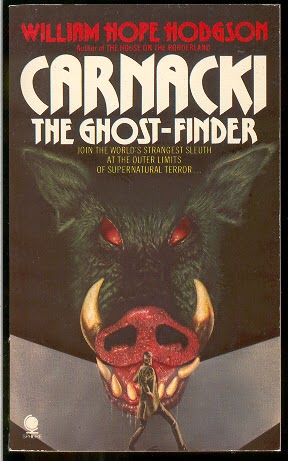
Carnacki the Ghost-Finder - William Hope Hodgson


Hodgson was killed in action in 1918.  He had never known huge literary success but was instantly forgotten in death.  The mighty Lovecraft tried to revive interest after more than a decade, and he succeeded insofar as August Derleth, king of horror pulp, continued to extol Hodgson's work.  Dennis Wheatley referenced him in The Devil Rides Out (in exactly the same way I reference him in my forthcoming short story on www.smashwords.com) but it was Hugh Greene who finally rescued him in his Rivals of Sherlock Holmes collections in the early Seventies.  Obviously Carnacki was not a detective as we like to think of Holmes, but actually the Holmes stories aren't that clever, they just seem so, and actually Carnacki would be entirely at home in The Hound of the Baskervilles or 'The Speckled Band'.  Anyway, Hodgson's works returned to print and have remained so.  This particular edition came out in 1980 and includes all the original Carnacki tales from 1913 and a couple of additions of dubious quality and/or pedigree.

To deal with the latter first. 'The Find' is crud, has nothing to do with ghost-finding and was probably abandoned by the author.  That author, though, was undoubtedly Hodgson, which is more than can be said about 'The Hog'.  This is a good story but much longer than the others and may well be the work of the aforementioned Derleth.  I am unsure.  If it is a pastiche or continuation it's a good one.  Perhaps Hodgson was trying to write a full-length Carnacki but couldn't get past a novella.

For the undoubted originals, the premise is always the same.  Carnacki invites four male friends round to his flat in Cheyne Walk, gives them supper and then regales them with an account of an investigation.  Some are paranormal, others fakes.  The best, 'The Horse of the Invisible', is both, a clever trick indeed.  I also liked 'The Whistling Room', which features a type of entity I've never come across before.  Hodgson's style is of its period.  He first published the stories in The Idler magazine in 1910, which gives me a chance to include an image from the magazine---


---and the house literary style is used.  It wasn't actually Hodgson's usual style.  An ex-seaman himself, his forte was the eerie sea yarn, more often than not written in oo-ar-matey style.  I reacquainted myself with Hodgson recently through his Sargasso Seas series.  There is one such here, 'The Haunted JARVEE', which is probably my third favourite.

In summary, then, definitely a classic of its genre, and inspirational, in my case at least. 'Carnacki: The Saiitii Manifestation' will shortly be available for free download.