Total Pageviews

Showing posts with label Michael Moorcock. Show all posts

Friday, 25 July 2025

Tales from the Forbidden Planet - Roz Kaveney (ed)


 This was a chance aquisition.   I was in London, in my favourite second-hand bookshop (Skoob, in the Brunswick Centre) and I didn't want to leave without a purchase.   That, I felt, would be letting the side down.   So I saw this, thought what the hell?   Wandered up to the counter where, of course, one of the books I had wanted for some time was on display ... but that's another story.

It was only when I was on the train, leafing through, that I realised this was a collection from the sci fi era currently interesting me - the Interzone Eighties, 1987 in fact, featuring several writers I have beens looking into recently.   Moorcock, of course (an End of Time story), Kilworth, Keith Roberts, and Lisa Tuttle, all of whom featured in the Other Rdens and New Worlds anthologies reviewed here in the last few weeks.   Aldiss is here, too, with a really enjoyable one called 'Tourney', and Iain M Banks (excellent).   I liked John Brunner('A Case of Painter's Ear'), Josephine Saxton's 'The Interferences' and Gwyneth Jones's 'The Snow Apples'.   I did not like in any way the story by Harry Harrison, but that's the point of anthologies, isn't it?

One of the things that attracted me in the shop was the fact the stories all had an illustration by a British illustrator of the period.   I thought this would be a bonus for me and my own illustrations.   As it happens, the only one I enjoyed was Dave Gibbons for the Banks story 'Descendant'.   I liked the cover illustration, too, the work of Brian Bolland.

Turns out the common denominator for the collection is that all these authors had done sessions at the Forbidden Planet bookshops.   As good a connection as any.

Friday, 18 July 2025

Other Edens - Christopher Evans and Robert Holdstock (eds)


 Other Edens is a sci fi collection from 1987 and very much from the Interzone period of British imaginative fiction.   Some of the most noted writers are respresented - Moorcock, Harrison and Aldiss - but not with their best work.   Those who stand out here are those who were then breaking through: Garry Kilworth, who I only knew from Interzone; Lisa Tuttle, who I had heard of but never read; and a couple of others completely new to me, such as Graham Charnock and Keith Roberts.

Roberts' story Piper's Wait was probably my overall favourite, a temenos story stretching very effectively over the ages.  Tuttle's The Wound was a close second, a very exciting take on mutable sexuality.   Kilworth's Triptych was by far the most radical and complex, a fragmented three-parter positively bursting at the seams with ideas.   I am increasingly interested in Kilworth.  He seems to have been extraordinarily prolific with over eighty novels spanning many genres, so it shouldn't be too hard to track one down.

Friday, 13 June 2025

New Worlds 8 - (ed) Hilary Bailey


 New Worlds magazine was founded before WW2 and taken over by Michael Moorcock in the sixties.   With the aid of an Arts Council grant Moorcock turned New Worlds into the monthly journal of the British New Wave in sci fi: Moorcock himself, Ballard, Aldiss etc.   Around 1970 the magazine started to flounder.   Moorcock persuaded Sphere to continue it as a 'quarterly' paperback.   By 1975 when this eighth and last edition came out, Moorcock's wife Hilary Bailey was editor and their close longterm collaborator M John Harrison was literary editor.

Bailey made a good job of editing this one.   The stories appear in descending order of quality.   We start with Harrison's 'Running Down', a Yorkshire-set tale combining his interest in climbing with nature horror.   Then we have 'White Stars', an interlude from Moorcock's long-running and intricate Dancers at the End of Time thread.   I was initially put off Moorcock by Dancers when I was a young teenager, but I thoroughly enjoyed 'White Stars'.   Barrington Bayley's 'The Bees of Knowledge' is different and well-written.   Peter Jobling's 'Building Blocks', which Bailey in her introduction suggests might be a debut piece, is equally interesting but not quite so well written.   The other, shorter, stories did not greatly appeal.

I was fascinated by the two book reviews at the end, one by Harrison, the other by John Clute.  Is this what sci reviews were like in the Seventies?   By way of illustration, I give you title of Clute's ten-page review of Brian Aldiss's novel, The Eighty-Minute Hour: 'I say Begone! Apotropaic Narcosis, I'm Going to Read the Damn Thing, Ha Ha.'   Worryingly, Harrison's marginally shorter review of Thomas M Disch's collection Getting into Death is in similar vein.

John Clute went on to become one of the founders of Interzone, which is in many ways was the successor to New Worlds.   The issue I have just acquired contains work by Harrison and Aldiss and Thomas M Disch.   I'll report on it shortly.

Monday, 3 March 2025

The Russian Intelligence - Michael Moorcock


 The Russian Intelligence is a pastiche spy story featuring a contemporary avatar of Moorcock's Eternal Champion, Jerry Cornell, in Swinging London, at least a decade before the book was written.  Actually it is a reworking and expansion of a story originally written in 1966.   This is Moorcock, after all, and the narrative probably had various earlier incarnations.

It reads like it was written very quickly.   Moorcock reckoned he could do 15,000 words a day in his heyday, so for Russian Intelligence maybe a week, tops.   This being Moorcock, speed doesn't mean inferior, just pacy.   When all is said and done, it is a pastiche of a genre which at the time was itself pretty silly.

Jerry Connell is a Class A agent with Cell 87.   We begin with Connell cradling his dying colleague, Thorp.   Naturally Connell is given the job of tracking down the killers.   Thorp was working on a series of leaks to the Russians.   Clues lead Connell to a publisher of comics, thence to the home of a Russian diplomat who is a subscriber.   While Connell is sneaking round the garden, inside the house the diplomat is being subjected to interrogation by the dreaded Joseph K (one of the better jokes), who is in awe of the British superstar.   Thus the chase begins, taking in discothèques in Soho and the Norfolk Broads.   That's discos in Soho and the damp nothingness of the Broads.

Connell's reputation is unjustified.   The main joke is that he is lazy and cowardly and lives in fear of his wife Shirley, who seems to always know when he has picked up a new girlfriend.   It all ends with a protracted chase around the fens pursued by a spectral horseman and his demonic minions, which is certainly no sillier than say Moonraker, indeed, isn't it what a moonraker used to be?

It's all great fun, expertly done, a window into a time gone by.

Tuesday, 11 February 2025

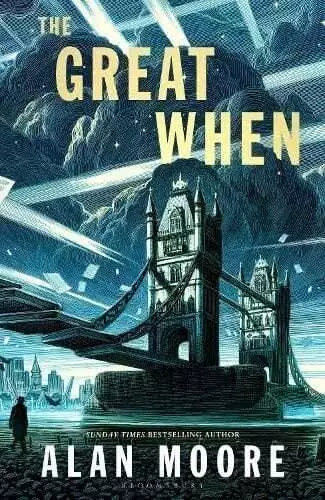
The Great When - Alan Moore


A novel by the great master of serious graphic novels.   A novel in the psychogeographical footsteps of Iain Sinclair with the imaginative spin of Michael Moorcock's Mother London.   What could be further up my street?   What could be better?   Nothing could be either: The Great When is a rush of thrills and delight from start to finish.

It is the coming of age of Dennis Knuckleyard, an orphaned teenager in 1949, working and lodging in the premises of second-hand bookseller and former starlet Coffin Ada.   Ada sends him to buy a set of books by Arthur Machen.   Dennis gets them for a snip.   But the box contains a book that shouldn't be there - a book Machen made up in two of his weird works.   Ada wants shut of it - immediately.   Dennis tries to return it to the vendor - only to find him being carried off to the morgue.

The next thing he knows, Dennis is being pursued through nighttime London by two of gangster Jack Spot's henchmen.   Down one backstreet Dennis stumbles against a crate which turns out to be a gate, a portal into a very different London.   This is Long London, a richer, more vibrant, more magical version - and somewhat more dangerous.

Back in the duller world of reality Dennis tracks down artist and mage Austin Osman Spare, former disciple of Aleister Crowley, who we met in the prologue.  Spare gets much inspiration from Long London, which he visits often.   He agrees to go there with Dennis to return the book which shouldn't exist.   First they go drinking in London's postwar Bohemia, beloved of Dylan Thomas and Andrew Sinclair (who also wrote of an alternate London in his Gog and Magog, which I sadly found unreadable).  Dennis soon meets his own Gog, Gog Blincoe, a wooden man from Long London who hangs round with a street vendor and art enthusiast called Ironfoot Jack Neave.   These are the good guys, who help Dennis rescue teenage prostitute Grace Shilling from the notorious Spot.

Spot wants to be introduced to the embodiment of all London villains, Harry Lud, a manifestation from the other London.   This doesn't go well for Spot but it seems to cure all Dennis's problems.   Jack, however, has one last visit to make, one last enemy to overcome...

Brilliantly written, every sentence brimming over with life and arcane knowledge.   I cannot wait for the next Long London novel, due out later this year.

Friday, 10 January 2025

Dark Magic - Mike Ashley (ed)


 Another Mammoth anthology edited by the great Mike Ashley.   This one errs more towards fantasy than my usual horror preference, but there are nevertheless some cracking stories here.  There are examples from the genre greats like Clark Ashton Smith and Michael Moorcock - a particularly fine one by Ursula K Le Guin - and really interesting contributions from contemporary writers I'm unfamiliar with but who I am now interested in reading more from.   In this category I'm especially enthused by Peter Crowther, James Bibby and Esther M Friesner.   There are one two duds, but that's a matter of taste and inevitable in any big collection.   That said, there is no bad writing.

Sunday, 21 July 2024

The Brothel in Rosenstrasse - Michael Moorcock


 In 1897 Ricky and Alexandra are staying at a luxury hotel in Mirenburg.   Alexandra is sixteen, Ricky twice her age.   Ricky is one of several Counts von Bek, not the important one, but a wealthy adventurer.   He and Alexandra have exhausted the permutations of sex and Alexandra in particular is keen to try something new.   So Ricky takes her to Frau Schmetterling's internationally renowned brothel in Rosenstrasse where he himself was educated in sexual matters.   They indulge.

Meantime the prospect of war hangs over this enclave of Mittel Europe.   Wedged between three mighty imperial powers, Russia, Germany and Austria, Waldenstein has remained proudly independent but disgraced politician Holzhammer has done a deal with the Austrians.   Soon Mirenburg is under siege.   The hotel is hit by a cannonball.   Ricky and Alexander become residents of the brothel in Rosenstrasse.   For a time they are safe - Frau Schmetterling's girls have after all served the senior officers on all sides - but Ricky fears he is losing Alexandra to a houseful of lesbians (all of whom he has had sex with in the past, or hopes to soon).   He starts to plan his escape.

This is very different from the usual Moorcock.   Ricky is a von Eck but he is not a Champion, far from it.   There is a stream punk element here - balloonists, etc - but nothing far-fetched or in any way fantastical.   The fantasy here is Mireburg which, despite the minute detail served up, including extracts from books of the period, is wholly 100% imaginary.   The other fantasy element is, obviously, sexual fantasy, in particular lesbianism and, in Ricky's case, paedophilia.   Alexandra is by no means his youngest; he goes into fond reminiscence about a younger girl whose virginity he bought from her disabled father in Naples.

Indeed, the book is Ricky's memoir, written on the eve of World War II, somewhere warm.  The text is peppered with interruptions from his manservant-nurse Papadakis, who also has his secrets, it seems, though they are only hinted at.

Written in 1992 this is Moorcock's take on the decadent fin de siecle literature of the 19th century.   Some of the material here is pretty hardcore but the brilliance of Moorcock's writing just about accommodates it.

Monday, 17 June 2024

The Bull and the Spear - Michael Moorcock


 Sometimes we need something different, a palate-cleanser, short and sharp.   The Bull and the Spear did the job for me.   I have long been curious about Michael Moorcock and his work.   I have previously read (and reviewed on this blog) a variety of books by him, and enjoyed them all.   This is the first volume of the Chronicle of Corum and the Silver Hand (1973-4), successor to what is known as the Swords Trilogy (1971-2).   We don't need to have read the first trilogy, Moorcock begins with a useful summary.   The Chronicle begins eighty years later.   Corum, who is virtually immortal, has survived his beloved human wife Rhalina and skulks in his castle, bored and troubled by dreams in which a group of humans is calling him.   His old comrade Jhary-a-Conel turns up to tell him these are humans on another plane of the multiverse (yes, Moorcock was using that term as early as 1973) who regard Corum as their sleeping champion who will rise and save them from annihilation.   That moment has come.   The magic of these particular humans is not strong, and Corum has to be willing if he is to transcend to their plane or dream.   Why not, thinks Corum.

The plane he finds himself on is like his, but not the same.   Corum's Castle Erorn is indistinguishable from the rock on which it stands, because Corum left it a thousand years ago.   The people who summoned him are being frozen out of existence by the Fhoi Myore, seven monstrous beings who have escaped from the void between the planes of the multiverse.   To defeat them, the people must regain two lost treasures, the spear Bryionak and the Black Bull of Crinanass.   The former will allow them to control the latter.   The problem is, the spear is with its maker, the smith Goffanon, the last of Sidhi, and he lives on the mystical island of Hy-Breasail which no human has ever visited and returned from.

Corum is not entirely human.   He belongs to one of the races which preceded humans.   He is one of Moorcock's eternal champions.   As a youth he was mutilated, losing his left hand and his right eye.   In the Swords trilogy he was given magical prosthetics but these have gone now and he uses a silver hand of his own making and wears an eyepatch embroidered by Rhalina.

The book is only 150 pages.   It races along, packed with ideas and amazing twists.   Goffanon, for instance, considers himself to be a dwarf - but is in fact eight feet tall and four feet wide, a dwarf giant.   Lots of the mythos is ancient Celtic slightly adjusted -  the British Atlantis, Lyonesse, is here Lwym-an-Esh, homeland of Rhalina.   The bull is both the bull of the Irish Tain bo Cuailnge and the bull cult of Crete.   But there is also Moorcock's personal, self-created mythology.    Jhary-a-Conel, the companion of champions, is obviously an echo of Moorcock's first eternal champ, Jerry Cornelius, the Swinging Sixties dandy.   How Moorcock manages to achieve so much story in something little more than a novella is astounding, and what keeps drawing me back to his work.

Sunday, 19 May 2024

The Sunken Land Begins to Rise Again - M John Harrison


 Now this was a discovery for me.   I admit, I'd not heard of Harrison, notwithstanding he was a pillar of British sci fi fantasy in the Sixties and Seventies, despite the fact he was associated with Michael Moorcock, that China Mieville is a fan, and that he qualifies (sort of, originally) as a local author.   But I know him now.   And I was blown away by this, his novel from 2020.

It's a contemporary tale of two peripheral people: Shaw, whose first name never becomes clear (it's probably Alex), and Victoria Norman.   They drift into one another's orbit in London, then drift apart again.   Victoria inherits her mother's house in Shrewsbury and Shaw gets a gig economy job, working for, in wh Tim, who keeps an office on a barge in Brent and who might possibly live next door to Shaw in the subdivided HMO in Wharf Street.   Tim has self-published a book and keeps a blog about ancient DNA.   Shaw meanwhile seeks a sort of therapy from a medium called Annie Swann, who seems to be Tim's sister.  Tim gets Shaw to record his sessions with Annie to use as material for his blog.

In Shrewsbury, Victoria gets local tradesmen in to do up the house.   They are very local - they might live next door - and are very tribal.   One of them, the roofer, is incredibly keen on The Water Babies, even keener that Victoria should read it.   Victoria makes a new friend in Pearl, who runs a cafe and turns out to be the daughter of Chris (who prefers to be called Ossie) and is the one who apparently lives next door to Victoria.   The building containing Pearl's cafe is another HMO, in which some very strange people dwell, including all the tradesmen Ossie coralled into working on Victoria's house.   Pearl disappears - Victoria sees her do it, and it is very strange.

The novel is very strange and compelling.   Harrison plays on the littoral nature of his settings and luxuriates in their psychogeography.   Despite being hopeless failures in life - because they fail to engage with life - Shaw and Victoria are characters we get to like and trust.   The secondary characters like Shaw's mum in the care home and her colourful marital backstory, Pearl and Tim and especially, all have their charm which is coupled with threat.  The fantasy element is crucial, yet downplayed.   It doesn't need to be explained, it just needs to be there.

I would have probably passed had it not been for the eyecatching cover image by Micaela Alcaino, which was right up my street, so I picked up the book, which was absolutely 100% what I'd been looking for.   An object lesson, there, in the importance of cover art.

Wednesday, 24 October 2018

Mother London - Michael Moorcock


Mother London is not what we expect of Michael Moorcock. That's our shortcoming, not his. He wrote Mother London in 1988 when he was absolutely at the top of his game, capable of writing absolutely anything. And here's the proof.


There's very little sci fi, but a load of fantasy. That's because Moorcock's three protagonists are on and off mental patients and we spend as much time as they do in the world of dreams. The London 'mother', insofar as there is one, is Mary Gasalee, a teenage mum who emerges from the ruin of her house in the Blitz, cradling her infant daughter. The moment she hands the baby to the ambulance crew she collapses - and remains in a coma for the next fifteen years. We enjoy her dreams which she spends largely with Hollywood stars - Merle Oberon is a particular dream friend and Ronald Colman keeps turning up unexpectedly. When Mary wakes she is in her middle thirties but still looks eighteen; everyone mistakes Mary and her daughter for sisters.


Recuperating in the hospital garden she meets Josef Kiss and does what women always do with Josef. We have already met Josef. He is an old style variety act - a mind-reader, albeit like Mary he can do it for real. In the war he made himself an ARP warden and a disarmer of unexploded bombs. This is how he met the eccentric Scaramanga sisters (in one of the best sections of the entire book). Since the war he does small character parts in film and on TV. He is best known as the face of frozen fish fingers. Josef is only sporadically mad and he occasionally books himself into various mental hospitals for rest and recuperation.


The third protagonist is David Mummery, a freelance journalist much younger than Mary and Josef. Josef, with his encyclopaedic knowledge of the city, its legends and byways, is David's mentor, Mary his first love. David is not as strong a character as the other two and therefore carries very little of the narrative. I was thinking he was a mistake until I came to the very last section and realised why he was there.


Chronology in Mother London is prismatic. If it matters, we are told when we are in the chapter headings. We always know where we are - London - and are mainly specifically located by ancient pubs. There is no apparent rationale behind the ordering of the sections except at the beginning and the end. The beginning is the weekly get-together of the patients at a clinic. The end is at the Scaramanga's cottage which will replace it after Thatcher's cuts. In this fictional version of the 1980s Thatcher is very much PM but Secretary of State for Health is Josef's antithetical sister, Dame Beryl Male, whose husband is in charge of the mental hospital where the protagonists first meet.


There is a splendid backdrop of fleeting characters, of whom I especially enjoyed the Fox family of villains. Many of these background characters are gypsies, who seem to fascinate Moorcock. And why not? They have been in London, he reckons, since it was pontoons in the primeval marshland. The Matter of Britain is also here, the buried demigods Lud, Gog and Magog, and Bran. And the three protagonists, all to varying extents able to hear the thoughts of others, are assailed by wedges of stream-of-consciousness which we soon recognise as flags of manic episodes.


I was absolutely stunned by Mother London. It truly is a masterpiece of London fiction. You have to be mad to live there, of course, so all Moorcock's core characters are.

Monday, 27 August 2018

The Shape of Sex to Come - Douglas Hill (ed)


What a title, eh? Amazing to think that you probably wouldn't get away with it today but back in the Seventies a title with sex in it would get you a publishing deal by return of post. Not everything is progress just because it happens later. And a couple of the well-known writers, I was pleased to see, foresaw the return of the puritans.


All eight authors here - and anthologist Douglas Hill himself - are or were well-known Science Fiction writers, mostly connected with Michael Moorcock, who rounds off the collection. Hilary Bailey took the connection further than most; she was married to him.


The sex is not especially graphic. This is to be expected, as very few writers in the genre predict a better future. Only John Sladek's 'Machine Screw' was meant to have any pornographic overtones (it originally appeared in one of Paul Raymond's top-shelf magazines). It's about a machine raping sex robot and it is easier to understand once you know that Sladek liked his satire with his surrealism.


Moorcock and Anne McCaffrey serve up slabs of fantasy adventure, which is not top of my list. Of the two I preferred Moorcock's 'Pale Roses' which is longer and therefore richer in its strangeness. It is part of his Dancers at the End of Time subset, which I haven't yet tackled, and which put me off him back in the Seventies. For the time being, anyway, I'm sticking to Moorcock's stand alone work. Mother London is on my waiting-to-be-read table.


Brian Aldiss's entry, 'Three Song for Enigmatic Lovers', is him on top form. I may well read it again because I suspect I missed some of the inferences. A K Jorgensson's 'Coming of Age' is the story I found most disturbing, Thomas M Disch's lousily titled Planet of the Rapes' is a clever reversion of expectations, and Robert Silverberg's 'In the Group' the most relevant to today because it's basically about digital copulation. My favourite, though, is Hilary Bailey's 'Sisters', which is a near-future story about the consequences of female liberation and the loss of the maternal role. In theme it is not dissimilar to the Disch story; in treatment, however, it is a world away for the simple reason that it is by a woman who was very clever and something of a pioneer. I was extremely impressed and definitely want to read more of her work.


Wednesday, 23 May 2018

Behold the Man - Michael Moorcock

Moorcock is the king of modern British sci fi. He has been writing at a stupendous rate for more than fifty years and there are more than a hundred books. This, from the late Sixties and Moorcock's late twenties, is one of very few stand alone works. A version - a novella version - of Behold the Man won the Nebula award (best novella 1967). The thing about Moorcock is, he constantly reworks, rewrites and expands. There are multiple versions of various stories, just as there are multiple universes in some of his fiction.


This, it might be said, is Moorcock's distinctive take on H G Wells' The Time Machine. Wells, being Wells, was only really interested in the future. The time machine here, we are told as soon as our hero sees it, cannot go forward, only back. And if we can only go back - subject to the usual caveat of not  changing history - where would most of us choose to go? Elizabethan England perhaps? The age of the dinosaurs? The Holy Land circa 30AD? As might be guessed from the title, our hero Karl Glogauer opts for the latter.

His life in Sixties London, which is recreated throughout the novel, has led him to question his religious beliefs. So when the physicist Sir James Headington shows him his time machine and invites him to use it, Karl has only one destination in mind.

Virtually the first person he encounters in Roman Palestine is John the Baptist. Fortunately Glogauer has taught himself Aramaic, unfortunately John doesn't seem to have heard of his supposed cousin, Jesus of Nazareth. Yet the time is right - 28AD. Jesus should be mustering disciples and spreading the Word. His ministry won't last long and, critically, John has to die first.

Thus begins Karl's quest for the as yet unknown Nazarene. I won't reveal how it pans out but will just state that it does so in a highly satisfactory manner.

This is the first full-length Moorcock I have tackled. I was put off about the time he was writing the original version of Behold the Man, by a ridiculous piece of fluff he wrote for an alternative magazine of Swinging London. I enjoyed this hugely. I loved the nonstop tide of ideas, the clever way he play with the various levels of narrative and the distinctive tone he gives to each.  Glogauer is an amiable hero, not quite an everyman, more an everyday avatar of the polymathic Moorcock. I have already ordered another Moorcock - one which isn't listed among the hundred or so in this series from Gollancz but which Moorcock himself mentions in his introduction - called Mother London. I am definitely keen to read his take on Elizabeth I, Gloriana, though I am slightly worried that has something to do with the off-putting bilge I read on the train home from London circa 1968-9. We'll see.

Monday, 22 December 2014

The Aerodrome - Rex Warner


The most striking thing about Warner's dystopian classic is the date of its composition.  The Shape of Things to Come and Brave New World were both written in the Thirties and allegorised the rising threat of Fascism,  Animal Farm and 1984 are both postwar Forties and reflect the perceived Soviet threat.  But The Aerodrome came out in 1941, when the war was well under way and Germany and Russia were still allied.  What threat is Warner dealing with here?

It seems to me he is dealing with a much earlier threat, one which never came to anything.  In the immediate aftermath of World War I, when Britain had faced airborne invasion for the first time, when millions had died for no apparent gain and millions more were dying from Spanish flu, spread by the returning survivors of war - back then it must have seemed that revolution was a real possibility and the most likely revolutionaries were the newly skilled servicemen, especially those masters of the newest war technology, airmen.

That is certainly what they are up to on the unnamed aerodrome outside Warner's unnamed country village.  The airmen are unaccountable - the Flying Officer shoots the Rector, by accident, at the fair and succeeds him as Rector in time for the funeral.  Then the Air Vice-Marshal, who attends the funeral, takes a shine to young Roy, who has only just found out he isn't really the Rector's son, and persuades him to join the Air Force.  The Air Vice-Marshal has a plan; it seems to involve taking over; but we never find out what it is because---

And underneath all this is the question who is actually the child of whom?  It's not just Roy.  No relationship in this neck of the woods seem to be what it really ought to be.  It doesn't help that only three characters are referred to by name - Roy, Bess and Dr Faulkner.  Everyone else is the Rector's Wife, the Squire's Sister, etc.

It's all very enigmatic, almost deliberately obscure.  Take, for example, the subtitle, 'A Love Story'.  Oh no it isn't.  Yet it is constantly entertaining and beautifully written.  Chapter Twelve, in which the Air Vice-Marshal addresses his new recruits, is a masterpiece of dystopia in its own right.  This Vintage edition also has the bonus of an excellent introduction by Michael Moorcock.  Well worth checking out.