Total Pageviews

Showing posts with label horror. Show all posts

Sunday, 5 September 2021

Tales of Hoffmann - E T A Hoffmann


We've all heard of Tales of Hoffman, obviously.  But how many have read the tales?  Well I now have - and my breath has been taken away.  Unfortunately this Penguin Classics version isn't all the tales, so I'm guessing you have to hunt down other editions to complete the set.  Still, the eight tales here make for a marvellous read.

First off, these are not short stories, as the 'tales' element might have inferred.  Seven of these are novellas, the other - 'The Mines at Falun' - either a long short story or a short novella.  Hoffman (1776-1822) seems to have written his entire literary output in the last six or seven years of his short life.  Before that he tried painting and succeeded to an extent as a composer.  And all the time he was a middle-ranking local bureaucrat.

R J Hollingdale, in his introduction, makes much of Hoffman's 'double life'.  It is Hollingdale's thesis that many of his characters have double lives.  That's certainly true, but many of them are also mad, as are the worlds in which they find themselves.  A better argument - which Hollingdale also makes - is that Hoffmann is the direct precursor of Poe.  This is especially true of the first novella here Mademoiselle de Scudery, an aged aristocrat at the court of Louis XIV, turns amateur sleuth in order to unmask a serial killer.  But then we have the very creepy 'The Sandman', in which the story itself has two lives.  And my favourite, 'The Choosing of the Bride', in which a sad local bureaucrat in his forties gets embroiled with what may be a two hundred year old goldsmith and his associate, the Wandering Jew.  This, by the way, is a knockabout comedy.

The truth is, I can think of no one remotely similar to Hoffmann.  The closest I can think of is Neil Gaiman. (Is 'The Sandman' some sort of arcane clue?)  I am a Gaiman enthusiast and now I absolutely crave more Hoffmann.  Unique, brilliant - otherwise indescribable.

Tuesday, 3 November 2020

The House in the Dark of the Wood - Laird Hunt


Laird Hunt was a discovery for me.  I had never come across his work before.  This was an offer from Pushkin Books, the ebook for 99p - and what a result!  The House in the Dark of the Woods is a modern fairy tale in the style of Angela Carter.  Like Carter, Hunt plays with traditional folk tropes, in his case American as opposed to Carter's English.  Wandering off into the woods seems to me fundamentally American, and that is what Hunt's unnamed heroine does here. The period seems to be the Puritan era, circa 1700.  The name those she comes across choose to call her is 'Goody' - very Hawthorne and Salem Witch Trials.  The modernist twist is that the woods is where the women hold sway: Eliza, who may well be a witch, and the roistering Captain Jane.  The 'magic' is very original, too.  Eliza exists in multiples, for example.  And as for Red Boy, the supposed master of the woods ... well, that's one of those things you have to read the book to find out.

I was hugely pleased with The House in the Dark of the Woods.  The length was spot on, 160pp or so.  That meant absolutely no room for filler or exposition, which are wholly irrelevant in folk/fairy lore.  The style, to my ear, was note-perfect.  It will come as no surprise that I followed up by buying Hunt's anthology for Pushkin, American Midnight

Sunday, 10 March 2019

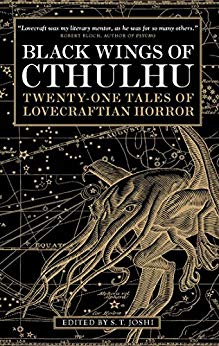
Black Wings of Cthulu (1) - S T Joshi (ed)

It's a measure of the influence of H P Lovecraft that so many others have written in homage. This is a substantial collection of 21 stories of varying length and Joshi has gone on to edit nine more to date - and these, of course, are just in reference to the Lovecraft's Cthulu or Elder Gods stories. He wrote plenty more that are more straightforwardly Gothic.


There are no bad stories here. I can only therefore mention my favourites. Caitlin R Kiernan's "Pickman's Other Model" gets the collection off to a flying start. I liked Sam Gafford's "Passing Spirits" and I loved "Inhabitants of Wraithwood" by W H Pugmire, which also develops Lovecraft's story "Pickford's Model", as does Brain Stableford in "The Truth About Pickman".I tend to prefer the longer stories but the one here that stayed in my mind the longest was "Susie" by Jason van Hollander, which closes the collection and only lasts seven pages - seven pages into which he crams several brilliant twists. Van Hollander also did the cover illustration which perfectly captures the theme.

Thursday, 19 October 2017

The Lurking Fear - H P Lovecraft


This Wordsworth collection concentrates on the non-Cthulhu. non-Arkham stories. The main preoccupation here is the Gothic, specifically inbreeding and ancient bloodlines tainted. The introduction by Matthew J Elliott is useful and the last entry is Lovecraft's own insights into his craft .Notes on Writing Weird Fiction'.


As for the stories themselves, some are unfinished or abandoned drafts, included for the completists. But there are also classics like 'The Music of Erich Zann', 'Beyond the Walls of Sleep', 'The Beast in the Cave' and, my favourite, 'The Rats in the Walls'. Overall, though, you wouldn't want this collection to be your first acquaintance with Lovecraft. There are many better and more typical collections, of which I have quite a few.

Monday, 31 October 2016

Horror Stories - E Nesbit


How this figures in the Penguin Worlds series of "Classic Science Fiction" is beyond me. Surely no one is more embedded in her time than Nesbit? And why we need the 500 word introduction by Naomi Alderman (co-curator) defeats me utterly. The cover couldn't be less appropriate if it tried.


That said, I was only vaguely aware that Nesbit had written ghost fiction (and it is very much ghost fiction we are talking about here). I think I may have come across "Man-Size in Marble" many moons ago, but that's about the extent of my knowledge.


Anyway, Nesbit is known today for her books for under-sixteens, The Railway Children (1906) of course, but also The Phoenix and the Carpet (1904). Her ghost stories were written for magazines and periodicals before she became famous and collected in three volumes between 1893 and 1897. Though they often go back to events in the mid-Victorian period when Nesbit herself was a young woman, the starting point is always the last twenty years or so of the 19th century. Surprisingly they are rarely written from the female viewpoint - she adopted the sexless 'E' of her authorial persona for a reason - and the female characters tend to be weak, doting and simplistic. Her heroes are young men about town, often priggish, very much devoted to their social status, hot-blooded and rash in their decisions. Nesbit has an habitual tone in which all her characters are depicted critically. She has a marvellously brisk way with back-story, which should be an object lesson to us all. Take this from "The Three Drugs":
The nature of his trouble is not germane to this story. There was a woman in it, of course, and money, and a friend, and regrets and embarrassments - and all of these reached out tendrils that wove and interwove till they made a puzzle-problem of which heart and brain were now weary.
 The usual framework is a love affair, either ill-judged or doomed. She is preoccupied with the idea of the loved one's return from the dead. There are a couple of exceptions: "The Three Drugs" and "The Five Senses", which I suppose just about qualify as early science fiction. In both cases medical men experiment with medically enhanced consciousness; in both cases the experimenters are themselves overwhelmed. They were highlights of this collection for me, but there was only one item I disliked - a something-and-nothing fragment called "The Judgement: A Broadmoor Biography", which sounds much more enticing than it actually is. It only lasts four pages and is an ill-advised venture into first-person dialect. It smacks of bottom-drawer material which should have been binned or otherwise forgotten. My advice is to skip it and enjoy everything else here. It's a collection which every student of the genre should read at least once.

Tuesday, 11 October 2016

Late Victorian Gothic Tales

It's a great idea to anthologise the late Victorian Gothic. This, after all, is the Gothic everyone knows today, the Gothic of Dracula and the Mummy as opposed to the original Gothic of Otranto and Vathek. Inevitably, though, you are going to end up with a mixed bag.


The first story, for example, is 'Dionea' by Vernon Lee (Violet Paget). 'Dionea' is very much in the neo-baroque mode of Walpole and Mrs Radcliffe. It is nevertheless very effective. 'Lord Arthur Savile's Crime' on the other hand is a spoof, clever enough but not especially funny and I'm afraid I long since tired of Wilde's juvenile precocity.  'Sir Edward Orme' by Henry James is beautifully written but not in any way disturbing. We then come to Kipling's 'The Mark of the Beast' which is both exquisitely written and profoundly disturbing. 'The Dak Bungalow at Dakor', by Kipling's fellow Raj writer Mrs Croker, is sludge not worth anthologising.


Then we have two stories by Conan Doyle at the height of his Sherlock Holmes success - 'Lot No 249', a mummy story, perhaps even the first mummy story, in which the characterisation of the mummy's owner is far more creepy than the mummy itself, and 'The Case of Lady Sannox', which so affected me that I am currently writing a direct follow-up for my own amusement. The thing with 'Lady Sannox' is Doyle's extreme contempt for the titular woman. Is this misogyny or puritanism? The mutilation inflicted on her reminded me strongly of Freud and Fliess's treatment of Emma Eckstein's nose, which has always seemed to me to be more about their sexual fetishes than hers.


Grant Allen's 'Pallinghurst Barrow' has a powerful theme but is poorly written. Two brief contes cruelles by Jean Lorrain have the opposite problem, strong and effective writing about nothing very much. 'The Great God Pan' by Arthur Machen is really a novella, an important distinction in that the fractured narrative he uses would not be practicable in a short story. It is one of Machen's better known works and the first I have read. I like it very much. I especially enjoy the way the horror is suggested and then cut away from, leaving it to the reader's worst imaginings. This of course is the technique later used to great effect by Val Lewton in his 1942 movie Cat People.


The final offering, M P Shiel's 'Viala', is another novella first published, like 'Pan', in The Bodley Head's notorious Keynotes series. Shiel is another pioneer of the macabre who I have heard about but never previously read. He is another I will have to pursue further, albeit he is totally different to Machen. Where Machen goes for subtlety and suggestion, Shiel is anything but. He is so wild and extravagant that often his language cannot keep up. His Viala is the Castle of Otranto remodelled by Vathek and transplanted to the Far North. Significantly for me, as a researcher into William Hope Hodgson, I'm pretty sure I now know where the idea of The House on the Borderland came from. As Roger Luckhurst notes in his introduction, 'Viala' is 'genuinely unhinged' - and that, it turns out, is by no means a bad thing.


To end with the Introduction... It will not be news to regular visitors to this blog, that I tend not to be a fan of the form in general. I have just bought a collection of ghost stories with an introduction of no more than 500 feeble words by some non-entity that made me want to get my money back. In this case, however, the Introduction and Notes are essential and add hugely to the experience of reading the book. Luckhurst knows whereof he speaks and can be trusted as a source for others. Well done to him and to Oxford World's Classics for producing this gem.

Sunday, 20 March 2016

We Have Always Lived in the Castle - Shirley Jackson

Shirley Jackson, where have you been all my life.  In fairness, you've been dead for 85% of it so it's not really your fault. I blame the publishers.  I blame critics for not dragging your work regularly into the spotlight.  I blame myself.

We Have Always Lived in the Castle is only a novella - Jackson made her name with a short story, 'The Lottery', and she is clearly comfortable in the short form. We Have Always Lived in the Castle is the best neo-gothic or indeed American Gothic novella I have ever read.  It is a work of the highest art.  It is a work of genius.  Check out the first paragraph and weep with glee:

My name is Mary Katherine Blackwood. I am eighteen years old, and I live with my sister Constance. I have often thought with any luck at all I could have been born a werewolf, because the two middle fingers on both my hands are the same length, but I have had to be content with what I had. I dislike washing myself, and dogs, and noise. I like my sister Constance, and Richard Plantagenet, and Amanita phalloides, the death-cup mushroom. Every one else in my family is dead.

It's worth reading that again when you have finished the story and all has been revealed. Then you realise the forensic precision of that list, the sort of list we all put together when we are six or seven but which is bad news when created by an eighteen year old. But, as you might guess, Merricat is not an ordinary girl, her childish precocity is not normal because she's not really a child any more.

To discuss the story in any detail would be to give too much away because every sentence here is a polished precision cog in the fictional machine. Every action and incident pays off in the end.  It is, in short, a masterpiece, not only of genre but of all literature.  It is beyond a must-read.  It ought to be compulsory for anyone who dares to venture onto similar turf.  It is an object lesson and an inspiration. I loved every word.

Thursday, 31 December 2015

The Wolves of London - Mark Morris


I had not come across Mark Morris before spotting this, the first part of his Obsidian Heart trilogy, in my local library.  I am already on the lookout for more.

Wolves is a horror/fantasy adventure with the added bonus (so often missed) of an engaging protagonist, Alex Locke, goalbird turned psychology lecturer, with something worthwhile at risk - he wanders from the straight and narrow because his eldest daughter's boyfriend is in bother, and gets stuck there when his younger daughter is kidnapped.  The writing style is lively but nowhere near so lively as Morris's imagination.  The surprises and twists keep on coming and kept me entertained to the very end.

Being a trilogy, the end is not conclusive and I admit I would have preferred some loose ends to be resolved.  I expect I shall just have to pick up Book Two, The Society of Blood, to satisfy my curiosity,

By the way, the artwork on the cover, by Amazing15.com, is just superb.