Total Pageviews

Showing posts with label H G Wells. Show all posts

Tuesday, 19 January 2021

The Haunting of H G Wells - Robert Masello


A fantasy adventure featuring HG versus the nefarious Hun in World War I.  The great man has embarked on his latest and greatest affair with Rebecca West when Churchill invites him to visit the trenches to write some morale-boosting pieces for the Home Front.  This leads to the haunting and a facet of trench life which I didn't know existed but probably did.  Meanwhile Rebecca visits the London home of the satanic Aleister Crowley who is sheltering the said Hun.  This leads to a showdown in St Paul's cathedral.

Masello writes in a well-practised style, easy and pacey, albeit I would have liked a touch more artistry.  What he does really well is keep the fantasy on the right side of credibility.  Overall, great fun. 

Thursday, 5 September 2019

The Fatal Eggs - Mikhail Bulgakov

I love Bulgakov. He is my favourite writer and wrote my favourite book, The Master and Margarita. The Fatal Eggs (1924-5) isn't in that league, but it is seeded through with bits of Bulgakov at his best.


In 1928 (a 'future' four years after it was written) Professor Persikov invents a red ray that speeds up the reproductive process. His invention couldn't be more timely, because a plague has wiped out the poultry of several large provinces. Eggs are hurriedly imported and bathed in the crimson glow of Persikov's ray. Meanwhile the Professor returns to his zoological studies in which his specialism happens to be eggs. Unfortunately, due to a typical bureaucratic blooper, supplies of eggs get mixed up. Poultry farms receive the eggs of amphibians and reptiles while Persikov wonders what he's supposed to do with common or garden chicken eggs.

The outcome - for Bulgakov - is inevitable. Giant predatory reptiles run amok in the provinces and rioting Muscovites attack the scientists. It's all wild, comic and clever. Just as the common cold did for H G Wells' martians, so a premature frost polishes off the tropical monsters. But, being Bulgakov and not Wells, we are reminded that some poor wretches have to dispose of the rotting corpses.

A fine translation by Roger Cockrell perfectly captures the tone.

Friday, 19 April 2019

Spaceways - Charles Eric Maine

I was reading Arthur C Clarke's Prelude to Space (reviewed below) in the 1953 paperback when I was struck by one of the ads in the back. Spaceways (never heard of it) was "originally a radio play, broadcast by the BBC in 1952 with immense success. Later it was made into the first British science-fiction film." As regular visitors must know by now, my doctorate is in radio drama and, as I say, I had never heard of Spaceways. As for movies, what about The Shape of Things to Come (1936)? That was science fiction, surely? It was certainly British (London Films). Anyway, I had to investigate further. Firstly I bought the book.


Not as good a cover as the Clarke paperbacks of the same era. The science is not as heavy as in Clarke, but ironically that results in it being closer to what actually happened - rockets taking off vertically in the middle of nowhere, rather than Clarke's fancy of horizontal runways. Maine, however, is a much better novelist than Clarke. His characters not only have inner lives, they have sex lives too, something the early Clarke would never countenance. In fact Spaceways is a genre hybrid, a noir-ish murder mystery based on the eternal triangle and set on a space research facility in the Nevada desert. Oh yes, I should have mentioned that. The pseudonymous Maine was British but this is an entirely American novel.


The other thing I should mention is that the novel is not directly based on the radio play. The radio play was turned into a Hammer movie, written by Maine, which he then turned into this book. I have looked up the credits for the radio broadcast, which seems to me to use the framing device of a court trial. It lasted 75 minutes, as did the film. The protagonist of the novel, Barry Conway of the Security Division of Special Services, is not in either the radio play or the movie. The movie seems to have a different plot to either the play or the novel. The central plot device, however, remains the same.


One of the key scientists is having a torrid affair with the wife of a senior colleague. The wife has cheated on the husband before, and he has responded violently. On the morning before the launch of the first space rocket (the novel is specifically set in 1955) the husband turns up for work with a black eye. When the rocket is safely heading for orbit, from which it will never return, it is discovered that both the wife and her lover are missing. The theory is that Hills, the cuckold, has killed them and stowed their bodies aboard the rocket. On that basis he stands trial, only to cause a sensation when he offers to prove his innocence by flying the second prototype rocket and bringing back the original. This is what happens - with an almighty twist, which I won't spoil for anyone who wants to seek out this curiosity for themselves - albeit I have as yet no idea whether it was remotely the same in either the play or the film.


And I do intend to take this further. The movie is easily available on DVD but the play will be harder to track down. In the meantime I have discovered that Maine did the same trick with other stories. Timeslip aka The Atomic Man is the movie version of his novel The Isotope Man, both of which I have already acquired.


As for the suggestion that Spaceways was the first British science fiction film, my interim theory is that whoever wrote the blurb in the back of the Pan was drawing a distinction between the post-Hiroshima technology-based fiction of Clarke, Maine and their contemporaries, and the purely speculative future fiction of Wells and Verne. Interestingly, directly underneath the blurb for Spaceways is an ad for The Time Machine and The Man Who Could Work Miracles (the latter a celebrated BBC radio drama of 1934, adapted by Laurence Gilliam). This describes H G Wells as, specifically, a "Pioneer of Space Fiction".


In the meantime, check out the long-forgotten Mr Maine. He really does merit rediscovery.

Wednesday, 23 May 2018

Behold the Man - Michael Moorcock

Moorcock is the king of modern British sci fi. He has been writing at a stupendous rate for more than fifty years and there are more than a hundred books. This, from the late Sixties and Moorcock's late twenties, is one of very few stand alone works. A version - a novella version - of Behold the Man won the Nebula award (best novella 1967). The thing about Moorcock is, he constantly reworks, rewrites and expands. There are multiple versions of various stories, just as there are multiple universes in some of his fiction.


This, it might be said, is Moorcock's distinctive take on H G Wells' The Time Machine. Wells, being Wells, was only really interested in the future. The time machine here, we are told as soon as our hero sees it, cannot go forward, only back. And if we can only go back - subject to the usual caveat of not  changing history - where would most of us choose to go? Elizabethan England perhaps? The age of the dinosaurs? The Holy Land circa 30AD? As might be guessed from the title, our hero Karl Glogauer opts for the latter.

His life in Sixties London, which is recreated throughout the novel, has led him to question his religious beliefs. So when the physicist Sir James Headington shows him his time machine and invites him to use it, Karl has only one destination in mind.

Virtually the first person he encounters in Roman Palestine is John the Baptist. Fortunately Glogauer has taught himself Aramaic, unfortunately John doesn't seem to have heard of his supposed cousin, Jesus of Nazareth. Yet the time is right - 28AD. Jesus should be mustering disciples and spreading the Word. His ministry won't last long and, critically, John has to die first.

Thus begins Karl's quest for the as yet unknown Nazarene. I won't reveal how it pans out but will just state that it does so in a highly satisfactory manner.

This is the first full-length Moorcock I have tackled. I was put off about the time he was writing the original version of Behold the Man, by a ridiculous piece of fluff he wrote for an alternative magazine of Swinging London. I enjoyed this hugely. I loved the nonstop tide of ideas, the clever way he play with the various levels of narrative and the distinctive tone he gives to each.  Glogauer is an amiable hero, not quite an everyman, more an everyday avatar of the polymathic Moorcock. I have already ordered another Moorcock - one which isn't listed among the hundred or so in this series from Gollancz but which Moorcock himself mentions in his introduction - called Mother London. I am definitely keen to read his take on Elizabeth I, Gloriana, though I am slightly worried that has something to do with the off-putting bilge I read on the train home from London circa 1968-9. We'll see.

Friday, 7 October 2016

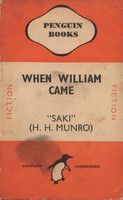
When William Came - Saki


Saki (H H Munro) is best known for mordant short stories like 'Gabriel-Ernest' and 'Sredni Vashtar'. Indeed, I hadn't realised he had written any novels. In fact there are three novels of which this is the third, published in 1913.


The date says it all - the eve of World War I, the last glorious summer of imperial peace and prosperity. But in Saki's world the titular William is Kaiser Bill and Great Britain has been annexed to the Hohenzollern Empire almost by accident. The German navy and air-ships were just too advanced. Rather than resist, the king abdicated and went into exile in his personal empire of India. It was not so much an invasion as a fait accompli.


Obviously everyone in 1913 was aware that war with Germany was a possibility. Invasion literature was incredibly popular. H G Wells published The War in the Air in 1908 and William le Queux had been knocking them out since 1894. But Saki's twist is to make the invasion bloodless, thus leaving him free to be witty and, in the scenes relating to Gorla Mustelford's debut as a 'suggestive dancer'. downright hilarious.


The story is set in the first full London season since the fait accompli. Society has moved on - or perhaps remained unmoved. The upper classes have accepted the odd grafin and welcomed Prussian officers with their cheerfully coloured uniforms and resorted to the usual trivial pastimes. Cicely Yeovil is a social fulcrum, with her shiny-haired young men and Gorla's debut to oversee. So it's all a bit of nuisance when her husband Murrey shows up.


Murrey is a man who travels to stave off the boredom. When William came, Murrey was battling fever in a Finnish hospital. When he heard about the fait accompli he assumed it was a product of his fevered imagination. Now back in London, he cannot accept it. He toys with the notion of heading off to the court in exile in Delhi - either that or taking up the mastership of the hunt down in Wessex.


Saki, at heart the short story master, does not hammer out a plot. The story is more that of the various participants. Gorla's debut is counted a success and the next social highlight is a march-past of the massed ranks of Boy Scouts in the Mall - which is where Saki springs his surprise.


It's a superlative twist, the last thing I expected, both amusing and moving.


Of the author's own attitude to the German threat we need be in no doubt. When war came Hector Hugh Monro was 44 years old. He nevertheless enlisted and served on the front until he was killed by a sniper in November 1916. So he is a hero and a writer of consummate skill. He deserves be better remembered.

Monday, 12 September 2016

A Sense of Wonder - John Wyndham and others

This collection of three sci-fi novellas put together and introduced by the arch-anthologist in the genre, Sam Moskowitz, can claim to have re-discovered John Wyndham's early story 'Exiles on Asperus'  (1933). Wyndham's estate only published it in 1979, ten years after his death, but here it is in 1976 with Moskowitz claiming it is the first publication in book form, which may very well be true.


Wyndham was 30 when he wrote it, still writing for genre magazines, in this case Wonder Stories Quarterly under a different variation of his name, John Benyon Harris. Moskowitz's point is that the three stories go beyond a sense of the fantastical into a sense of wonder. In other words, they ask mature questions like what is technology for, and what effect will scientific advances have on human nature. I would add the suggestion that the length they have to play with (each runs roughly 50 pages in paperback) allowed them to ask such questions and develop more rounded characters.


In any event, Wyndham's story is, as you would expect, the best of the three. By 2077 Earth has colonised the Solar System (we'd better get a move on then). It is an empire not unlike the British Empire, which did some good things and some appalling things. The Martians, who are regarded as semi-human, have rebelled and been suppressed. The Argenta is transporting some of the ringleaders to a penal colony. They are holed by a message rocket, the 21st century equivalent of a message in a bottle. The message was sent out 25 years earlier by the captain of the Red Glory, wrecked on the planetoid Asperus. It is perfectly possible that the castaways are still there. The Argenta lands to investigate.


The crew are indeed still there. They have bred a second and a third generation. Also resident are the Batrachs, an alien race of bat-like creatures who control the humans, using them to carry out tasks which their wings prevent the Batrachs doing for themselves. So far so predictable. We assume, along with the crew of the Argenta, that the humans want liberating. Without giving too much away, let's just say it comes down to mind control through conditioning. Mussolini was already in power when Wyndham wrote this story; Hitler was on the rise and in Britain the Daily Mail was backing Moseley's Blackshirts. The horrors of the Holocaust were still to come, thus Wyndham reflected a world in which fascism was seen as a possible solution. And that moves 'Exiles on Asperus' into another league entirely.


Murray Leinster's 'The Mole Pirate' and 'The Moon Era' by Jack Williamson suffer by comparison. They don't really ask such big questions and are limited by being earthbound in the former and driven by the prospect of cash rather than wonder in the latter. That is not to say that they do not have their moments.


Leinster (real name William F Jenkins 1896-1975) was a prolific writer of pulp fiction. His mole is a machine which can dematerialise and pass through solid matter. Rather than use it for something significant, it is hijacked and used for bank robbery. There is, however, a fabulously imaginative sequence when inventor Jack Hill is kicked out of the dematerialised mole with nothing but a pair of radioactive snow shoes to prevent him falling through the Earth.


Williamson (1908-2006) was notable rather for those he inspired (Asimov, Pohl etc.) than the stories themselves. He was only 23 when he wrote 'The Moon Era' so it is not surprising that his hero, Stephen Conway, is driven by the primal impulses of financial security and sex. His inventor uncle offers to make him heir to his millions if Stephen will test-fly his latest and greatest invention, an anti-gravity machine that should fly to the moon inside a week.


I enjoyed the concept of a space capsule that basically falls off the Earth. The twist is that it also goes back in time, aeons over the course of a week, landing on a Moon that still supported life forms. Stephen encounters the last surviving female of the pure moonlings. They strike up a relationship in order to escape the impure moonlings, who live in machines, a sort of splicing of H G Well's Martian invaders and the Daleks. It is the totally alien nature of the Mother which sets Williamson's story apart, especially the way in which despite her otherness she and Stephen manage to establish a convincing relationship.

Wednesday, 30 May 2012

A Man of Parts - David Lodge


I have developed a liking for Lodge's fiction over the last decade.  The British Museum is Falling Down is one of those novels that is somehow forever with you; the university novels are uniformly amusing.  Being a H G Wells buff, I couldn't wait to get this book home.  I wish I had.

It is not a bad book.  It is some way from being a good book and - hard as it is to believe it when it's a biographical novel about someone so active, in all senses, as Wells - it is dull, dull, dull.

When Lodge realises his text is tending towards the industrial and/or superficial, he introduces an imaginary interlocutor who interviews Well about his actions and emotions.  This is a cracking idea and does renew interest for a while.  But everything else is so thoroughly quotidian...  Wells had an olympic sex life but do we ever learn anything about emotion or sensation while he's at it?  Wells was involved with all the great writers of his age - Henry James, Conrad, Shaw, Bennett - but on this account they were even duller than he was.

The experience of reading this book won't put me off Lodge's work - it was a mistake, David, please don't repeat it - and it has certainly had one of the desired effects on me.  It's sent me off in search of more Wells books - and something by Rebecca West, who was definitely more interesting that the talented but demanding flibbertigibbet depicted here.

Thursday, 8 March 2012

The War in the Air - H G Wells


This 1908 classic is one of Wells's lesser-known 'scientific romances'.  To my mind, it benefits from having a Mr Polly/Kipps-style everyman - Bert Smallways - as its hero.  Bert is hapless, his involvement in the titular war is accidental - but it also determines the outcome and Bert is equipped at the outset with the skills necessary for him to turn the tide.

To a far greater extent than Wars of the Worlds, Invisible Man or Time Machine, enjoyable though they are, War in the Air accurately predicts much of what was to come, not only murderous air raids but social and political trends.

Even in 1908 (probably earlier, because War in the Air was serialised in the Pall Mall Magazine before being published in book form) Wells accurately foresaw....
  1. "The great powers were first the United States, a nation addicted to commerce... Next came the great alliance of Eastern Asia ... advancing with rapid strides year by year to predominance in the world's affairs.  Then the German alliance still struggled to achieve its design of imperial expansion, and its imposition of the German language upon a feebly united Europe..."
  2. "Even more pacific than the British Empire were France and its allies, the Latin powers, heavily armed states indeed but reluctant warriors, and in many socially and politcally leading western civilisation.  Russia was a pacific power perforce, divided within itself, torn between revolutionaries who were equally incapable of social reconstruction, and so sinking towards a tragic disorder of chronic political vendetta.  Wedged in among these portentous larger bulks, swayed and threatened by them, the smaller states of the world maintained a precarious independence, each keeping itself armed as dangerously as its utmost ability could contrive." [pp 72-73]
Fascinating.  With historical hindsight the diagnosis seems so right, yet so little of it came to pass, but still these are the very same threats to supposed world order that a malign press and untrammelled political cadre use to bludgeon us into cowed obedience a clear century later.  What did come to pass, which Wells predicts with worrying accuracy, were the said press, ineffective government, even the Credit Crunch.
  1. "...and they permitted the growth in their midst of an evil-spirited press, mercenary and unscrupulous, incapable of good and powerful for evil.  Their State had practically no control over the press at all."
  2. Already the whole financial fabric of the world was staggering... Credit went down in a wild whirl of selling.  Everywhere appeared a phenomenon that had already in a mild degree manifested itself in preceding periods of panic; a desire to secure and hoard gold before prices reached bottom.  But now it spread like wildfire, it became universal."  [pp. 230-232]
On the other hand, he did also postulate a worldwide monorail system and gyroscopically-controlled two-wheeled cars.  Nevertheless, even when Wells sets outside to be frivolous, or offers us a simple adventure story, he cannot resist the considered critique on the world as it was and is.  The hallmark of a true literary great.

Book of the blog thus far.