Total Pageviews

Showing posts with label short stories. Show all posts

Thursday, 26 October 2023

Werewolves in their Youth - Michael Chabon


 A collection of nine decent-length short stories by Michael Chabon, Werewolves in their Youth distills the charactersistics that make Chabon one of the best US writers of recent times - wit, elegance, the eye for the telling detail, the nuances of speech, etc.  Oddly, the title story was my least favourite; no particular reason, just that Stephen King does these things better.   On the other hand I loved 'The Harris Fetko Story', a skewed take on the Great American sports hero, and 'In the Black Mill', a Lovecraftain pastiche which Chabon cleverly links to perhaps his bestknown novel Wonder Boys.   I single out these two and have given my reservations about 'Werewolves', but I enjoyed all the stories here and recommend the collection wholeheartedly.

Friday, 7 April 2023

Babette's Feast - Isak Dinesen


 Originally published in 1958 when Blixen/Dinesen was 73, this is one of her last collections whereas Seven Gothic Tales (reviewed below) was one of her first.  There is absolutely no difference in quality.  As with the Gothic Tales, there is a common theme.  Originally the title was Anecdotes of Destiny, which is exactly what they are, but I fully understand why Penguin have renamed the book.

There are five stories, only three of them substantial.  'Diver' and 'The Ring' really are just anecdotes, albeit excellent ones.  The substantial works are 'Babette's Feast', 'Tempests', and 'The Immortal Story'.  I was absorbed by them all.  In theory, I suppose, I should with my background (theatre) I should prefer 'Tempests', especially given that one of the few Shakespeare plays that still enthuses me is The Tempest.  Actually, though, my favourite was 'The Immortal Story.'   I think it was its oddness - a wealthy English tea merchant in Canton decides to re-enact a modern myth - and its circularity.  I have a theory that the tying up of narrative ends is one of Dinesen's defining traits.  And we must remember the original title.  These events, even the twists and turns of the plot, were all pre-ordained.

I continue to be amazed how the same person can write stories like these and Out of Africa.  I tell myself it is the ghastly, unwatchable film of the latter that puts me off and the book might be perfectly acceptable.  I'm still not going to read it.  I'm tempted to try The Angelic Avengers next.

Thursday, 17 November 2022

Prince of Darkness - Ray Russell


 Prince of Darkness  is a collection of Russell's magazine stories from about 1955 to 1970.  Several appeared in Playboy, of which he was for a long time fiction editor.   'The Prince of Darkness' is actually 'The Cage', the title under which it was originally published in 1958 and as which it reappears in 1980's Haunted Castles.

The best story here is 'Domino' (1967), which is almost long enough to be a novella.  It is certainly long enough to allow Russell's 'contemporary' style (very different to his 'gothic' style) to work effectively.  It's the story of Jack Straw, a jaded journalist who is lavishly commissioned to cover the funeral of a South American dictator who has died of meningitis.  Straw is the ideal man for the job because he wrote a book about President Mendoza's previous career as a controversial film director who married his muse, a former nude dancer.  Because of the book, Straw has contacts at the highest level of government in the unnamed Latin nation.  It's a story in which nothing and no one is as they seem.  An expert long short story well worth the lesser work that precedes it here.

Friday, 5 February 2021

The Bradmoor Murder - Melville Davisson Post


You want your murders vintage?  How about this, from 1922, by an American 'master' living in England and obsessed with the English upper class.  The title story is a locked room mystery about ancient curses.  Indeed, all the stories are broadly similar in that they have narrators who have little or nothing to do with the story but who are told what happens by others.  There are elements of the supernatural which recurring characters like Sir Henry Marquis, Head of Scotland Yard's CID, and Sir Godfrey Simon, the world-famous alienist, accept without batting an eye.  Everybody has a peerage or at least a knighthood and the action takes place everywhere from Libya to Belgium.  They are very unusual and quite fascinating.  And there are more of the same available from Bloomsbury Reader

Tuesday, 17 March 2020

Capital Crimes - (ed) Martin Edwards


Capital Crimes is one of the British Library's magnificent crime classics, edited by Martin Edwards, who oversees the entire series. What we have here are Golden Age short stories which share a London location. They range from Conan Doyle ('The Case of Lady Sannox', which I have reviewed elsewhere on this blog) to Anthony Gilbert ('You Can't Hang Twice'). Some are naturally better than others but for once there are no duds. My favourite is 'The Hands of Mr Ottermole' by Thomas Burke, 'the laureate of London's Chinatown' apparently, and definitely a breath of fresh air as a working class writer, and 'Cheese', an offbeat item from Ethel Lina White, author of what became Hitchcock's The Lady Vanishes.

Sunday, 10 March 2019

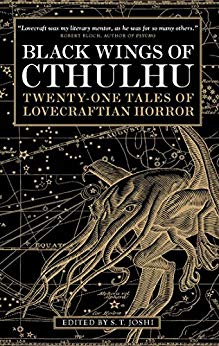
Black Wings of Cthulu (1) - S T Joshi (ed)

It's a measure of the influence of H P Lovecraft that so many others have written in homage. This is a substantial collection of 21 stories of varying length and Joshi has gone on to edit nine more to date - and these, of course, are just in reference to the Lovecraft's Cthulu or Elder Gods stories. He wrote plenty more that are more straightforwardly Gothic.


There are no bad stories here. I can only therefore mention my favourites. Caitlin R Kiernan's "Pickman's Other Model" gets the collection off to a flying start. I liked Sam Gafford's "Passing Spirits" and I loved "Inhabitants of Wraithwood" by W H Pugmire, which also develops Lovecraft's story "Pickford's Model", as does Brain Stableford in "The Truth About Pickman".I tend to prefer the longer stories but the one here that stayed in my mind the longest was "Susie" by Jason van Hollander, which closes the collection and only lasts seven pages - seven pages into which he crams several brilliant twists. Van Hollander also did the cover illustration which perfectly captures the theme.

Monday, 26 November 2018

The Golden Apples of the Sun - Ray Bradbury


This collection of Bradbury short stories dates from the early Fifties, before he had committed himself wholeheartedly to science fiction. Thus most of the stories here are not sci fi. By and large they are fantasy, some tilting more towards allegory.


It might not be the usual Bradbury field but it is definitely the usual Bradbury standard of writing. That is to say, exceptional. These stories might have appeared in pulp magazines but Bradbury still polishes his phrases, looks out for and treasures the occasional quirk, and leaves nothing on the bone. My personal favourites are 'The Flying Machine' (set in a mythical ancient China and definitely allegorical), 'Hail and Farewell' about a boy "twelve years old with a birth certificate n his valise to show he had been born forty-three years ago', and the opener, 'The Fog Horn' in which a sea monster perhaps a million years old answers the call.


All in all, classy ephemera.

Thursday, 17 May 2018

The Encyclopedia of the Dead - Danilo Kis

Danilo Kis (1935-1989) was a Yugoslavian expat, living and working in France. He wrote some novels but is perhaps better remembered for his short stories (or pocket-sized novels, as he called them) of which this, from 1983, was his final collection.
Kis's style deliberately reminds us of Borges but I also found links with Umberto Eco (whose Prague Cemetary is strongly reminiscent of Kis's 'The Book of King and Fools') and Isak Dinesen (very much so in an off-beam love story like 'Last Respects'). He is elusive and goes to considerable lengths to disguise fiction as fact. The key story here is presumably 'The Encylcopedia of the Dead' itself, which is what it says it is - a woman looks up her father in the huge encyclopedia of everyone who has not been recorded elsewhere. Actually I wanted the story to go further - so that should you ever be mentioned in any other written record (such as a short story or a memoir) you are automatically deleted from the encyclopedia of unknowns. Perhaps that is easier to envisage in the age of the internet. Kis's story is an uncomfortable reminder how far archival records have come in just 35 years. I liked 'The Book of Kings and Fools' even more, largely because  I had read and enjoyed Prague Cemetery so recently.


My favourite over all, though, is 'Simon Magus', the gnostic story of the rival messiah who fell spectacularly foul of Christ's disciples. This is exactly the sort of story I love to read and write.


I am not the biggest fan of introductions. Here, however, the introduction is by Mark Thompson, who is Kis's biographer, and I feel the stories would have been harder to get into without it.

Sunday, 12 February 2017

The Secret Sharer - Joseph Conrad


"The Secret Sharer" (1910) is by modern standards a short novella. In its day it was a long short story originally published in Harper's Magazine.


Needless to say, we find ourselves aboard ship in exotic waters, in this case the Gulf of Siam. Our 'hero' is the new captain, two weeks into his first command and struggling to exert his authority over the junior officers. He finds relief by spending the night on deck - until he looks down and sees what seems to be a naked, headless body floating in the water. In fact it's a living man who, once aboard and seen in the ship's night lights, is extremely like the captain himself.


The newcomer, Leggatt, was first mate of a ship becalmed nearby. He too was an outsider, who had to demonstrate his authority. Unfortunately this led to the death of a seaman. Leggatt was locked in his cabin until he could be delivered to civilian authority. Her escaped and swam through the islands until he found the ship he is now aboard.


The captain has a decision to make. Should he return the fugitive? Should he hold him prisoner until the next decent-sized town? Or should he aid and abet? Can he bring himself to condemn someone so like himself in face and situation? That's the moral dilemma and Conrad doesn't shirk the challenge. Of course the captain makes the wrong choice - Conrad's protagonists almost always do, hence the drama - and we are soon heading into shore in the teeth of a furious typhoon that has the blood pounding in our imaginative veins.

Tuesday, 31 January 2017

The Four-Dimensional Nightmare - J G Ballard


Short stories were never going to be the driving force of Ballard's fiction. They were just something he wrote to get into print and build a readership. This 1977 Penguin collection is an oddity even for Ballard. Two of the stories in the version originally published by Gollancz in 1963 have been replaced. To be fair, one of the replacements, "Thirteen to Centaurus", is one of the standout stories here. The other, "The Overloaded Man", is however completely forgettable.

As for the rest, time is a recurring theme. "The Voices of Time" and "The Garden of Time" rather speak for themselves, and "Chronopolis" isn't exactly oblique in its subject matter. I actually enjoyed all three. The length of the first allows for complexity and ambiguity, which I find Ballard always does rather well, whereas the shortness and simplicity of the second tilted it more towards fantasy, which Ballard does hardly at all. "Chronopolis" would be a classic short story in any collection with its brutal, sardonic twist.

Both "Chronopolis" and "Thirteen to Centaurus" feature clever and lonely young boys as protagonists. Empire of the Sun, which I consider Ballard's masterpiece, of course tells the tale of young Jim. I really wish he had used the young boy character more often. You can forgive a teenager his or her obsessions, whereas the grown men of High Rise and Kingdom Come can be downright unpleasant.

Two of the three remaining stories, "Cage of Sand" and "The Watch-Towers", share the abandoned city setting of "Chronopolis". I preferred the former, which is set on Mars, where a handful of hangers-on gather to watch the regular orbit of the capsule with a dead astronaut in it.

My favourite in the collection, though, has to "The Sound-Sweep". The over-developed world has become so noisy that people are employed to sweep away extraneous noise. The mute Mangon has a particular gift for tracking down and erasing the slightest lurking murmur. In his spare time he pays court to the forgotten operatic diva Madame Gioconda. No one listens to live music now. The fashion is for
Ultrasonic music, employing a vastly greater range of octaves, chords and chromatic scales than are audible by the human ear [which] provided a direct neural link between the sound stream and the auditory lobes, generating an apparently sourceless sensation of harmony, rhythm, cadence and melody uncontaminated by the noise and vibration of audible music.
Now that is exactly the sort of fiendish construct that gets the very best out of Ballard!

Monday, 9 November 2015

The Best Short Stories - Rudyard Kipling


Kipling is such a difficult writer to pin down.  He won the Nobel Prize for Literature, but wrote only one novel; he celebrated British Imperialism but was in no sense blind to the squalor in which so many of its citizens lived; he often seems misogynistic yet in so many of his stories he celebrates strong, capable women; he is at home in a very personal brand of mysticism yet is utterly fascinated by the latest technology of his day; he is best known for his anthropomorphic tales (Jungle Book etc,) but can also produce a piece as startlingly and subtly original as any post-modernist.

Now, I hated two of the anthropomorphic tales here - "The Ship that Found Herself" and (ugh!) "Below the Mill Dam", which was so cloyingly twee, I couldn't force myself to the end. "The Maltese Cat", on the other hand, I found tolerable in that at least it was about an animal, which we can all accept has a certain level of thought process and, furthermore, it was set in India, which Kipling knew so well.  There are naturally several Indian tales here.  For me the best was "At the End of the Passage", which is about the downside of working in colonial service.

There are tales of the macabre, notably "Wireless", which exemplifies Kipling's blend of mysticism and modernity, with the titular wireless somehow channeling the spirit of the poet Keats (who was a qualified apothecary) into the soul of an Edwardian pharmacist and fellow consumptive.  'They' was profoundly affecting - a ghost story in which the presence of dead children is a cause for celebration.  Again, it is the narrator's up-to-the-minute motor car which attracts the inquisitive spirits.  'They' really is a beautiful piece of work.

The two best stories, though, are "The Finest Story in the World" and "Mrs Bathurst".  I think most Kipling readers would agree on the merits of the latter.  The former is still very clever and layered - a wannabe writer tells a more experienced hand about his idea for a story.  The narrator, recognising the potential of the idea, buys the rights for a pittance.  But the youth falls in love with a shop girl and cannot remember how the story ends.  The misogyny and the snobbery implicit in the device is, I accept, a major flaw.  It's ironic, given that the next story in this collection, "The Record of Badalia Herodsfoot" is a slice of life at its rawest, set in the London slums, in which Badalia is strong, honest and honourable, despite her circumstances.

As for "Mrs Bathurst" - what a marvel it is.  Mrs B is a widow based in New Zealand whose fame has spread through the Empire.  She is indirectly recalled by an ill-assorted group of men who happen to come together in South Africa.  She herself only appears in an early cinema film of people getting off a train in London - a moment of sheer genius on Kipling's part, again showing his fondness for the latest gadgetry. The end is both startling - two unidentifiable human figures reduced to charcoal by lightning - and inconclusive.  There is nothing to say if either victim is the lady in question or her apparently final lover.  The story's power lies in its elusiveness.  And its power is extraordinary.  I cannot stop thinking about it, three days after reading it.

Regular readers of this blog will know that I am not a fan of introductions to books.  I make an exception for that of Cedric Watts in this instance.  He is especially useful on "Mrs Bathurst".  I read his comments both before and after reading the story itself.

Monday, 29 June 2015

Teatro Grottesco - Thomas Ligotti


Thomas Ligotti has become a cult writer since the millennium.  People liken him to Lovecraft, Poe, and M R James.  I like all those authors so naturally I was keen to try Ligotti.  My conclusion?  He's not like the aforementioned.  He's not scary, though he does successfully get under your skin, and for all the very obvious work that goes into crafting his stories, he ends up being a bit dull.  For me, the problem is that his first-person narrator has always the same characteristics - reclusive, obsessive, an outsider with a bad stomach - no matter whether he is a creative artist or a drudge in a slave-labour town.  The towns, likewise, are always in the north, on the border, and he has usually left by the time he comes to write down his experience.  There are other regular tropes - other recluses, bizarre modern artworks, and carnival performers (carnies are much scarier in America, apparently, than they are in the UK).  Frankly, some of the long pieces are distinctly over-wrought - by the time I've got to the end of some of his paragraphs I've forgotten what he began with.  I admire the work, the commitment to form.  I own Ligotti has created a fictional world almost as real as Lovecraft's Arkham.  But he's not adventurous enough for my taste.

Saturday, 13 December 2014

The Unsettled Dust - Robert Aickman


The third of the Faber Finds collection I bought earlier this year and which have informed my reading (and a good slice of my writing) ever since.  There is a fourth, traditionally published by Faber on the back of the Finds success, which I will be treating myself to as a reward for surviving Christmas.

Overall, I found The Unsettled Dust  most satisfying of the three collections.  "The Cicerones" is well known, following a TV adaptation a couple of years ago which did much to stimulate a new interest in Aickman, certainly in my case.  "The Unsettled Dust", "The House of the Russians" and "The Stains" are equally disturbing in a similar way - the unexplained, peripheral horror; an almost feral nastiness always waiting to pounce.

What will I do when I've read the fourth and final collection?  I shall have to seek out the stories that missed the cut.

Tuesday, 18 February 2014

The Revolution - Eric Linklater


A real oddity - three linked short stories published by the White Owl Press as a single volume just 80 pages long.  In 1934 Linklater was about five years into his fiction writing career and still wildly experimental.  We begin with the story of the Russian actress Olenina (not a million miles away from Lenin, namewise), marooned in London by the outbreak of World War I, the mistress of a high-ranking British officer and on the verge of having sex with a Russian waiter who she thinks is about to volunteer for active service.  There's a neat twist, quite funny, and then we move on to the revolution itself, in Baltland, a sort of Nordic Ruritania. King Oscar III is a benevolent constitutional monarch brought down by the actor, playwright and socialist Jean Paris - who just happens to the lover of the actress Olenina.  The King and Queen are exiled - along with Paris and Olenina, considered by the ruling Committee of Five "to be dangerous to the new Republic by reason of their ability to excite the populace, their unruly and impolite views of life, their penchant for criticism, and their tendency to revolution."  In the third story the exiles are lodged together in a Scottish Highland castle and they come to realise that their causes and beliefs are not so far apart.

Every writer goes into a bit of an eclipse after their death but Linklater's has gone on far too long.  He was a significant writer of the mid Twentieth Century with a unique outsider's viewpoint (he considered himself an Orkney man and was passionate about the very far north), an easy narrative gift, a satirical humour and a lifelong fondness for pushing the boundaries of his chosen form.  He was also a major radio dramatist with a short but critical role in World War II home front propaganda.

In many ways he's like a Scottish George Bernard Shaw but funnier and in no way a pacifist (he was badly wounded in World War I and on active duty guarding Scapa Flow before war was actually declared in 1939).