Total Pageviews

Showing posts with label Penguin Modern Classic. Show all posts

Thursday, 28 August 2025

The Underground Man - Ross Macdonald


 This is one of the later Lew Archer novels.   Archer is middleaged, methodical.   He is, basically, Paul Newman in his prime.   Newman played him in Harper and The Drowning Pool but Peter Graves took the role in the TV adaptation of The Underground Man.

The story is essentially one of a disfunctional family in and around old money.   The old rich are aloof and stuck in their ways, the infiltrators are either nouveau riche or grifters.   Macdonald comes up with a brilliant metaphor.   The Broadhurst family owned the entire canyon until Mrs Broadhurst entered into a dubious deal with property developer Brian Kilpatrick.   Now the hills and forest above the new housing are ablaze.

Mrs Broadhurst married a fly-by-night pilot after the war.   He soon left her for a local teacher.   Mrs B's son Stanley is obsessed with finding his father - but now Stanley has disappeared.   He was last seen in his sports car with a very young woman who the day before was so stoned she jumped off a yacht into the sea and Stanley's young son Ronny, whom Archer had come across in his yard that very morning.   It's all very incestuous (without actually being incestuous) - a restricted number of closely interrelated relationships most of which involve abandonment.

Ross Macdonald (Kenneth Millar, 1915-83) was a master craftsman and was in his prime with the Lew Archer series.   The story moves along at a brisk place, the writing chiselled to a fine edge without ever going to extremes.   There is psychological depth, suspense, and whilst Archer himself never seems to be in danger, the necessary jeopardy comes from the fire, which is especially effective given what happened lately to Southern California.

Another (#21) in Penguin's magnificent Crime & Espionage series of Modern Classics.

Monday, 28 July 2025

Count Luna - Alexander Lernet-Holenia


 Count Luna is an absolute work of genius by an extremely fine writer who is inexplicably under-translated into English.   Sadly, I have now read all three of the more-or-less available: this, plus Baron Blagge and I was Jack Mortimer.   My posts on the other two have had great responses and loads of clicks, so I don't see some enterprising publisher starts digging into Lernet-Holenia's back catalogue.

Like the others, Luna is a work of wit and imagination.   It also hinges on a serious subject: how does a vanquished people deal with its guilt over the crimes against humanity committed in their name?

Alexander Jessiersky, a third generation millionaire of Polish extraction, lives in a palace in central Vienna.   He has a beautiful wife and loads of children.   He is not especially interested in the family transport business but it functions prosperously without him.   Before the war, however, the board of directors wanted to buy a property owned by the down-at-heel aristocrat Count Luna.   Luna wouldn't sell - it was the last of his inheritance - and the board of directors therefore reported him to the Gestapo who hauled him off to a concentration camp.   Jessiersky had nothing to do with it - but he knows he should have intervened and used his veto.   Guilt has gnawed at him throughout the war and after.   During it, he tried to send Luna money and food.   Now he is obsessed with the notion that Luna has survived his ordeal and is back in search of revenge.

Jessiersky is an obsessive researcher, happiest in his well-stocked private library.   He delves, develops theories - and goes quietly mad.   He takes to killing people.   He flees Austria and ends up in the catacombs of Rome.   We know this from the outset - his disappearance below ground in the Church of Sant' Urbino is where Lernet-Holenia starts his fable.   The interest - the game - is how he came to be there.   The genius is that Lernet-Holenia doesn't leave it there.   He takes us with Jessiersky into what happens next, which is something rather beautiful.

Lernet-Holenia writes like a dream.   He juggles complex ideas like guilt and death and the possible hereafter with deceptive ease.   Jessiersky has done no more than thousands of his compatriots did.   His only sin is that he failed to do something.   The outcome of his inaction may not have been too terrible.  But what Jessiersky does to himself and others fifteen years later is terrible.   Terrible yet empathetic and therefore sad.   We laugh and we sigh but always with sympathy.   Which is what makes Count Luna an absolute masterpiece.

Sunday, 13 July 2025

The Labyrinth Makers - Anthony Price


 Number 26 in the new thirty-strong run of Penguin crime and espionage modern classics, this drew my eye with the legendary green cover.   Anthony Price was a high-grade journalist who wrote on the side and The Labyrinth Makers was his first novel in 1970.   It won him a Silver Dagger from the Crime Writers Association, and no wonder.

Twenty-five years on from World War 2, we are deep into the Cold War.   Dr David Audley is a reclusive desk operative for the Secret Service, specialising in the Middle East.   Then a wartime RAF Dakota is unearthed during construction work for a natural gas pipeline and Audley finds himself inexplicably switched to a multi-agency investigation.   The plane and its pilot are no mystery: everybody has been looking for Flight Lt John Steerforth and his Dakota since they vanished during the Berlin Airlift in September 1945.   Until now they were assumed lost at sea.   But Steerforth evidently managed to nurse his plane back to England after ordering his crew to bale out over the North Sea.   The question is, what became of his cargo?

Because John Steerforth was not only a decorated war hero, he was a post-war smuggler.   For him the ruins of Berlin were a honey-pot of looted goodies and Steerforth might, by accident or design, have hit upon a very special treasure indeed.   The Russians, from whom it was stolen, have never given up looking for Steerforth's plane.   Now it has been found, they are very interested indeed.   And because they are interested, those higher up the intelligence food chain in London are also interested.   And they have decided, for reasons unknown, that David Audley is the man they need on the ground.

The snag is, the crates found in the wrecked Dakota are not the crates the Russians are mad keen on recovering.   They are decoys, filled with building rubble.   Which means that Steerforth must have stashed them on the day before the doomed flight, somewhere near his isolated base in Cambridgeshire because there was no time for one man working alone to move and bury so much treasure.   Which is why Audley has been winkled out of seclusion.   He might have no experience of field work but he does have a gift for lateral thinking.

The Labyrinth Makers is a great read, a classic espionage thriller of its era, smartly written with genuinely interesting characters.   Faith Steerforth, for example, the late Flight Lieutenant's daughter, is not just sex interest, as she would have been in Ian Fleming or even John le Carre circa 1970.   She helps Audley solve the mystery.   Likewise our supposed villain, the Soviet masterspy Nikolai Andrievich Panin, whose reputation is cleverly built up until he finally turns up thirty pages from the end, is no one-dimensional Fleming villain or even the far complex Karla; he wants the stolen booty back because he suffered the ignominy of losing it in 1945.   His only plan for the treasure is to donate it to a German museum.   The two files of old intelligence files which Steerforth took with it by mistake, Panin is quite happy to burn right here and now.

A real find, this.   I want more and quick internet searches reveal there is quite a lot more.   Price even has another Dagger-winning novel in the Penguin series.   His Other Paths to Glory is at lucky number thirteen in the list.

Thursday, 22 May 2025

Heroes and Villains - Angela Carter


 Angela Carter has been an inspiration to me, from her radio plays to her arcane fairy tales and her novels, some of which I have reviewed on this blog.   The Bloody Chamber and Nights at the Circus must have been read before I started the blog.   Thankfully Carter managed a significant output before her early death.

Heroes and Villains was published in 1969, which would place it about midway in her truncated career.   She seems to have been in full possession of all her powers.   I found it a masterful piece of writing, beguiling and shocking in equal measure.   As always in her best work, it centres on a young woman discovering her sexuality.

The setting is Britain post apocalypse.   The survivors have grouped into three known clusters, the Professors, the Barbarians and the Out People.   The Professors are the remnants of civilisation who now literally occupy ivory towers.   Barbarians descend from gypsies and travellers.   The Out People occupy the fallen cities and because they hunkered out the blast are often hideously mutated.   The three peoples attack and loot one another.

Marianne is the daughter of a Professor.   As a young child she watched her brother die during a Barbarian raid.   At sixteen she leaves her sanctuary and is promptly captured by the Barbarian Jewel Lee Bradley, the same Barbarian who cut down Marianne's brother, who carries her off to his camp.   As a Bradley Jewel is Barbarian aristocracy, along with his numerous brothers.   Their foster mother Mrs Green was also once a Professor's daughter.   Another Professor who has crossed over is the shaman Donally, who has tutored Jewel.   Donally is so decadent that he keeps his son chained up and beats him.   He fancies himself the last remaining artist and has tattooed the story of Adam accepting the apple from Eve on Jewel's back.

Jewel casually takes Marianne's virginity as a gesture of ownership.   Marriage then becomes inevitable.   Neither much wants it, despite being mutually attracted.   But they come to terms - which is really what the book is about: the accommodations we all make in order to move forward in life.

It is beautifully done.  Carter conjures up an English arcadia re-growing from the blasted ruins.   Her characters are vivid, perverse, compelling.   Her proses sizzles.   Her masterstroke is to leave the story halfway through.   By which I mean, there is a decisive climax, but so many strands cry out for resolution.   We are desperate to find out what happens next.   Our minds inevitably run on - and only the very best of books let that happen.

Tuesday, 7 May 2024

Baron Bagge - Alexander Lernet-Holenia


 Lernet-Holenia is a key figure in Twentieth Century Austrian literature, badly underpublished in English translation.   I looked on the British Library catalogue and only came up with four of his works in English.   I cannot understand this.   I jumped at the chance when I saw Count Luna was newly added to Penguin Modern Classics and that Baron Blagge had been republished to keep it company.   Waterstones only had Blagge but I was fine with that.

Blagge is a short novella or long short story.   The similarities with the stories of Isak Dinesen/Karen Blixen are everywhere.   Upper class characters who find themselves overwhelmed by a vaguely supernatural situation.   Blagge is a junior officer in Count Gondola Dragoons.   In 1915 they find themselves in pursuit of the Russians in the Carpathian mountains.   There is a battle on a bridge.   The dragoons found themselves in the village of Nagy-Mihaly where Bagge is greeted by the beautiful Charlotte Szent-Kiraly, daughter of the best friend of Bagge's mother.   The mothers have long conspired to marry their children, but they have never met.   Yet Charlotte somehow knew that Bagge was coming today.   It's very odd.

And the oddness is the beauty of the book.   It is beautifully written and exactly the right length to do the story justice.  The characters are wonderfully realised, especially the supporting cast - Bagge's touchy superior Semler, and Charlotte's father with his damp handlebar moustache.  I absolutely adored it.   Exactly the sort of book I am constantly on the lookout for.   I must have more.

Monday, 13 March 2023

Death of a Salesman - Arthur Miller


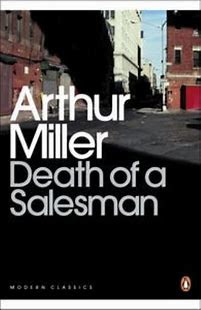
 The classic play from 1947, in a fresh Penguin Modern Classic edition with a besautifully evocative cover.  Miller sets out to do what nowadays seems impossible to conceive - a tragedy played out in suburbia.  Yet he achieves everything he wanted.  I can't remember reading a playscript so moving, with characters that leap off the page.  And as a four-time graduate in drama, let's just say I have read a lot of playscripts.

Willy Loman is a travelling salesman, thirty-five years on the road, but he's coming to the end.  He literally can't keep his mind on the road, which makes him a danger to himself and others.  He can't afford to retire, nor does he want to.  The road is his life.  The road enables him to maintain the illusion he's a big shot, a success.  Being at home is, for Willy, a reminder of failure.  Whatever his successes, real or imagined, as a seller of goods, as a father and provider he's a dud.  His two thirty-something sons are back in their boyhood bedroom, Biff a failed football player back from being little more than a bum out West, and Happy, assistant to a deputy in some dead-end business.  The house Willy has slaved to buy is crumbling, like the car and refrigerator both on hire purchase.

The rwo days we experience in the two acts are when the tragedy builds to its inevitable climax.  All the lies, the pretences, the missed opportunities - all come crashing down.   I didn't spot a flat note in the entire script.  What a challenge for actors!   What a feast for play-goers and those, like me, who can now only bear to read plays, such is the decayed condition of the theatre in Britain.   A reminder of what once was possible.

Monday, 16 August 2021

The Bird's Nest - Shirley Jackson


I've read a little Shirley Jackson (We Have Always Lived in the Castle is reviewed here) but I had no idea she wrote a novel like this.  The Bird's Nest is the tangled psyche of Elizabeth Richmond, a dull 25 year-old orphan who lives with her aunt.  She suffers from back pain and headaches so her family doctor refers her to starchy old Dr Victor Wright who fancies himself adept at psychotherapy.  Wright isn't an actual psychotherapist, you understand, just an enthusiastic dabbler.

Wright hypnotises Elizabeth and unleashes multiple personalities - Lizzie, Beth, Betsy and Bess, who - rivals with one another - unleash chaos.  The trick Jackson pulls off is to tell her story through different characters.  The mark of her genius is that she doesn't do the obvious and split the narrative through the split personalities.  No, she gives us Elizabeth herself, Betsy (the most active of the alternates), Doctor Wright (twice) and fiesty Aunt Morgen.  Moreover, only the verbose, pontificating Wright narrates in the first person.  It's very clever, beautifully done, and totally engrossing.  No wonder The Bird's Nest is a Penguin Modern Classic.