Total Pageviews

Showing posts with label Angela Carter. Show all posts

Thursday, 22 May 2025

Heroes and Villains - Angela Carter


 Angela Carter has been an inspiration to me, from her radio plays to her arcane fairy tales and her novels, some of which I have reviewed on this blog.   The Bloody Chamber and Nights at the Circus must have been read before I started the blog.   Thankfully Carter managed a significant output before her early death.

Heroes and Villains was published in 1969, which would place it about midway in her truncated career.   She seems to have been in full possession of all her powers.   I found it a masterful piece of writing, beguiling and shocking in equal measure.   As always in her best work, it centres on a young woman discovering her sexuality.

The setting is Britain post apocalypse.   The survivors have grouped into three known clusters, the Professors, the Barbarians and the Out People.   The Professors are the remnants of civilisation who now literally occupy ivory towers.   Barbarians descend from gypsies and travellers.   The Out People occupy the fallen cities and because they hunkered out the blast are often hideously mutated.   The three peoples attack and loot one another.

Marianne is the daughter of a Professor.   As a young child she watched her brother die during a Barbarian raid.   At sixteen she leaves her sanctuary and is promptly captured by the Barbarian Jewel Lee Bradley, the same Barbarian who cut down Marianne's brother, who carries her off to his camp.   As a Bradley Jewel is Barbarian aristocracy, along with his numerous brothers.   Their foster mother Mrs Green was also once a Professor's daughter.   Another Professor who has crossed over is the shaman Donally, who has tutored Jewel.   Donally is so decadent that he keeps his son chained up and beats him.   He fancies himself the last remaining artist and has tattooed the story of Adam accepting the apple from Eve on Jewel's back.

Jewel casually takes Marianne's virginity as a gesture of ownership.   Marriage then becomes inevitable.   Neither much wants it, despite being mutually attracted.   But they come to terms - which is really what the book is about: the accommodations we all make in order to move forward in life.

It is beautifully done.  Carter conjures up an English arcadia re-growing from the blasted ruins.   Her characters are vivid, perverse, compelling.   Her proses sizzles.   Her masterstroke is to leave the story halfway through.   By which I mean, there is a decisive climax, but so many strands cry out for resolution.   We are desperate to find out what happens next.   Our minds inevitably run on - and only the very best of books let that happen.

Tuesday, 3 November 2020

The House in the Dark of the Wood - Laird Hunt


Laird Hunt was a discovery for me.  I had never come across his work before.  This was an offer from Pushkin Books, the ebook for 99p - and what a result!  The House in the Dark of the Woods is a modern fairy tale in the style of Angela Carter.  Like Carter, Hunt plays with traditional folk tropes, in his case American as opposed to Carter's English.  Wandering off into the woods seems to me fundamentally American, and that is what Hunt's unnamed heroine does here. The period seems to be the Puritan era, circa 1700.  The name those she comes across choose to call her is 'Goody' - very Hawthorne and Salem Witch Trials.  The modernist twist is that the woods is where the women hold sway: Eliza, who may well be a witch, and the roistering Captain Jane.  The 'magic' is very original, too.  Eliza exists in multiples, for example.  And as for Red Boy, the supposed master of the woods ... well, that's one of those things you have to read the book to find out.

I was hugely pleased with The House in the Dark of the Woods.  The length was spot on, 160pp or so.  That meant absolutely no room for filler or exposition, which are wholly irrelevant in folk/fairy lore.  The style, to my ear, was note-perfect.  It will come as no surprise that I followed up by buying Hunt's anthology for Pushkin, American Midnight

Tuesday, 2 April 2019

The Infernal Desire Machines of Doctor Hoffman - Angela Carter


I was only familiar with Carter's radio plays and later fiction - the gothic fables most readers are aware of. The Infernal Desire Machines of Doctor Hoffman (1972) was apparently the turning point. Carter had won the Somerset Maugham Award which enabled her to spend two years in Japan, and this was the result.

It is very, very different. For a start, the protagonist-narrator, Desiderio, is a man, a minor underling in an unnamed city state in what is said to be South America, which is besieged by the illusions created by the Desire Machines. He is sent on a quest to bring down Doctor Hoffman through his daughter Albertina. The quest is utterly surreal, involving circus sideshows, freaks, Indian tribes, a swashbuckling sex-maniac Count and a tribe of centaurs. We can see the seeds of her future work.

The style, though, is experimental. She uses a quote from Jarry as an epigraph and indeed the pseudo philosophy she plays with throughout is very Jarry-esque, that is to say pataphysical. The action comes in spurts, is very colourful and often funny. It is over-wrought as so many experimental novels are. When you sling overboard all normal fictional restraints, where or why would you stop? The outcome is great fun and an essential read for all interested in Angela Carter, which should of corse be everyone. But I have to say I missed the nostalgic, almost elegiac tone of the later novels.

The introduction in this edition, by Ali Smith, is the worst I can remember reading.

Tuesday, 13 May 2014

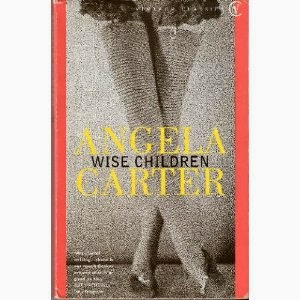
Wise Children - Angela Carter


Carter's last novel, published a year before her ridiculously early death, is a tour de force of wit and imagination.  Dora and Nora are twin by-blows of the Hazard theatrical dynasty.  On the day of their father's hundredth birthday (and that of his long lost twin), Dora sets down her memories of him/them and her and Nora's own career in illegitimate variety theatre.  It's a novel about women but in no derogatory sense a 'women's' novel, any more than Charlotte Bronte or George Eliot are gender-limited authors.  That said, Carter's feminist brio - both characteristics increasingly historical in the age of Katie Price - is what makes the story fizz and spark.  The highlights are too numerous to mention.  Come to think of it, I can't recall any lowlights whatsoever.  A magnificent, truly beautiful book.  What a loss Carter was.

Friday, 11 October 2013

Come Unto These Yellow Sands - Angela Carter


Angela Carter was a true enthusiast of radio drama which she found ideally suited to her gothic sensibilities.  For Carter, radio was the natural home of her fantastical creations.  So what we have here are the radio versions of Company of Wolves, Vampirella and Puss in Boots, plus the title play, a magnificent dramatic feature on the Victorian artist, madman and murderer, Richard Dadd.  I suspect I saw the same exhibition of Dadd's work from the madhouse that Carter did, sometime around 1973.  I too fell under the spell of The Fairy-Feller's Masterstroke.  We all did.

What Carter achieves here is a seamless meld of fact and disordered fantasy.  Doctors and Dadd's former friends discuss his condition whilst characters from his paintings - Oberon, Titania and the Fairy-Feller himself - discuss their own reality.  Magnificent.  Very few radio plays nowadays attempt anything remotely so ambitious, and the situation is likely to get worse as we goes weeks on end without Drama on 3 and the plays on 4 become every more like bad TV.  So transport yourself back to the late Seventies and early Eighties when Carter was working in radio and remember that they did these things differently back then.

For a longer, more scholarly review click here.