Total Pageviews

Showing posts with label H P Lovecraft. Show all posts

Sunday, 21 December 2025

The Mammoth Book of Cthulhu - Paula Guran (ed)


 The subtitle, 'New Lovecraftian Fiction', is an exact description of the concept.   Virtually all the contributions are original to this collection.  By and large they bring Lovecraft's Cthulhu Mythos into the twenty-first century.   A majority are by women, which in itself casts a fresh light on Lovecraft's originals in which there are few if any women.   Lovecraft's personal attitude to women was to say the least unusual (see Houellebecq on Lovecraft, reviewed here earlier this month).   On that subject, and on Lovecraft's racism, the final item in the collection is a bracing non-fiction piece by Veronica Schanoes called 'Variations on Lovecraftian Themes.' 

There were no stories I didn't enjoy reading.   I thought the standard overall was high.   Naturally, some appealed more to me than others, a personal preference reflecting my own perception of Lovecraft rather than anything in the work itself.   I liked 'A Clutch' by Laird Barron, 'It's All the Same Road in the End' by Brian Hodge, 'I Believe That We Will Win' by Nadia Bulkin and (probably my favourite) 'In the Ruins of Mohenjo-Daro' by Usman T Malik.

Regular visitors to this blog will notice that I get through a fair few anthologies, particularly in speculative fiction.   Through that I am beginning to notice anthologists to look out for and who to avoid.   Paula Guran is definitely one of the former.

Sunday, 14 December 2025

H P Lovecraft: Against the World, Against Life - Michel Houellebecq


 As stated in my last post, I had to buy this book as soon as I saw it listed in the front of Serotonin.   It arrived whilst I was reading Serotonin and I wolfed my way through it, finishing before I finished reading Serotonin.   Usually I try and space out my reading of authors I have suddenly discovered (no real reason for that, other than a general concept of neatness and variety).   In this case, however, the two really became one.

Lovecraft was Houellebecq's first publication, Serotonin his most recent translated into English.   Almost thirty years between them - and yet the tone, outlook and style is identical.   Short, snappy passages of intense writing marked by a profound pessimism.   The latter is very like Lovecraft, the former very much not.   Houellebecq's main preoccupation is Lovecraft's literary style and, though I have read most Lovecraft and not so very long ago, I hadn't really realised how odd that style is - so prolix, so arcane, archaic and artificial.   It is in fact a wall Lovecraft is building, not so much between author and reader as between reality and midnight black fantasy.   The same applies to Houellebecq's thesis as expressed in the subtitle, Against the World, Against Life.   Lovecraft's fiction is exclusively unreal, unworldly and not about life as we know it.  Like his style, his vision is absolutely unique.   There are no models he can have followed; those who follow him signally fail to achieve the overall mordancy.

Traditionally Lovecraft is seen as being reclusive and remote.   Houellebecq is at pains to point out this is not entirely true.   Lovecraft had friends.   He even had a wife (which I had not realised) and remained on good terms with her even after retreating back to his old home.   He was (and I did know this) enormously supportive of younger writers who wrote to him.   He won their affection and Houellebecq is much kinder than other critics to those like August Derleth who maintained Lovecraft's reputation after his death and, indeed, brought him into the literary mainstream.

This is a marvellous book, beautifully written, inscisive and empathic.   The inclusion of two of the 'master texts', The Call of Cthulhu and The Whisperer in Darkness is a wonderful bonus.

Wednesday, 26 March 2025

Menace of the Monster - Mike Ashley (ed)


 Classic Tales of Creatures from Beyond, says the subtitle.   These things are always subjective.   Lovecraft's 'Dagon' is a classic, no question, but this version of War of the Worlds, an abridgement for a continental abridgement, and a Boys' Magazine version of King Kong belong more in the Interesting Curiosity department.   The latter, by the way, is much better than the former, despite the former being done by Wells himself.

Among the others, I liked 'The Dragon of St Paul's' by Reginald Bacchus and C Ranger Gull and 'Discord in Scarlet' by A E Van Vogt, which Vogt successfully claimed was source material for the Alien  franchise.   These stories illustrate the dichotomy editor Ashley has juggled with here.   'Dragon', like 'Dagon', is really weird fiction, or even weird adventure; 'Discord' is science fiction, pure and simple.  I am perfectly happy with the mix but suspect purists might jib.

Of the others, I found 'Personal Monster', by 'Idris Seabright' aka Margaret St Clair (1911-95) stayed with me longer than any other.   The ending I thought was masterful.

NOTE: Turns out I made it to my 1000th post sooner than expected.   This is it.   Monsters, sci fi, classic and weird ... I guess that about sums up this blog.   On to the next milestone!

Thursday, 26 October 2023

Werewolves in their Youth - Michael Chabon


 A collection of nine decent-length short stories by Michael Chabon, Werewolves in their Youth distills the charactersistics that make Chabon one of the best US writers of recent times - wit, elegance, the eye for the telling detail, the nuances of speech, etc.  Oddly, the title story was my least favourite; no particular reason, just that Stephen King does these things better.   On the other hand I loved 'The Harris Fetko Story', a skewed take on the Great American sports hero, and 'In the Black Mill', a Lovecraftain pastiche which Chabon cleverly links to perhaps his bestknown novel Wonder Boys.   I single out these two and have given my reservations about 'Werewolves', but I enjoyed all the stories here and recommend the collection wholeheartedly.

Tuesday, 14 May 2019

The King in Yellow - Robert W Chambers


The King in Yellow is in every sense a strange book. It's a collection of stories but not one of them is called The King in Yellow. In fact The King in Yellow is a printed playscript of material so mind-blowing that anyone who reads it risks insanity. The fictional text pops up in the first four stories but only in the first (and best) 'The Repairer of Reputations' does it fully do its damnedest. The story is truly macabre. To start with, it is set in 1920, a quarter of a century after it was written. New York has become very much as it is today, cracking down on immigrants, isolationist, and populist. In a move that is almost inevitable for Trump's second term, New York now boasts a Lethal Chamber in Washington Park. Sitting in the park and watching the euthanists run up the steps to the Chamber is the epitome of popular pastimes. Castaigne, our narrator, has just been released from psychiatric care. He is not mad, he tells us, and never was. He told his psychiatrist he wasn't mad and has offered to prove it by killing him. In the meantime he has cured himself by reading The King in Yellow. Now all manner of things are clear to him. First and foremost he must prevent his cousin from marrying the daughter of Hawberk, the artisan restorer of ancient armour. Castaigne has an ally in Mr Wilde, the repairer of reputations, who happens to live upstairs from Hawberk. Wilde is a midget with a fingerless hand who engages in perpetual strife with an extraordinarily vicious cat. Wilde has a book called The Imperial Dynasty of America, which is naturally of great interest to Castaigne, given that he and his cousin both feature towards the end.

This sounds bizarre, and it really is, startlingly so for 1895. The writing is simply dazzling. Chambers was an art student in Paris and has a tremendous gift for description. My favourite line comes from a story at the other end of the collection, but is typical of the whole book: "when again he raised his eyes, the vast Boulevard was twinkling with gas-jets through which the electric lights stared like moons." This comes from a second cluster of loosely linked stories featuring several re-occurring art students. These are not horror stories or even weird fiction, but they are very good. My second favourite, "The Street of the First Shell' is also set in the Latin Quarter but a generation earlier, in 1870, when Paris was besieged by the Prussians. This prefigures the historical fiction with which Chambers made his fortune.

The King in Yellow is and always was a curiosity. Apparently Chambers never wrote anything else quite as weird. Its influence was certainly telling; the links with Lovecraft are clear. I recommend it to all students of the genre.

Sunday, 10 March 2019

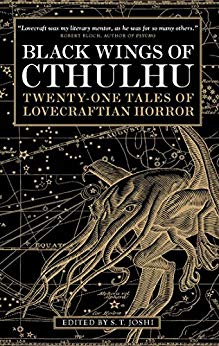
Black Wings of Cthulu (1) - S T Joshi (ed)

It's a measure of the influence of H P Lovecraft that so many others have written in homage. This is a substantial collection of 21 stories of varying length and Joshi has gone on to edit nine more to date - and these, of course, are just in reference to the Lovecraft's Cthulu or Elder Gods stories. He wrote plenty more that are more straightforwardly Gothic.


There are no bad stories here. I can only therefore mention my favourites. Caitlin R Kiernan's "Pickman's Other Model" gets the collection off to a flying start. I liked Sam Gafford's "Passing Spirits" and I loved "Inhabitants of Wraithwood" by W H Pugmire, which also develops Lovecraft's story "Pickford's Model", as does Brain Stableford in "The Truth About Pickman".I tend to prefer the longer stories but the one here that stayed in my mind the longest was "Susie" by Jason van Hollander, which closes the collection and only lasts seven pages - seven pages into which he crams several brilliant twists. Van Hollander also did the cover illustration which perfectly captures the theme.

Thursday, 19 October 2017

The Lurking Fear - H P Lovecraft


This Wordsworth collection concentrates on the non-Cthulhu. non-Arkham stories. The main preoccupation here is the Gothic, specifically inbreeding and ancient bloodlines tainted. The introduction by Matthew J Elliott is useful and the last entry is Lovecraft's own insights into his craft .Notes on Writing Weird Fiction'.


As for the stories themselves, some are unfinished or abandoned drafts, included for the completists. But there are also classics like 'The Music of Erich Zann', 'Beyond the Walls of Sleep', 'The Beast in the Cave' and, my favourite, 'The Rats in the Walls'. Overall, though, you wouldn't want this collection to be your first acquaintance with Lovecraft. There are many better and more typical collections, of which I have quite a few.

Tuesday, 30 August 2016

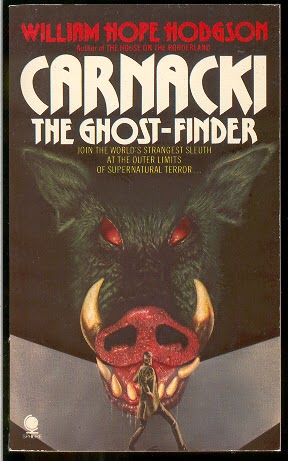
Masters of Terror Volume 1 - William Hope Hodgson

It's interesting that Corgi chose Hodgson for the first in its Masters of Terror series back in 1977. He was out of copyright by then, of course, and one cannot be a paperback master when they still have to pay royalties. Interest in Hodgson had revived earlier in the decade when one of his Carnacki stories was dramatised in Hugh Greene's TV series The Rivals of Sherlock Holmes, but I suspect it was the reappraisal of H P Lovecraft that was going on at the same period which led to this publication, because it was Lovecraft who first described Hodgson as a master.


The introduction is by Peter Tremayne, who can always be counted on to do his homework. OK, he is slightly wrong about the dates of Hodgson's apprenticeship at sea - but I only discovered the real dates thanks to being able to view the actual documents online. Tremayne has seen publications which I haven't but will do now.
He discusses the seven stories and the reasons for their inclusion in short but effective order. 'A Tropical Horror' from 1904 was Hodgson's second published story and his first in the genre he was to make exclusively his own - sea-horror. 'The Voice in the Night' is another such, as is 'The Mystery of the Derelict', which Tremayne considers a classic. The fourth story - 'The Terror of the Water-Tank' - is here because it is one of Hodgson's rare attempts at land-based horror. I'm afraid I found it trivial.
The narrator of 'The Finding of the Graiken', one of Hodgson's Sargasso Mythos stories, was too like the narrator of 'The Terror of the Water-Tank' to hold my attention - a middleclass lightweight who does not personally confront the horror. In that respect Hodgson's most effective form was one he hit upon almost from the start: get the hero to spot the horror in the first few paragraphs, then have him confront it face to face (always supposing the horror has a face) and survive to tell us the tale. That is why, in my opinion, 'The Stone Ship' is my favourite in this collection. I had not come across it before - hadn't even heard of it - but it is classic Hodgson: a young hand spots a mysterious wreck, a search party goes aboard and confronts a truly ghastly horror which is revealed in a spectacularly gruesome manner.
The final story, clumsily called 'The Derelict' and thus easily confused with the earlier story, is included because it combines the sea-horror of Hodgson's early period with the science-fiction otherworldly horror of his masterpiece novel The House on the Borderland and the last, still controversial epic The Night Land.


All in all, then, a great introduction to the signature work of an undervalued writer with a useful and authoritative introduction to point you in the right direction for further exploration.

Monday, 29 June 2015

Teatro Grottesco - Thomas Ligotti


Thomas Ligotti has become a cult writer since the millennium.  People liken him to Lovecraft, Poe, and M R James.  I like all those authors so naturally I was keen to try Ligotti.  My conclusion?  He's not like the aforementioned.  He's not scary, though he does successfully get under your skin, and for all the very obvious work that goes into crafting his stories, he ends up being a bit dull.  For me, the problem is that his first-person narrator has always the same characteristics - reclusive, obsessive, an outsider with a bad stomach - no matter whether he is a creative artist or a drudge in a slave-labour town.  The towns, likewise, are always in the north, on the border, and he has usually left by the time he comes to write down his experience.  There are other regular tropes - other recluses, bizarre modern artworks, and carnival performers (carnies are much scarier in America, apparently, than they are in the UK).  Frankly, some of the long pieces are distinctly over-wrought - by the time I've got to the end of some of his paragraphs I've forgotten what he began with.  I admire the work, the commitment to form.  I own Ligotti has created a fictional world almost as real as Lovecraft's Arkham.  But he's not adventurous enough for my taste.

Thursday, 11 June 2015

The House on the Borderland - William Hope Hodgson

Mr Hodgson is perhaps second only to Algernon Blackwood in his serious treatment of unreality.  Few can equal him in adumbrating the nearness of nameless forces and monstrous besieging entities through casual hints and insignificant details, or in conveying feelings of the spectral and the abnormal in connexion with regions or buildings
Thus said H P Lovecraft in his rolling survey of the form, "Supernatural Horror in Literature", written between 1925 and 1934.


Well the object here is very much the building, and what happens there is abnormal to the ultimate degree.  Those who know Hodgson only for the Carnacki stories or his innumerable tales of the Sargasso, are missing out.  Borderland prefigures his final novel, The Night Land, which even Lovecraft and Clark Ashton Smith felt 'went a bit too far'.  It might have been written in 1907 (see 'the editor's' introduction) but in many ways it could easily have come from the acid-ridden 1960s.

It starts traditionally enough.  Two Victorian chaps take a holiday in the far West of Ireland.  There they stumble upon the ruined, abandoned house, perched precariously on an unstable rock platform over a huge bottomless abyss.  In the rubble inside the house they find a damaged manuscript written by the last owner, a nameless recluse.  We do not know when the manuscript was written or when the house was abandoned, and very soon the issue of time becomes irrelevant.

The recluse describes how he was sitting in his study late one night when he felt himself being borne up and away by invisible forces, into space and out of the solar system.  In another part of the galaxy he visits a planet where he finds a massive replica of his house hewn out of green stone, standing on the border of the Silence.  He wakes back in his study and finds that nothing has changed.  Or has it?

Part of his garden is carried away in a landslip.  The pit begins to form.  Creatures emerge and attack the house, which the recluse now realises stands on the border between dimensions.

A good third of the book is taken up with a second out-of-body experience in which he seems to live forever, so long that he sees and survives the death of the sun itself.  He seems to wake, but---

Unique for its day and very much a precursor of modern visionary sci fi, this book essentially defines the term 'fantastic fiction'.  A must-read for any student of the genre.

And what, for the record, did Lovecraft think of The House on the Borderland?  Why, this---

The House on the Borderland (1908) - perhaps the greatest of all Mr Hodgson's works - tells of a lonely and evilly regarded house in Ireland which forms the focus for hideous other-world forces and sustains a siege by blasphemous hybrid anomalies from a hidden abyss below.  The wanderings of the narrator's spirit through limitless light-years of cosmic space and kalpas of eternity, and its witnessing of the solar system's final destruction, constitute something almost unique in standard literature.  And everywhere there is manifest the author's power to suggest vague, ambushed horrors in natural scenery.  But for a few touches of commonplace sentimentality this book would be a classic of the first water.
I'd quibble with the last sentence - Lovecraft, understandably, had no knowledge of Hodgson's love life, which I see mirrored in the recluse's reunion with his lost love in the second vision - but otherwise, I think he pretty much covers all the bases.  And I'd forgive him almost anything in return for the word kalpas, albeit Lovecraft borrows it from Hodgson's book.

Tuesday, 12 June 2012

The Whisperer in Darkness - H P Lovecraft


I hadn't read any Lovecraft since I was a boy.  They turned up in collections of horror fiction, but usually the short ones, and reading this collection has shown me that Lovecraft is most successful in novella form, when he has space to develop his cosmic theories, and time in which to layer up his arcane atmosphere.

The early short stories included here - Dagon, The Nameless City, The Hound, The Festival and The Call of Cthulhu - didn't really hit the spot for me.  They only served to set the scene for the four much longer works that follow: The Case of Charles Dexter Ward, The Dunwich Horror, The Whisperer in Darkness and At the Mountains of Madness.  The first two deal with Cthulhu as background only whereas the concluding stories address it head-on.  Indeed, Mountains of Madness, is probably the most detailed exposition of the mythos that Lovecraft wrote.  I particularly enjoyed the clever interplay between the cutting-edge technology of 1930 and the "elder secrets" it uncovers.

Otherwise, Dunwich Horror was my favourite, the story of the alarmingly precocious Wilbur Whateley and his ill-judged, ill-fated trip to Miskatonic University.  Monster he may be, but Lovecraft manages to evoke sympathy for the boy's sad end.