Total Pageviews

Showing posts with label M John Harrison. Show all posts

Friday, 18 July 2025

Other Edens - Christopher Evans and Robert Holdstock (eds)


 Other Edens is a sci fi collection from 1987 and very much from the Interzone period of British imaginative fiction.   Some of the most noted writers are respresented - Moorcock, Harrison and Aldiss - but not with their best work.   Those who stand out here are those who were then breaking through: Garry Kilworth, who I only knew from Interzone; Lisa Tuttle, who I had heard of but never read; and a couple of others completely new to me, such as Graham Charnock and Keith Roberts.

Roberts' story Piper's Wait was probably my overall favourite, a temenos story stretching very effectively over the ages.  Tuttle's The Wound was a close second, a very exciting take on mutable sexuality.   Kilworth's Triptych was by far the most radical and complex, a fragmented three-parter positively bursting at the seams with ideas.   I am increasingly interested in Kilworth.  He seems to have been extraordinarily prolific with over eighty novels spanning many genres, so it shouldn't be too hard to track one down.

Friday, 13 June 2025

New Worlds 8 - (ed) Hilary Bailey


 New Worlds magazine was founded before WW2 and taken over by Michael Moorcock in the sixties.   With the aid of an Arts Council grant Moorcock turned New Worlds into the monthly journal of the British New Wave in sci fi: Moorcock himself, Ballard, Aldiss etc.   Around 1970 the magazine started to flounder.   Moorcock persuaded Sphere to continue it as a 'quarterly' paperback.   By 1975 when this eighth and last edition came out, Moorcock's wife Hilary Bailey was editor and their close longterm collaborator M John Harrison was literary editor.

Bailey made a good job of editing this one.   The stories appear in descending order of quality.   We start with Harrison's 'Running Down', a Yorkshire-set tale combining his interest in climbing with nature horror.   Then we have 'White Stars', an interlude from Moorcock's long-running and intricate Dancers at the End of Time thread.   I was initially put off Moorcock by Dancers when I was a young teenager, but I thoroughly enjoyed 'White Stars'.   Barrington Bayley's 'The Bees of Knowledge' is different and well-written.   Peter Jobling's 'Building Blocks', which Bailey in her introduction suggests might be a debut piece, is equally interesting but not quite so well written.   The other, shorter, stories did not greatly appeal.

I was fascinated by the two book reviews at the end, one by Harrison, the other by John Clute.  Is this what sci reviews were like in the Seventies?   By way of illustration, I give you title of Clute's ten-page review of Brian Aldiss's novel, The Eighty-Minute Hour: 'I say Begone! Apotropaic Narcosis, I'm Going to Read the Damn Thing, Ha Ha.'   Worryingly, Harrison's marginally shorter review of Thomas M Disch's collection Getting into Death is in similar vein.

John Clute went on to become one of the founders of Interzone, which is in many ways was the successor to New Worlds.   The issue I have just acquired contains work by Harrison and Aldiss and Thomas M Disch.   I'll report on it shortly.

Friday, 6 June 2025

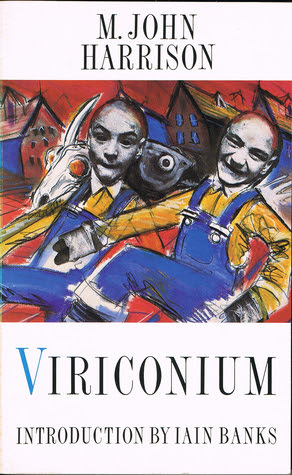
Viriconium - M John Harrison


 Discovering the work of M John Harrison over the last year or so has been a profound experience.   He is by far the best of his genre, though that poses the question: what exactly is his genre?   I'll take a stab at dark imaginative fiction.   It doesn't matter if it has a sci fi setting, an imagined world outside time, or a neglected corner of this world, Harrison always goes further, adding a sense of the inexplicable, which is pure Harrison.

This Unwin paperback from the mid-80s combines two books of the Viriconium series, the novel In Viriconium (1982) and the short stories and associated pieces collected as Viriconium Nights (1984).   There are other Viriconium works, notably The Pastel City and A Storm of Wings.

Viriconium is everywhere and nowhere.   It is not always Viriconium; sometimes it is Uroconium, or Vrico.   It is medieval and sometimes it is fin de siecle Paris.   There is an Artists' Quarter, a High City, and heathland.   The totem of the city, though, is the Mari Lwyd, immortalised by Dylan Thomas's friend Vernon Watkins.  

Characters come and reappear in different contexts.   They have wondrous names and titles.  Ardwick Crome, the Grand Cairo, Morgante who is also Rotgob and sometimes Kiss-O-Suck, Mammy Vooley, Ignace Retz and Dissolution Khan.   One story, 'A Young Man's Journey to Viriconium', is absolutely set in contemporary York and is about how one gets from here to the mystic city via a mirror "in the lavatory og the Merrie England cafe, a little further down New Street than the El Greco, between Ramsden Street junction and Imperial Arcade" in, I think, Huddersfield.   Which feels exactly right.

In Virconium is the most satisfying piece, a sort of love story set in the Artists Quarter during a time of plague.   In this period a pair of demi-gods called the Barley Brothers (Matey and Gog) rampage through the city until they are defeated by the painter Ashlyme.   The stories of Virconium Nights are, by definition, more fragmentary but each has incredible depth, compelling the reader to ask questions and make connections, not all of which are necessarily there.

Fascinating, enthralling, often startling.   M John Harrison is giving my all-time favourite author (the late E L Doctorow) a run for his money.

Friday, 23 August 2024

The Centauri Device - M John Harrison


Suddenly everyone wants Captain John Truck, which is odd, given that nobody has ever wanted him before.   General Alice Gaw of the Israeli army wants him, as does her opposite number with the Arab socialists, and Dr Grishkin, and even Chalice Veronica host of the longest running party in the universe.  Hitherto John Truck and his ship My Ella Speed has had to make do ferrying second rate cargo around the lesser spaceports at the ass-end of the Galaxy.   Now, people are kidnapping him off the street, recusing him and snatching him for their own nefarious purposes.

The thing is, the Opener archeologist Grishkin has found the legendary Centauri Device on Centauri VII, the only planet to have been murdered.   Nobody knows what the Device will do.  The Israelis and the Arabs assume it's a super-weapon that will decide their endless Earth-shattering war.  Grishkin dreams it is a religious revelation, possibly apocalyptic.   Chalice envisages the high of all highs, or at least trading it for a megaload of drugs.   The one thing upon which all agree is that only a Centaurian can operate the Device.   Which is a problem, given the race has been all but exterminated.   Truck is the all-but in question.   His prostitute mother Spaceport Annie coupled with one of the last Centauri and space John is the result.

It's a hell of a take on the Grail Quest - an off-kilter, typically Harrison take - complete with Fisher King 9the aesthetic anarchist Pater) and a Merlin of sorts (Pater's son, the conjurer Himation.   Guinevere has a scarred face and Truck is an unlikely Lancelot.   But he gets there in the end.   He conjoins with the Device and---

I simply cannot get enough of M John Harrison.   This is the third of his novels I've read this year and I want more.   He is so different, so unique.   Nobody does it like him.   Nobody does what he does better.

Friday, 5 July 2024

Empty Space - M John Harrison


 Spanning time, space and planes of existence, Empty Space is just breathtaking in conception.   It may well continue stories from earlier books - Nova Swing is the name of the beat-up spaceship owned and run by Fat Antoyne and his two shipmates, and also the title of the Harrison novel immediately before this.   It doesn't matter.   Everything we need to know is here.

On what we might call the terrestrial, twenty-first century plane, Anna Waterman is a widow in her late fifties or early sixties, living in a prosperous village on the fringes of London.   After two unsatisfactory marriages Anna has rather lost her way in life.   At her daughter Marnie's insistence she is grudgingly seeing a London psychiatrist.   Half the time Anna doesn't show up or forgets.   Marnie fears the onset of dementia.   Anna, however, is mapping out a future for herself.   It isn't easy.   Her summerhouse keeps setting on fire without being burnt, and there are copper-coloured poppies in her garden.

About as far away from this as it is possible to get, on the scrubby minor planets of the Kefahucki Tract, Toni Reno wants Fat Antoyne to collect and transport what can only be called mortsafes.   This being the far distant future, the mortsafes are self-aware.   Meanwhile an assistant investigator in Saudade City is called to a troubling death.   The victim is suspended in mid-air, as if falling in empty space.   Toni Reno soon becomes another victim, and the chop-shop proprietor who artificially enhanced (tailored) the nameless assistant.  They may not actually be dead, but they are certainly fading away, literally.

One of the mortsafes might possibly contain the Aleph.   The Aleph may be someone we have already met.

Harrison's skill in handling all the strands and bringing them together at the end is just staggering.   I was swept along throughout, totally engrossed.

Sunday, 19 May 2024

The Sunken Land Begins to Rise Again - M John Harrison


 Now this was a discovery for me.   I admit, I'd not heard of Harrison, notwithstanding he was a pillar of British sci fi fantasy in the Sixties and Seventies, despite the fact he was associated with Michael Moorcock, that China Mieville is a fan, and that he qualifies (sort of, originally) as a local author.   But I know him now.   And I was blown away by this, his novel from 2020.

It's a contemporary tale of two peripheral people: Shaw, whose first name never becomes clear (it's probably Alex), and Victoria Norman.   They drift into one another's orbit in London, then drift apart again.   Victoria inherits her mother's house in Shrewsbury and Shaw gets a gig economy job, working for, in wh Tim, who keeps an office on a barge in Brent and who might possibly live next door to Shaw in the subdivided HMO in Wharf Street.   Tim has self-published a book and keeps a blog about ancient DNA.   Shaw meanwhile seeks a sort of therapy from a medium called Annie Swann, who seems to be Tim's sister.  Tim gets Shaw to record his sessions with Annie to use as material for his blog.

In Shrewsbury, Victoria gets local tradesmen in to do up the house.   They are very local - they might live next door - and are very tribal.   One of them, the roofer, is incredibly keen on The Water Babies, even keener that Victoria should read it.   Victoria makes a new friend in Pearl, who runs a cafe and turns out to be the daughter of Chris (who prefers to be called Ossie) and is the one who apparently lives next door to Victoria.   The building containing Pearl's cafe is another HMO, in which some very strange people dwell, including all the tradesmen Ossie coralled into working on Victoria's house.   Pearl disappears - Victoria sees her do it, and it is very strange.

The novel is very strange and compelling.   Harrison plays on the littoral nature of his settings and luxuriates in their psychogeography.   Despite being hopeless failures in life - because they fail to engage with life - Shaw and Victoria are characters we get to like and trust.   The secondary characters like Shaw's mum in the care home and her colourful marital backstory, Pearl and Tim and especially, all have their charm which is coupled with threat.  The fantasy element is crucial, yet downplayed.   It doesn't need to be explained, it just needs to be there.

I would have probably passed had it not been for the eyecatching cover image by Micaela Alcaino, which was right up my street, so I picked up the book, which was absolutely 100% what I'd been looking for.   An object lesson, there, in the importance of cover art.