Total Pageviews

Tuesday, 27 September 2016

The Extraordinary Voyage of Pytheas the Greek - Barry Cuncliffe

I don't remember when I first heard about Pytheas - it was more than thirty years ago and it may even have been via one of Barry Cunliffe's other books. I have been fascinated ever since.


Pytheas is said to have been the first man to circumnavigate the island of Britain and leave a record of his voyage. This was around 350 BC. Beyond that, we stray into less certain ground. For a start, Pytheas wasn't really a Greek. He was a citizen of the Greek maritime colony of Massalia, modern Marseilles. His book, On the Ocean, has not survived. What we know of it is quoted or referenced by later writers - some of them, like Pliny, more than four hundred years later. Others like Strabo, writing about the time of Christ's birth, only quoted Pytheas to demonstrate what a fantasist he was. Strabo, however, was an armchair geographer, writing in the declining, decadent years of Greek culture, whereas Pytheas was a son of the Great Expansion and claimed to have seen the far-off islands for himself. What clinches Pytheas's story for me is that he was a merchant on the make - he wanted to explore Britain in the hope of turning a profit. That rings true.

Pytheas also claimed to have visited Ultima Thule, an island north of Britain regarded as the last habitable outpost of humanity. Cunliffe explores the various possibilities. Was it Iceland, Norway, one of the Danish islands or one of the Faroes? The truth is we will never know. I accept without question that it was possible to get to Iceland from the north of Scotland in the vessels used at the time - boats and ships did not change greatly in the North for another fifteen hundred years and we know that early medieval travellers made it to Greenland and even North America. I question if it was Iceland, though. Iceland is so very different; anyone who landed there could not avoid noticing the difference (and there was no point going anywhere if you did not at least try to make landfall). On the other hand we do not have Pytheas's original text. We do not even have quotations from it that are 100% reliable. It is all a matter of judgement. Cunliffe is a scholar of history, the greatest scholar of Celtic Britain, a hands-on field archeologist; for him ancient texts are simply possible clues to new discoveries on (or in) the ground. Pytheas, of course, did most of his exploration on the water, where no trace will ever be found.

Cunliffe's other great gift is his writing ability. He never simplifies for the sake of making a cheap point, nor does he bombard the reader with unnecessary scholarship. His desire is to bring Celtic Europe to life for everyone. And he does that here brilliantly.

Monday, 19 September 2016

Rare Earth - Paul Mason

Paul Mason is the celebrated TV journalist, probably the last openly left-wing member of the breed. Rare Earth (2012) is his first and so far only novel.


As you would expect, it is about TV journalism. His hero, David Brough, is a gritty Northerner, difficult to employ because of his old-fashioned yen for a real story. He is part of a team visiting China to provide some colour for a feature on the next economic superpower. Unfortunately he stumbles on pollution, corruption and state manipulation of the market in rare earth (compounds essential for digital hardware).


Fair enough, you might think. An interesting and worthwhile read. But then Mason springs his big surprise. Many of the characters are troubled by ghosts - yes, actual dead people spirits who converse with the living as if they were, well, alive. Then there are fantastically inventive characters like the "private military and security" team of supermodel bikers who rescue Brough from the desert and eighty-four year-old General Guo, who once swam in the Yangtse with Chairman Mao and who now seems to be running everything despite living in a shantytown shed.


It's the inventiveness that keeps you hooked for 300+ pages. That and the pacey style, because Mason writes exactly like he speaks - in superfast epigrams. In the hands of another this would be a worthy but scarcely surprising story (it's not exactly a secret that globalisation is built on poverty and corruption); with Mason we get a kaleidoscope of facts, comedy and fantastical fizz. He should make time to write another.

Monday, 12 September 2016

A Sense of Wonder - John Wyndham and others

This collection of three sci-fi novellas put together and introduced by the arch-anthologist in the genre, Sam Moskowitz, can claim to have re-discovered John Wyndham's early story 'Exiles on Asperus'  (1933). Wyndham's estate only published it in 1979, ten years after his death, but here it is in 1976 with Moskowitz claiming it is the first publication in book form, which may very well be true.


Wyndham was 30 when he wrote it, still writing for genre magazines, in this case Wonder Stories Quarterly under a different variation of his name, John Benyon Harris. Moskowitz's point is that the three stories go beyond a sense of the fantastical into a sense of wonder. In other words, they ask mature questions like what is technology for, and what effect will scientific advances have on human nature. I would add the suggestion that the length they have to play with (each runs roughly 50 pages in paperback) allowed them to ask such questions and develop more rounded characters.


In any event, Wyndham's story is, as you would expect, the best of the three. By 2077 Earth has colonised the Solar System (we'd better get a move on then). It is an empire not unlike the British Empire, which did some good things and some appalling things. The Martians, who are regarded as semi-human, have rebelled and been suppressed. The Argenta is transporting some of the ringleaders to a penal colony. They are holed by a message rocket, the 21st century equivalent of a message in a bottle. The message was sent out 25 years earlier by the captain of the Red Glory, wrecked on the planetoid Asperus. It is perfectly possible that the castaways are still there. The Argenta lands to investigate.


The crew are indeed still there. They have bred a second and a third generation. Also resident are the Batrachs, an alien race of bat-like creatures who control the humans, using them to carry out tasks which their wings prevent the Batrachs doing for themselves. So far so predictable. We assume, along with the crew of the Argenta, that the humans want liberating. Without giving too much away, let's just say it comes down to mind control through conditioning. Mussolini was already in power when Wyndham wrote this story; Hitler was on the rise and in Britain the Daily Mail was backing Moseley's Blackshirts. The horrors of the Holocaust were still to come, thus Wyndham reflected a world in which fascism was seen as a possible solution. And that moves 'Exiles on Asperus' into another league entirely.


Murray Leinster's 'The Mole Pirate' and 'The Moon Era' by Jack Williamson suffer by comparison. They don't really ask such big questions and are limited by being earthbound in the former and driven by the prospect of cash rather than wonder in the latter. That is not to say that they do not have their moments.


Leinster (real name William F Jenkins 1896-1975) was a prolific writer of pulp fiction. His mole is a machine which can dematerialise and pass through solid matter. Rather than use it for something significant, it is hijacked and used for bank robbery. There is, however, a fabulously imaginative sequence when inventor Jack Hill is kicked out of the dematerialised mole with nothing but a pair of radioactive snow shoes to prevent him falling through the Earth.


Williamson (1908-2006) was notable rather for those he inspired (Asimov, Pohl etc.) than the stories themselves. He was only 23 when he wrote 'The Moon Era' so it is not surprising that his hero, Stephen Conway, is driven by the primal impulses of financial security and sex. His inventor uncle offers to make him heir to his millions if Stephen will test-fly his latest and greatest invention, an anti-gravity machine that should fly to the moon inside a week.


I enjoyed the concept of a space capsule that basically falls off the Earth. The twist is that it also goes back in time, aeons over the course of a week, landing on a Moon that still supported life forms. Stephen encounters the last surviving female of the pure moonlings. They strike up a relationship in order to escape the impure moonlings, who live in machines, a sort of splicing of H G Well's Martian invaders and the Daleks. It is the totally alien nature of the Mother which sets Williamson's story apart, especially the way in which despite her otherness she and Stephen manage to establish a convincing relationship.

Sunday, 11 September 2016

Michael Tolliver Lives - Armistead Maupin


Michael 'Mouse' Tolliver, key character of the Tales of the City series, HIV positive and survivor of Guillain-Barre Syndrome is, to everyone's surprise, not least his own, pushing sixty and very much alive in the first decade of the Third Millennium.


I was a massive fan of Maupin's stories, mopping up the collections as they came out, and was surprised by this late return, especially in novel form. I need not have been. It is a triumph, the product of a master who has reached the pinnacle of his powers. One difference, of course, is that Michael is our narrator, omnipresent and the filter through which we view events. The other is the golden glow of acceptance. The misfits who pitched up at Mrs Madrigal's house in post Haight Ashbury San Francisco bonded by virtue of their outsider status. Thirty-five years later the world has moved on. Gay people and transsexuals are accepted without comment. Michael has married, for goodness sake, and the octogenarian Anna Madrigal now lives in an apartment with three other transsexuals for neighbours, including Jake, who is FTM.


Outside the Frisco enclave, however, things can be a little more awkward. Michael's mother is dying in Florida, which means Michael must visit his brother and sister-in-law who adhere to the militant wing of born again Christianity. Irwin and Lenore could easily be caricatures but Maupin is far too skilled and considerate to fall into that trap. Irwin and Lenore have their problems too - big ones it turns out.


All of life - and death - is here. All the surviving members of the Barbary Lane crowd are covered - Brian and Mary Anne and Mona, who moved to England and became an English country dyke. In its quiet, gentle and above all humane way Michael Tolliver Lives is something of a masterpiece. I'm heading back to the originals and I'm really annoyed that I can't find my copy of Maybe the Moon, which is my favourite Maupin.

Wednesday, 7 September 2016

The Myth of Meritocracy - James Bloodworth

This is an essay in Biteback's Provocations series, edited by Yasmin Alibhai-Brown. James Bloodworth is a journalist and political blogger. Like Alibhai-Brown, Bloodworth is of the Left, albeit a bit soft-Left for my taste. Nevertheless an unashamedly political publication lacerating the myth of right-wing reform (aka cuts) is to be wholeheartedly welcomed.


Bloodworth starts with another essay, The Rise of the Meritocracy (1958) by Labour policy maker Michael Young. Like Thomas More's Utopia, Young's work is a satirical fantasy. Unfortunately those for whom he created policy were a lot less intelligent than he was. The blunt end of politics, Right and Left, adopted 'meritocracy' (Young's coinage) as their watchword. Be it Equality of Opportunity or Equal Access to Wealth, social mobility was the mantra. Yet, as Bloodworth demonstrates in blistering detail, social mobility, after sixty years of actual effort, has never been more of a chimera since the days of serfs and vassals.


What has happened to give the illusion of progress is that the traditional working class - factory workers, miners, weavers - has more or less vanished in post-industrial Britain, a decimation far worse than in other so-called developed nations thanks to a full decade of Thatcherite venom. The working population now is employed in services, retail and distribution, and there really is less of a social gulf between worker and line manager. The elephant in the room is that there is an unbridgeable gulf between the employed oiks and their ultimate paymaster. The super rich do what they have always done: they start off radical and end up ultra-conservative. Richard Branson is the perfect example - a rogue shaker of shibboleths in the Seventies, now a tax exile living on his brand and clinging on to every last penny so that his children and grandchildren will never need to sully their hands with work, risk or stress. The term 'robber baron' has a lot more reality than meritocracy.
The traditional posh, meanwhile, also do what they have always done. They suck up to the likes of Branson, flatter them as entrepreneurs, then suck all the rebellion out of them and make them 'one of us'.


The result is that, despite endless reform, far more posh youths go to Oxbridge than kids from comprehensives. Oxbridge graduates disproportionately dominate banking and parliament. That makes them very unlikely to back any meaningful attempt at tax reform or, indeed, genuine social mobility. The second sons and the thick can no longer find their traditional havens of religion and the armed forces, so they become commissioners at the BBC and Channel 4. Unsurprisingly they favour their fellow Old Etonians and Harrovians who, when all's said and done, are the only ones who can afford to study the arts since the abolition of maintenance grants.


You have probably noticed by now. I really enjoyed Bloodworth's argument, both what he says and the way he says it. He has a real gift for the catchy line. Of course, being hopelessly of the lower orders myself, I would do, wouldn't I?

Monday, 5 September 2016

Nostromo - Joseph Conrad

The deeper I got into Nostromo, the more I was reminded of Camus' The Plague. Both dissect closed societies under stress; both share a preoccupation with moral corruption. Just as The Plague isn't really about the epidemic, so Nostromo isn't really about the title character, who barely appears in the first half of the 450-page book, or even about the San Tome silver mine which infects the lives of everyone in the enclave of Costaguana.  The plague bacillus and the silver mine are merely the causative agents of their respective stories, Nostromo the symptom.

Conrad's theme - certainly the theme of Nostromo and The Heart of Darkness - is the corruption of imperialist capitalism. I suppose, in a sense, it is also the theme of The Secret Agent in so far as imperialism and capitalism are what the anarchists seek to overthrow. Conrad, it seems to me, has no problem with Western powers seeking to 'civilise' the indigenous populations of Africa and South America. Despite the notorious title of one of his novels, Conrad does not strike me as racist in the context of his time. His natives are not debased or in any way contemptible. To help them with work and education is, he seems to say, honourable. His venom is reserved for the secondary agents of change, the money-men who exploit - indeed, steal - the natural resources of the subject territories. The monster Kurtz in Heart of Darkness is the company man who goes into the wilderness to mop up all the ivory he can find, not the dying man gone native that Marlow brings back downriver. In Nostromo we have the American financier Holroyd, presented as a figure of ludicrous pomposity during his brief visit to Costaguana. It is Holroyd who bankrolls Charles Gould in asserting his rights to the silver mine - the 'Gould Concession' that killed his uncle and destroyed his father. It is Holroyd's foolish foray south that cements the reputation of Nostromo, the capataz de cargadores, who rescues him from the untamed wilderness.


Nostromo and Charles Gould are seemingly opposites - the former an Italian sailor who has pitched up by chance in Costaguana complete with assumed name, Gould the third-generation European resident, the pillar of society, heir to controversial rights. Actually they are both victims of Holroyd and his cash. With Holroyd's money behind him Gould devotes every last iota of his energy to his mine, neglecting his wife, becoming apathetic to old friends and neighbours. When revolution comes, as it regularly does in Costaguana, his only concern is preventing the soldier-politicians getting hold of his silver. Nostromo, meanwhile, finds that his fame as the preserver of Holroyd - and, indeed, at least one unseated president - has outstripped his status as capataz of the stevedores who operate the seaport of Sulaco for its other offshore exploiters, the Oceanic Steam Navigation Company. Where Charles Gould is aloof and detached, Nostromo cultivates his own myth and becomes peripherally involved with every aspect of Cosraguanan society. When the Montero revolution threatens, it is inevitably Nostromo that Charles Gould enlists to take his silver out to the OSN steamer that will take it north to Holroyd. In that single transaction both men are corrupted beyond redemption.


One last link with The Plague is the doctor. Bernard Rieux is Camus' hero but in Nostromo's Dr Monyngham the only truly honest man and thus cannot be heroic. Monyngham, the ugly outsider, who moons hopelessly over Gould's wife, knows his own worthlessness. Years ago, a young idealist, he was tortured by a previous regime and after they had starved him and crippled him told them everything they wanted to know. Monyngham is ugly and friendless and not even very good at his job - but he knows corruption when he sees it. There is a nighttime scene between the doctor and Nostromo in the commandeered offices of the ONS, with the body of another pathetic torture victim hanging in background, that has to be one of the greatest scenes in all literature.
Conrad goes to phenomenal lengths to bring us the history and topography of his fictional republic. He uses startlingly modern tricks to take us inside his world. The Monterist revolution is daringly not shown because it would detract from the Faustian pact between Gould and the capataz. Instead it recounted as the boring reminiscences given years later to foriegn visitors by the genial OSN agent Mitchell whose claim to fame is that he was the discoverer and first patron of Nostromo.


The only flaw, it has to be said, is Conrad's inability to create convincing women. There are, famously, no women in the main narrative of Heart of Darkness, only the faintly spectral fiancee of Kurtz whom Marlow visits at the end. In Nostomo there are lots of women - Mrs Gould, the first lady of Sulaco; Antonia, the beautiful daughter of the great Costaguanan democrat and historian; the wife and daughters of Georgio Viola, the former follower of Garibaldi. Sadly none of them leap off the page. Their role is to succour and suffer.


Nonetheless, Nostromo remains a masterpiece.

Tuesday, 30 August 2016

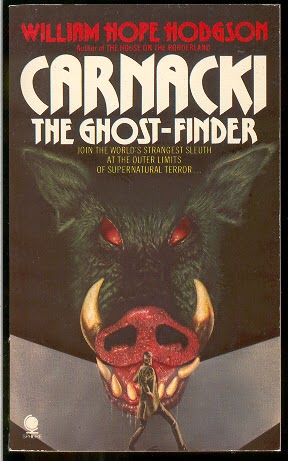
Masters of Terror Volume 1 - William Hope Hodgson

It's interesting that Corgi chose Hodgson for the first in its Masters of Terror series back in 1977. He was out of copyright by then, of course, and one cannot be a paperback master when they still have to pay royalties. Interest in Hodgson had revived earlier in the decade when one of his Carnacki stories was dramatised in Hugh Greene's TV series The Rivals of Sherlock Holmes, but I suspect it was the reappraisal of H P Lovecraft that was going on at the same period which led to this publication, because it was Lovecraft who first described Hodgson as a master.


The introduction is by Peter Tremayne, who can always be counted on to do his homework. OK, he is slightly wrong about the dates of Hodgson's apprenticeship at sea - but I only discovered the real dates thanks to being able to view the actual documents online. Tremayne has seen publications which I haven't but will do now.
He discusses the seven stories and the reasons for their inclusion in short but effective order. 'A Tropical Horror' from 1904 was Hodgson's second published story and his first in the genre he was to make exclusively his own - sea-horror. 'The Voice in the Night' is another such, as is 'The Mystery of the Derelict', which Tremayne considers a classic. The fourth story - 'The Terror of the Water-Tank' - is here because it is one of Hodgson's rare attempts at land-based horror. I'm afraid I found it trivial.
The narrator of 'The Finding of the Graiken', one of Hodgson's Sargasso Mythos stories, was too like the narrator of 'The Terror of the Water-Tank' to hold my attention - a middleclass lightweight who does not personally confront the horror. In that respect Hodgson's most effective form was one he hit upon almost from the start: get the hero to spot the horror in the first few paragraphs, then have him confront it face to face (always supposing the horror has a face) and survive to tell us the tale. That is why, in my opinion, 'The Stone Ship' is my favourite in this collection. I had not come across it before - hadn't even heard of it - but it is classic Hodgson: a young hand spots a mysterious wreck, a search party goes aboard and confronts a truly ghastly horror which is revealed in a spectacularly gruesome manner.
The final story, clumsily called 'The Derelict' and thus easily confused with the earlier story, is included because it combines the sea-horror of Hodgson's early period with the science-fiction otherworldly horror of his masterpiece novel The House on the Borderland and the last, still controversial epic The Night Land.


All in all, then, a great introduction to the signature work of an undervalued writer with a useful and authoritative introduction to point you in the right direction for further exploration.

Sunday, 28 August 2016

The Fall of Troy - Peter Ackroyd


This is a typical Ackroyd confection - a novel that looks and sounds like fictionalised history but actually isn't. You begin by wondering why what is obviously Heinrich Schliemann is called Obermann. Schliemann's young Greek bride was called Sophia, as is Obermann's, albeit the former was Engastromenos whilst the latter is Chrysanthis. Obermann's backstory is the same as Schliemann's - dubious mercantile activities in Russia; a Russian wife. And, obviously, Obermann has excavated the ruins of Hissarlik and is convinced beyond the slightest doubt that he has found the city as described by Homer.

Obermann is physically very different from Schliemann. The real discover of Troy was small and weasel-faced. Obermann is big and athletic, his physical presence as powerful as his belief in Homer's historical accuracy. Schliemann divorced his Russian wife, but one of the key twists of the novel is what Obermann did with his. The big difference, though, is that Schliemann was the discoverer of Troy whereas Obermann's story is specifically the Fall of Troy. The challenges to Obermann's preconceived mental map of Troy and the Trojans spurs him to extreme reactions. As the discrepancies increase they tip Obermann over the edge into primitive, primal behaviour - the sort of behaviour that the evidence suggests the real Trojans indulged in - and thus the book becomes the Fall of Obermann, brought down by Troy.

By changing the names Ackroyd gives himself licence to elaborate on the facts and shape them to suit his story. The challengers to Obermann - the American scholar William Brand and Alexander Thornton of the British Museum - are treated as physical threats, threats to his masculinity. Obermann meets them on terms, but in the end the force of reason wins out.
The Fall of Troy is therefore a book about scholarship, about the manipulation of history, about the idea of hero. What makes it special, the best of Ackroyd's recent novels, is that he uses his themes to enhance and illuminate his characters. Sophia, for example, is the most compelling of Ackroyd's female characters that I have come across. It is she, rather than Obermann, who has stayed in my mind. This is fiction of the highest quality.


I have always been interested in Troy. The Lost Treasures of Troy by Caroline Moorhead (1994) is my favourite non-fiction account of Schleimann's great project.
It is twenty years since I read it, so I won't review it here. Nevertheless I recommend it unreservedly. A quick internet search suggests it may now be called Lost and Found. Such are the perils of a title.

Monday, 22 August 2016

The Psalm Killer - Chris Petit


It's surprising, when you think about it -that the thirty-year 'Troubles' in Northern Ireland haven't spawned their own genre. I mean, the premise has everything - ancient blood feuds, dark deeds in ordinary streets, corruption and double-dealing on a truly epic scale. Perhaps it is still too soon. Perhaps so little of the truth is out there in the public domain that building a fiction on what little we do know seems like a hostage to fortune.
None of this, clearly, deterred Chris Petit, film maker (e.g. the cult Radio On) and occasional crime novelist. Psalm Killer came out in 1996, a year before the Northern Ireland Agreement, and is set mainly a decade earlier with flashbacks to ten years before that. It therefore covers most of the period.

The protagonist is Inspector Cross of the RUC, an Englishman married into the Ulster squirearchy. Petit thus deals with the key obstacle in writing about the Troubles - which side is right and who is the good guy. Cross is an outsider, even to the RUC. His marriage is failing and he has always been a disappointment to the in-laws. He has no real opinions about the situation.  He checks under his car for bombs every morning before leaving for the office. He investigates murders.

Our antagonist, the titular Psalm Killer, is also English, an emotionally crippled soldier who volunteered to serve deep undercover in Northern Ireland. Known only by his codename Candlestick, he first infiltrates the loyalist paramilitaries, then switches to the Republicans. He disappears, ostensibly killed, only to surface again in the mid-Eighties. Unlike Cross, Candlestick does have opinions. He is apparently killing people to draw attention to his beliefs.

This brings us to Petit's central theme, which is the corruption, institutional, moral, political, that kept the Troubles going so long that by 1995 peace seemed to be in nobody's interest. Petit has done tons of research - he provides a long bibliography with useful pointers to what the main sources discuss - and he deploys his discoveries by showing rather than telling. The problem, though, is that to show so much corruption in all its multifaceted glory requires a book of considerable length. At 635 pages in paperback, The Psalm Killer is simply too long, the story so complex that by the time of the final twist - which is a good one - I could no longer remember who the surprise person was.

So, Psalm Killer has its flaws, but there is so much quality here, so much information that no one else has revealed so effectively, that it is well worth seeking out. Petit writes well. He takes the trouble to give his characters back stories and Achilles' heels that go beyond the norm. It is a fine example of a genre that should exist but doesn't. In that sense it not only defines the genre, you could say it is the genre.

I am keen to read more. Robinson, Petit's first novel from 1993, sounds like my cup of tea,