Total Pageviews

Showing posts with label World War I. Show all posts

Friday, 27 February 2026

Peace on the Western Front - Mattia Signorini


 You know you are getting old when you come across a book written by someone too young to know how hackneyed his subject was when you were young.   Admittedly Mattia Signorini is Italian and Italians were not involved on the Western Front but it seems the Christmas Truce of 1914 was news to him when he was hiking in the Italian Alps in 2019.

Now his short novel has been translated into English (beautifully done by Vicki Satlow) and is seeking the attention of a nation who has had the Christmas Truce rammed down its throat for over a century.   Fortunately, Signorini's approach is different and wonderfully effective.   We begin with an injured veteran returning to Flanders Field with his young son in 1933.   He is German but he tells his  boy the story of an English soldier he came across, not in No Man's Land but in Ploegsteen Forest.

We then switch to the Englishman, William Turner, who has volunteered for the war that will be over by Christmas.   William is searching for meaning in life by keeping a promise he made to his dying mother to do something to help other people.   Like everyone else in this volunteer army he is lost.   Fortunately he soon makes friends with Edgar Martin, another misfit, who hopes to make a career in the army - anything being better than the wretched hand to mouth existence which was all he'd known in England.

The whole story is compressed into the single month of December 1914.   The misery and horror is all there yet friendship and fellowship somehow rise above it.   Both William and Edgar are wounded in that period yet both are back on the frontline before Christmas.   The end is not the football match but what happens immediately after, when William walks towards the German Line.   What actually happens to him is left ambiguous, the highpoint of an extremely effective novel.   Highly recommended.

Friday, 5 September 2025

In Flanders Field - Leon Wolff


 Wolff (1914-91) was an American author who only wrote four books, of which In Flanders Field (1958) was by far the most important internationally.   It set in stone the image of Earl Haig's incompetence during the Allied campaign of 1917 - "The greatest and most futile slaughter in modern times", like it says on the cover blurb.

Wolff is no academic.   His account is down-to-earth, detailed and brutally factual.   The notes and sources are here, as they should be, but relegated to the end so as not to interfere with the journalistic narrative.   The literature review, with which most of us begin, is in the last chapter, which is about what happened to the main characters next.   Usually I would shy away from that sort of epilogue but Wolff makes it eminently worthwhile as a means of highlighting Haig's fate.   He got his earldom and a grant; otherwise he was ostracised from the corridors of power.

To show how powerful and important this book is, not just to academics and students but to anyone who cares about the issues of war, this is how Wolff handles the conclusion of hostilities:

It had meant nothing, solved nothing, and proved nothing; and in so doing had killed 8,538,315 men and variously wounded 21,219,452.   Of 7,750,919 others taken prisoner or missing, well over a million were later presumed dead; thus the total deaths (not counting civilians) approach ten million.   The moral and mental defects of the leaders of the human race had been demonstrated with some exactitude.

Wednesday, 20 March 2024

Life Class - Pat Barker


 Life Class is the first of Barker's second World War I trilogy, as far as I know unnamed, the follow-up or complement of the award-winning Regeneration Trilogy.   Regeneration told us things we really didn't know about the war, in particular the never-discussed subject of the jitters, shell-shock, or PTSD as it is called today.   It had its real-life heroes - Owen and Sassoon - mixed with fictional characters.   It also gave us a meaningful woman's take on the situation through the nurses at Craigavon Hospital where traumatized soldiers were given ground-breaking experimental treatment.

The second trilogy is about art students at London's Slade School.   Here some of the real-life people are flimsily disguised.   You don't need a post-graduate degree from the Courtauld to recognise Kit Neville as the flawed and brilliant Christopher Nevin.   In fact you don't need much background knowledge to know all this stuff.   It's common knowledge, entry-level stuff.   I quite liked Toby's Room, the second in the trilogy, because the loss of a young life was beautifully and insightfully done.   I'm afraid Life Class is more cliched than insightful.   The real people were much more interesting, though it's far too early in the war to get too involved with the one who interests me most, the surgeon-turned-art-tutor Henry Tonks.

The thing about World War I is that it was a complete waste of time.   Hundreds of thousands of young lives were squandered in horrific circumstances.   Barker tries to describe the horror by setting all of the war action in a field hospital.   Unfortunately her key character, Paul Tarrant, just isn't interesting enough to take us into the heart of darkness.   He blocks it out and so, I'm afraid, do we.

Nothing by Pat Barker can ever be bad.   She is a magnificent writer but not always the best deviser of stories.   Regeneration was brilliant and terrifying.   The Silence of the Girls is, to my mind, far and away the best of the recent feminist takes on Greek myth.   Life Class is not quite as good.

Monday, 30 August 2021

Abraham Lincoln - John Drinkwater


Abraham Lincoln is the play that made John Drinkwater famous on both sides of the Atlantic.  He produced it at Birmingham Repertory Theatre, which he ran, in October 1918.  It then transferred to London and became an enormous hit, even though - as everyone said at the time - it had none of the usual attributes of commercial theatrical success.  There is no love interest, no jokes.  Any real conflict is either offstage or internal until the very last moment.  There are no surprises.  Barely any continuity.  Instead we jump from Lincoln at home, accepting nomination, to the White House a year later,  then two years later, then Appomattox, April 1865, and finally Ford's Theatre, a few evenings later.

What the play had, however, and what the English public desperately wanted to see as the world's worst war finally ended, was a moral hero who justified the bloodshed and pledged reconciliation.  This, of course, is not what Allied politicians ultimately delivered, but it was absolutely what the public wanted.  And it is beautifully done.  Drinkwater was a minor Georgian poet who dabbled in verse drama before he wrote Lincoln.  He was also a man of the theatre.  His father had walked out on a secure teaching job to go on the stage.  Drinkwater himself had been with Barry Jackson, who had founded and built the Birmingham Rep in 1913, for more than a decade.  He knew what the public wanted and he provided it.

The history is accurate enough, but it is revealed subtly and only when absolutely needed.  Nobody's character develops much except for Lincoln, who undergoes every bit of suffering during the bloody Civil War but keeps on going because do so is the right thing.  He frees the slaves.  He lets the defeated Confederate cavalry keep their horses to till the land.  And as we all know, for this he was shown no mercy.  The assassination, which we all know is coming, is handled in the only way it can still be shocking - in a true coup de theatre, which must have been a nightmare to stage (Barry Jackson himself designed the sets).

Traces of the conventions of the English Arts Theatre movement survive in the poetic chorus of two 'chroniclers'.  These are easily ignored for the modern reader.  We will simply say, this is why Drinkwater was the least successful of the core Georgian poets.  He made up for it by being a much better playwright than any other (and, for those who don't know, all the others wrote plays).

Tuesday, 19 January 2021

The Haunting of H G Wells - Robert Masello


A fantasy adventure featuring HG versus the nefarious Hun in World War I.  The great man has embarked on his latest and greatest affair with Rebecca West when Churchill invites him to visit the trenches to write some morale-boosting pieces for the Home Front.  This leads to the haunting and a facet of trench life which I didn't know existed but probably did.  Meanwhile Rebecca visits the London home of the satanic Aleister Crowley who is sheltering the said Hun.  This leads to a showdown in St Paul's cathedral.

Masello writes in a well-practised style, easy and pacey, albeit I would have liked a touch more artistry.  What he does really well is keep the fantasy on the right side of credibility.  Overall, great fun. 

Monday, 11 November 2019

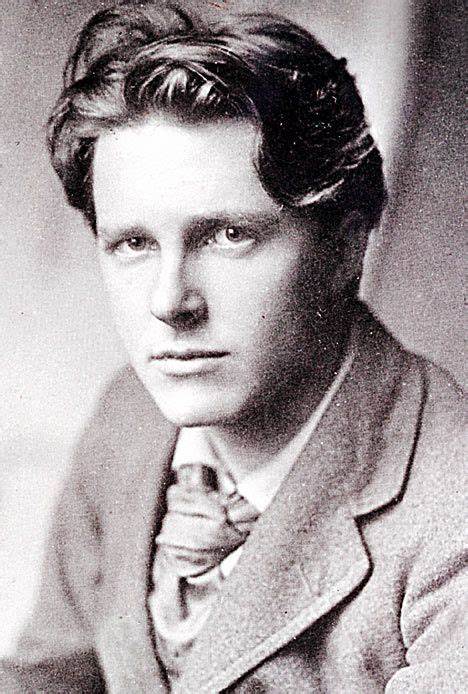
Rupert Brooke, His Life and Legend - John Lehmann

I have been reading a lot about Rupert Brooke lately, in connection with a couple of personal projects of which, hopefully, more later. There are a fair few works on Brooke but the vast majority suffer from an obvious problem - length. Brooke was astonishingly busy, he wrote a lot from an early age, he had an enormous social circle and he travelled the world. But even so, he was only 27 when he died, and you simply can't justify 500+ pages for a life that short.


John Lehmann (1907-87) came of an astonishingly intellectual and creative family. His sister Rosamund was a novelist, his sister Beatrix a highly-celebrated actress. John was a poet and publisher. He founded New Writing in 1936, became a managing director of the Hogarth Press in 1938 and founded his own firm, John Lehmann Limited, in 1946. Finally, in 1954, he started The London Magazine. It's all very close-knit, a bit incestuous, and a bit artsy-craftsy. Which made him the perfect author for a critical biography of Rupert Brooke, who was a beneficiary and part-creator of similar arrangements before his ludicrous death in 1915. Best of all, Lehmann can do in 170 pages what Brooke's other biographers can't manage in several hundred pages. He brings Brooke alive in all his contradictory aspects - obsessed with women but offensively dismissive when the mood takes him; flirting with homosexuality but keeping his patron Eddie Marsh, who worshiped him, at a very resolute arm's length; globetrotting but always trying to micromanage his English friends. He was not a nice man but he was extraordinarily beautiful. He was a talented poet, more gifted than most in his day but did not live long enough to become truly great. And, as Lehmann says, he has been abandoned by the lirerary world which prostrated itself before his metaphorical shrine in 1915, in favour of those who came shortly after him and who lived long enough to experience the true horror of mechanized war: Sassoon, Owen and Graves.

Lehmann treats Brooke's service in a respectful and fair manner. Brooke was a volunteer, as everyone was in 1914. He did not ask Marsh, who was Churchill's secretary, to get him a safe billet in the Royal Navy Voluntary Reserve and it soon proved not to be particularly safe. Lehmann is better than most is describing Brooke's single experience of being under fire, in the long-forgotten farce of the British attempt to relieve the German siege of Antwerp. And let us not forget that Brooke was en route for the Dardanelles and the mass slaughter of Gallipoli when sunstroke did for him.

For anyone wanting to dip their toe into Brooke studies and come away with solid facts and a sound appraisal of his achievements, I cannot recommend Lehmann too highly.


Sunday, 15 September 2019

The Secret Rooms - Catherine Bailey


This is a captivating and unusual book. Bailey was granted access to the extensive archive of the Manners family, kept at Belvoir Castle in Leicestershire, home of the Duke of Rutland. Her aim was to research a book on the men of the Belvoir Estate during World War I. The current duke's great grandfather, Henry, had been a noted recruiter of volunteers for the Leicestershire Tigers. He had even offered to pay their usual wages while they were away.

On arrival she discovered the mystery of the secret rooms. This is where Henry's son John, the ninth duke had died in April 1940, aged only 53. More than that, he had locked himself in these humble 'business' rooms - excluding his family and some of the best doctors in the land - in order to work on the vast family archive. Moreover, it wasn't just the Manners papers that were stored there in 1940. The ninth duke had campaigned hard to ensure that huge chunks of the National Archive were secretly moved to Belvoir for safe keeping.

John himself had served in the First War. His father Henry had boasted that his own son - his only remaining son - was serving at the Front like the humblest farm hand. But Bailey soon discovered that the archives had been systematically edited - filleted by John - to remove all mention of certain periods in his life, including the latter part of his war service. Why? And who on Earth broke into the sealed rooms three nights after John's death?

As I say, it is a compelling story of arrogance, cowardice, bereavement and entitlement. Bailey builds the key characters as well as any novelist. Yet she is equally diligent in recording the problems of archival research. She answers the questions she set herself. Some solutions are sad, others downright extraordinary. She doesn't answer the one question I have always had about this truly ghastly family. How did they become dukes in the first place? They weren't warlords, nor royal by-blows. Sure, they owned and amassed inordinate land banks but so did many other families who came over with the Conqueror, and none of them became dukes. Other than pile up - and later lose - unimaginable fortunes, what did any of them ever do?

Monday, 9 September 2019

Biggles Flies East - Captain W E Johns


Biggles Flies East (1935) is the seventh Biggles book, albeit Johns only started to publish them three years earlier. It is, like many of the early installments, a book for young adults rather than merely boys. The plot is complex and there are serious themes. The accurate historical detail, as always with Johns, is laid on good and thick. It is not, however, racist. The Huns are enemies, not crazed loons, and even the nomadic Arabs are portrayed as men of honour. They are, nonetheless, all men. I cannot recall a single female character, let alone a significant one.

Essentially, the plot is this: Biggles is seconded to Palestine where a man known as El Shereef is inciting the locals to rise up against the British. He is sent undercover to the Germans, posing as a British-born German pilot. Here he comes up against the man who is to become his enemy over the coming decades, Erich von Stalhein, whom he soon concludes is another spy. The British equivalent of von Stalhein is Major Sterne, who Biggles glimpses one night as a shadow in a tent.

Meanwhile Biggles's oppo Algy acts as his go-between with Military Intelligence. When Algy comes under fire from the German ace Leffens, Biggles has to save him. The dog-fight which follows is superbly done, genuinely exciting. The plot resolves neatly in the end and all loose ends are tied.

I haven't read Biggles since I was ten years old, though I hoped to dig my old copies out of the attic. Instead I found this brand new reprint by Red Fox on the carousel in my local library. I was very impressed.


Sunday, 18 February 2018

The Razor's Edge - Somerset Maugham

The sharp edge of a razor is hard to pass over; thus the wise say the road to salvation is hard." (Upanishad)


The Razor's Edge (1944) is said to be Maugham's last great novel. It came as a shock to me, who remembers Maugham's death being announced on the BBC News in 1965, to realise that by 1944 he had been a novelist for almost half a century. No wonder then that his prose is beautiful yet simple, utterly devoid of cliche. What is more remarkable is the structure, which borders on the experimental. In the very first section he tells us that this is a novel, based on fact, that will not have a conventional ending. He - Maugham - remains the narrator and makes it very clear that this is a close approximation of the real Maugham and (just once) he is even called Maugham by one of the other characters. Who they really are, beneath the false names he has given them, is neither explained nor hinted at; he tells us we would not know them, they are not famous people.

They are however glamorous people, as Maugham himself was supremely glamorous by that point. He starts just after World War I in America. Maugham is already famous and wealthy enough to roam the world at will.  Through his friend Elliott Templeton, a snobbish, effete American ex-pat, he is introduced to the Bradley family. Mrs Bradley is Elliott's sister, the widow of a middling US diplomat. Her daughter Isabel is a coltish adolescent hopelessly in love with Larry Darrell, who lied about his age to fly in the war. Isabel is doted on by Gray Maturin whose father is a millionaire stock broker. Also present is a younger girl, Sophie Macdonald.

And that is basically it. Maugham narrates his encounters with these people over the next twenty years. He tells us when he is reconstructing conversations and events he only heard about but did not witness. There is a vast amount of travel and a hell of a lot of conversation. Elliott becomes increasingly flamboyant and ridiculous but is always saved by fundamental goodness of heart. Isabel almost marries Larry but ends up marrying Gray, whose fortunes rise and fall with the Crash of '29. Larry almost marries Sophie but doesn't.

So what is it all about? Maugham, of course, witnessed the war and the human damage first hand with the Ambulance Corps. He understands something of the lost generation but is too old and too British to understand the repercussions for the American Dream. This is what he explores. Larry never recovers; he avoids all responsibility, professes no ambition, commercial or academic, but instead wanders the world in menial jobs in the search for 'meaning'. Isabel meanwhile clings to the battered remnants of the Dream like a tigress. Sophie lets it all overwhelm her. In the end, nothing is resolved. Elliott and Sophie die, Gray gets back into business, and Larry vanishes, his quest unresolved. Maugham is the only one left in Europe.

One key section towards the end is an interminable evening in a French cafe in which Larry tells Maugham about his time spent on the ashram of an Indian mystic. This is in fact Maugham's own story. It was he who really visited the ashram of the enlightened guru Sri Ramana Maharshi. Did he find meaning or peace? He doesn't say. This is a novel, not autobiography. And it is a wonderful novel, surely a Twentieth Century classic. It encompasses that quest for meaning in the face of mechanized war and unrestrained capitalism which was surely the driving force of all art in the last century.

Friday, 7 October 2016

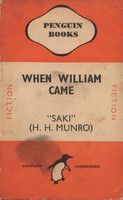
When William Came - Saki


Saki (H H Munro) is best known for mordant short stories like 'Gabriel-Ernest' and 'Sredni Vashtar'. Indeed, I hadn't realised he had written any novels. In fact there are three novels of which this is the third, published in 1913.


The date says it all - the eve of World War I, the last glorious summer of imperial peace and prosperity. But in Saki's world the titular William is Kaiser Bill and Great Britain has been annexed to the Hohenzollern Empire almost by accident. The German navy and air-ships were just too advanced. Rather than resist, the king abdicated and went into exile in his personal empire of India. It was not so much an invasion as a fait accompli.


Obviously everyone in 1913 was aware that war with Germany was a possibility. Invasion literature was incredibly popular. H G Wells published The War in the Air in 1908 and William le Queux had been knocking them out since 1894. But Saki's twist is to make the invasion bloodless, thus leaving him free to be witty and, in the scenes relating to Gorla Mustelford's debut as a 'suggestive dancer'. downright hilarious.


The story is set in the first full London season since the fait accompli. Society has moved on - or perhaps remained unmoved. The upper classes have accepted the odd grafin and welcomed Prussian officers with their cheerfully coloured uniforms and resorted to the usual trivial pastimes. Cicely Yeovil is a social fulcrum, with her shiny-haired young men and Gorla's debut to oversee. So it's all a bit of nuisance when her husband Murrey shows up.


Murrey is a man who travels to stave off the boredom. When William came, Murrey was battling fever in a Finnish hospital. When he heard about the fait accompli he assumed it was a product of his fevered imagination. Now back in London, he cannot accept it. He toys with the notion of heading off to the court in exile in Delhi - either that or taking up the mastership of the hunt down in Wessex.


Saki, at heart the short story master, does not hammer out a plot. The story is more that of the various participants. Gorla's debut is counted a success and the next social highlight is a march-past of the massed ranks of Boy Scouts in the Mall - which is where Saki springs his surprise.


It's a superlative twist, the last thing I expected, both amusing and moving.


Of the author's own attitude to the German threat we need be in no doubt. When war came Hector Hugh Monro was 44 years old. He nevertheless enlisted and served on the front until he was killed by a sniper in November 1916. So he is a hero and a writer of consummate skill. He deserves be better remembered.

Tuesday, 2 August 2016

Noonday - Pat Barker


Noonday is the concluding part of Barker's second wartime trilogy (unlike the Regeneration Trilogy, it doesn't seem to have a name), which interestingly carries the characters forward from WWI to WW2, specifically 1940 and the London Blitz.


I have said before, in my review of Toby's Room, that this trilogy is not as good as Regeneration, albeit the premise is much the same - artists at war are subjected to pioneering medical treatments. The difference is that Regeneration is about poets, many of whom we have heard of, having their traumatised souls put back together in a North Country sanatorium; this second sequence is about painters and plastic surgery and is set primarily in bohemian London, which makes it all a bit precious. Another shortcoming is that the characters are not real people but heavily and obviously based on real people, which is distracting for those of us who can guess. And, unfortunately, the central character in the latter is a woman, Elinor. In Toby's Room, therefore, credibility is stretched to get her into the hospital where Kit Neville is having his face restored.The truth is, society women played virtually no meaningful role in WWI. Some indeed did a bit of nursing but mostly it was just good works and posturing. Things were different in WWII and that makes Noonday a much better book than Toby's Room. Elinor, her husband Paul, and the disfigured Kit Neville are all actively engaged on the Home Front, Paul an ARP warden, Elinor and Kit both driving ambulances. They are all now in their Forties, facing the same middleaged crises we all face, only heightened by the very real prospect of being blown to smithereens at any moment.


Barker is a fantastic writer and there are moments of great beauty here. There is a moment towards the end when Kit and Elinor wave to one another across a firestorm which is truly heartbreaking. I also really enjoyed the skewering of Kenneth Clark, long before his Civilisation fame, recruiting war artists from his personal coterie and chasing after young girls.


[Also reviewed on this blog]

Sunday, 14 February 2016

Toby's Room - Pat Barker

It's a follow-up to Life Class, apparently, but it is, inescapably, an offshoot of the magnificent Regeneration Trilogy which made Barker's name and won her the Booker Prize.


The trilogy was about World War I, poetry and mental illness.  Toby's Room is about World War I, painting, and facial disfigurement.  The art school chums who met at the Slade in Life Class are now exposed to the full horror of mechanised warfare.  Kit Neville, the Christopher Nevinson clone, has his face blown off in France and is brought home to Queen Mary's Hospital in Sidcup where the plastic surgery pioneer Harold Gillies does his best to make the facially disfigured acceptable and 'Harry' Tonks, professor at the Slade, draws meticulous records of the process.  Gillies and Tonks are obviously real whereas the 'students' are thinly fictionalised.  The Bloomsbury Set make a brief cameo appearance - notably and memorably Lady Ottoline Morrell.

The titular Toby is Toby Brooke, brother of the artist Elinor.  They are very close - too close, indeed. Toby goes to war as a doctor and is posted missing, presumed dead.  Elinor feels compelled to find out the truth.  Neville was a stretcher bearer in Toby's unit.  Elinor contacts him through fellow student Paul Tarrant, himself invalided out of the front line.  They visit Neville at St Mary's where Elinor is recruited by Tonks to assist with his "Rogue's Gallery".

The problem is, the book is in two distinct halves - pre-war and towards the end of the war.  It may well be that Life Class forced this structure onto Toby's Room.  I don't know but will certainly find out. It makes Toby's Room, as a standalone novel, clumsy and disjointed.  The characterisation is, nevertheless, excellent, especially with Neville himself, who is far more interesting than our apparent heroine.  And the writing, as always with Barker, is exquisite.

Not perfect, then, but a fascinating addition to the canon.

Tuesday, 29 April 2014

They Called It Passchendaele - Lyn Macdonald


The early engagements of the BBC's battle to bore us to death with a four-year wallow in World War I ironically inspired me to tackle a trio of Lyn Macdonald's book that have been sitting on my shelf for the thick end of twenty years.

Originally written to coincide with the sixtieth anniversary, Macdonald's series were groundbreaking in that they focused on the ordinary mugs who risked and indeed sacrificed their lives for this pointless last hurrah of European imperialism.  I should stress that it's me, not Macdonald, who calls it pointless.  She, wisely, lets the men speak for themselves, only narrating events in order to give their personal accounts context.  And the horrors described by those who were actually there - and, almost by definition, survived - screams the futility of it all.  Obviously I began with Passchendaele which, shamefully, I didn't even know was the third battle of Ypres.  Just before starting I tried to look up the military records of my great uncle Bill, who lost his leg in the war - I didn't know when or where, and only met him a few times as a young boy.  But it turned out the regiment he was most likely to have joined, the East Lancashire, was here at Passchendaele,  Their 'southern' officer, Paddy King, is one of Macdonald's main memorialists, and she even includes a verse of their regimental  marching song, which I found tremendously evocative:

"We are the Burnley Mashers/When we go out at neet/The lasses all admire us/and think we look a treat."

Touching, appalling, horrifying - a fitting memorial to those who fought.