Total Pageviews

Showing posts with label play. Show all posts

Saturday, 22 April 2023

To Have the Honour - A A Milne


 You see the name A A Milne, you think Pooh, you perhaps think Toad of Toad Hall.   You almost certainly don't think witty grown-up West End comedies, yet it was as a playwright that Milne made his name and, no doubt, much of his money.

To Have the Honour was premiered at Wyndham's in the autumn of 1924, produced by and starring Sir Gerald du Maurier,, manager of Wyndham's and father of Daphne.   Du Maurier, in his fiftieth year, plays a matinee idol Balkan prince who finds himself a weekend guest in English surbubia and who turns out to be not or who he seems to be.

The plot is paper-thin but that doesn't matter.   This is a comedy of manners and, most interestingly, an exploration of assumed identity, the face we put on to both impress our peers and to cover own insecurities.

Angela Battersby has met Prince Michael in Monte Carlo, as you do, and has invited him to drop in at her father's house in leafy Wych Trentham if he happens to be in the area.    So he does.  Angela hurriedly scrapes together a dinner party of friends she thinks will be impressed.   But one of them recognises the imposter.   This moment, the exact midpoint of the play, is a total reversal of our expectations.   Far from exposing the fraud, the one in the know turns out to be another fraud and together they plot their way out of the situation.   They also turn out to be married to one another, a plot twist that should be preposterous and yet, with Milne's exquisite touch, seems unremarkable.

JenniferBulger, the wife the fake prince deserted, is content with her life as a non-existant general's widow in Wych Trentham, so Prince Michael - plain Michael Brown - has to make his excuses and leave.  He doesn't want to - he wants to be with Jennifer again - and so builds another fake story to explain the first.   It unravels in Act Three but still contrives to end happily.

Could To Have the Honour be successfully revived today?  I think so.   The issues - outward show, royalty in the modern monarchy, even a hint of Post Traumatic Stress Disorder - are all relevant, and Milne is not as mannered as Coward.   In its way it is of-its-time as a Restoration Comedy and could be revived simply as an excellent period piece.

Monday, 30 August 2021

Abraham Lincoln - John Drinkwater


Abraham Lincoln is the play that made John Drinkwater famous on both sides of the Atlantic.  He produced it at Birmingham Repertory Theatre, which he ran, in October 1918.  It then transferred to London and became an enormous hit, even though - as everyone said at the time - it had none of the usual attributes of commercial theatrical success.  There is no love interest, no jokes.  Any real conflict is either offstage or internal until the very last moment.  There are no surprises.  Barely any continuity.  Instead we jump from Lincoln at home, accepting nomination, to the White House a year later,  then two years later, then Appomattox, April 1865, and finally Ford's Theatre, a few evenings later.

What the play had, however, and what the English public desperately wanted to see as the world's worst war finally ended, was a moral hero who justified the bloodshed and pledged reconciliation.  This, of course, is not what Allied politicians ultimately delivered, but it was absolutely what the public wanted.  And it is beautifully done.  Drinkwater was a minor Georgian poet who dabbled in verse drama before he wrote Lincoln.  He was also a man of the theatre.  His father had walked out on a secure teaching job to go on the stage.  Drinkwater himself had been with Barry Jackson, who had founded and built the Birmingham Rep in 1913, for more than a decade.  He knew what the public wanted and he provided it.

The history is accurate enough, but it is revealed subtly and only when absolutely needed.  Nobody's character develops much except for Lincoln, who undergoes every bit of suffering during the bloody Civil War but keeps on going because do so is the right thing.  He frees the slaves.  He lets the defeated Confederate cavalry keep their horses to till the land.  And as we all know, for this he was shown no mercy.  The assassination, which we all know is coming, is handled in the only way it can still be shocking - in a true coup de theatre, which must have been a nightmare to stage (Barry Jackson himself designed the sets).

Traces of the conventions of the English Arts Theatre movement survive in the poetic chorus of two 'chroniclers'.  These are easily ignored for the modern reader.  We will simply say, this is why Drinkwater was the least successful of the core Georgian poets.  He made up for it by being a much better playwright than any other (and, for those who don't know, all the others wrote plays).

Tuesday, 23 June 2020

Three Political Plays - Michael Hastings

Michael Hastings was the enfant terrible of the Angry Young Men. Look how young he was when his first plays were produced. He was always political and had a lifetime fascination with Africa. I remember watching his TV epic, The Search for the Nile, several times, and on the basis of that I bought his first collection of published plays when I was still at school.

This Penguin collection brings together three of his most overtly political plays. In chronological order, Lee Harvey Oswald was first staged in 1966, two years after the Warren Commission published its transcripts and report, deciding that Oswald was the lone shooter of President Kennedy in Dallas in November 1963. It is essentially a documentary drama, with the Commission members, combined in one body, questioning its best two witnesses - Oswald's batty mother Marguerite and his terribly young Russian widow Marina. They act out their relevant remembrances of Lee as he goes progressively off the rails. Hastings does not throw into question Lee's guilt, though he does mention a few anomalies. He is much more interested in the question of context - what was it that so radicalised the assassin?

For the West is a study of the crazed dictator Idi Amin, written ten years after Oswald but still while Hastings was under forty and while Amin was still propped up in pretend power by those who pulled his strings. It is good, but not as good as Oswald. As a character Idi is less compelling than Lee. I suppose the problem is, Idi was always going to fall one way or another. Lee is the man who stopped us finding out what kind of president Kennedy could have become in a second term.

The Emperor is a dramatization of Ryszard Kapusccinski's long-form journalistic account of Haile Selassie's fall, which I reviewed a year or two back on this blog. The problem here is that there is nothing to dramatize, or at least nothing that benefits from dramatization. The key to the book is that we hear the testimony from real people who worked as part of the imperial household. They know it is all sham, they know they look ridiculous to the outside world, but these are the best of all possible jobs in a land bled dry. The other thing is that all reported the Emperor as a silent figure into whom his subjects could read whatever they wanted. The play isn't helped by the typical Jonathan Miller production device (Miller is given a co-writer credit, though what he could possibly have added is beyond me) of a handful of actors acting the parts and playing silly buggers with doors and windows. The sort of rubbish that was considered cutting edge in 1987 but led to the total extinction of serious straight plays in the commercial theatre.


Monday, 14 October 2019

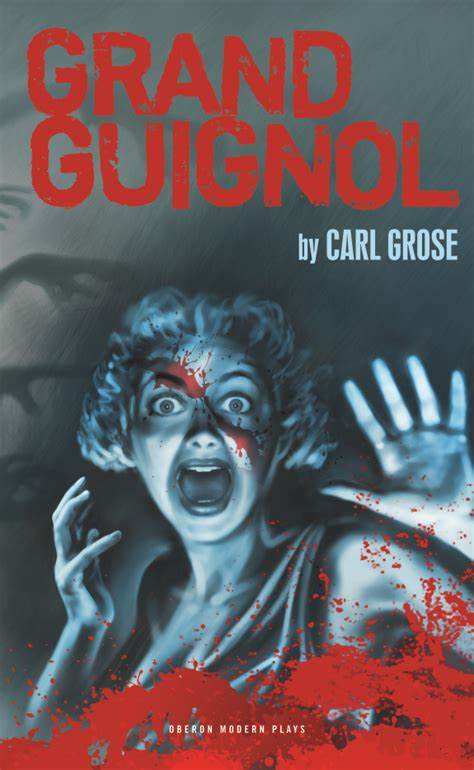
Grand Guignol - Carl Grose


Grand Guignol  is a play. Not a Grand Guignol play but a play about Grand Guignol, specifically the creation of the form in the Parisian theatre of that name around 1900. It starts with a performance of such a play which causes the celebrated physiologist Alfred Binet, the inventor of intelligence testing, to intervene. He simply cannot contain himself and leaps up onstage, breaking the illusion. He gets introduced to the Prince of Terror, Andre de Lorde, otherwise a shy, unassuming librarian and they start to collaborate. Ultimately they conceive the most outrageous of classic Grand Guignol (certainly in England), Crime in a Madhouse. 

The performance switches between actual performance and the actors who are doing the performance. Everything we need to know about Grand Guignol in order to follow the action is provided. It is more or less accurate - Grose in his acknowledgements cites the best known authorities on the form, Mel Gordon, Richard Hand and Michael Wilson. There is what I felt was an unnecessary subplot and one rather clumsy in-joke. Other than that, the play is great fun and I would love to see it live.


Grand Guignol was first performed in The Drum at the Theatre Royal Plymouth on October 29 2009.


Sunday, 29 September 2019

Tales From Hollywood - Christopher Hampton


This 1983 play is about the emigre German writers who found refuge from the Nazis in Hollywood: Brecht, for example, but mainly the Mann brothers, Thomas and Heinrich. Heinrich was the elder brother and was famous for his novels before Thomas but who was then eclipsed by his more conservative, deeper thinking sibling. By the time war breaks out both are in Hollywood but only Heinrich is reliant on Hollywood. Thomas tours universities and is tipped for the Nobel prize; Heinrich is spendthrift, bibulous and has a younger, lower-class wife, Nelly.

Our guide to this inversion of the Hollywood Dream is the Hungarian playwright Odon von Horvath, who is himself a dream in this story, given that he was killed by a falling tree in the Champs d'Elysees in 1938. But here he befriends Heinrich, pays reverence to Thomas, and responds a little too readily to Nelly's drunken flirting. The play ends badly for Nelly but not for Horvath, because he is already dead and finally, symbolically, realises it.

Hampton is one of the best writers of plays in English of the later Twentieth Century. In the Eighties it was basically between him and Stoppard, and after 1990 neither of them has written anywhere near enough. Both wear their book-learning as a badge of authority and neither has reflected deeply enough on the human condition, having both been successful from an early age. That does rather show in Tales From Hollywood.

What is it about? Displacement? Thomas Mann was permanently displaced; he wrote the bulk of his work outside Germany. Brecht wrote masterpieces like Galileo in exile and Heinrich's fame had already faded by 1940. Hovath, the child of an empire that had vanished during his lifetime, was a resident of nowhere - literally, in the context of the play. The only real displacement here is Nelly, who caught the roving eye of the man who thought up The Blue Angel and rose above her station. Tales of Hollywood is not about the writers who have no tales to tell about Hollywood, but about Nelly, who came to Hollywood with no dreams left and already out of place.

The famous writers are slightly two-dimensional, apart from our narrator, Hovath. He is a fantastic character and the best actors must yearn to play him: witty, self-deprecating, omniscient, playful, charming. And Nelly... a dream part, surely, for an actress just entering middle age. At the National Theatre in 1983 she was played by Billie Whitelaw. Casting that says it all.

Wednesday, 7 August 2019

Murmuring Judges - David Hare


The second in David Hare's state of the nation trilogy, Murmuring Judges is, as the title suggests, an examination of the state of the legal system and what, in legal terms, counts as a win. The play was first staged in 1991 and it's disappointing how little has changed. Indeed - the question is unavoidable - can it change? In a combative system there can only be winners and losers, and one of the upsides of criminal law is that there are no grey areas. Having just written that last clause, I'm asking myself if it needs qualification. There should be no grey areas - you are either guilty or you are not. The intractable problem of the legal profession where everyone from beat constable to Lord Chief Justice keeps a scorecard is that grey areas are too often made out to be black or white.

Gerard gets five years, which seems a bit unfair. He was only a peripheral player in the crime and has no previous. But still his barrister, Sir Peter, can live with it. It was, after all, only a Legal Aid case. Not the sort of thing he would usually tackle. So Gerard is a new prisoner and Sir Peter has a new pupil, Irina. She's very bright, of course; she's also black and beautiful. She looks good on Sir Peter's arm for an evening at the opera. Trouble is, she's interested in Gerard's case. She recognises the unfairness of the sentence and is concerned about something the main police witness said.

The witness is Barry, who has a reputation for closing cases. His girlfriend Sandra is also concerned about Gerard's sentence. She was present on the arrests and noticed something odd in the way Barry treated the senior, more hardcore criminals.

The scale is panoramic - something that could only really be staged by a massive, publicly-funded theatre company. There are lots of characters and lots of subplots. You can almost see Hare plotting his thesis on a huge whiteboard. And it's very, very good. In the end Gerard wins his appeal and gets six months reduction in sentence. So everyone's a winner - except Lady Justice.


I had forgotten how good David Hare can be. I followed him when we were both young and still have most of his plays from those years. He went upmarket in the Eighties whereas I became much more political, and I ceased to pay attention. I have, however, seen his more recent TV films and found much to be enjoyed. Clearly I have catching up to do.

Thursday, 14 December 2017

Tyger - Adrian Mitchell


Tyger is a celebration of William Blake written for the National Theatre in 1971. Note that word 'celebration'. In no sense is this a play but it is theatrical and it certainly is celebratory. Mitchell is still mired in that period of reverential obscurity that follows death. He is not thought good or bad because he is not thought about at all. Mitchell was such a poet of his time - the Sixties - that one wonders what the next generation will make of him. Those of us who remember the era (OK, the Seventies was more my era but I knew who Mitchell was long before I read the original reviews of Tyger) will recognise it here, with the added bonus of hefty slices of Blake's lesser known poetry.


The problem with the text is that this was very much a musical, with tunes by Mitchell's regular collaborator, the jazz musician Mike Westbrook. Much of the dialogue and the vast majority of the poetry was intended to be sung. Without the tunes, what can we make of the words? In truth, not a lot.


The style is Ubuesque. Blake starts attacking the establishment and ends up being exiled to the moon where he starts to build his New Jerusalem. Inbetween there are some very funny spy interludes and a hilarious turn by Mad King George the Fifty. There is also a toe-curlingly awful sketch in which great poets of the past and present salute Blake's achievement in comic verse. It's a rag-bag but one which is constantly inventive, persistently off-beam and thoroughly subversive, much like its hero. A monument to its day, which I don't see being revived anytime soon.