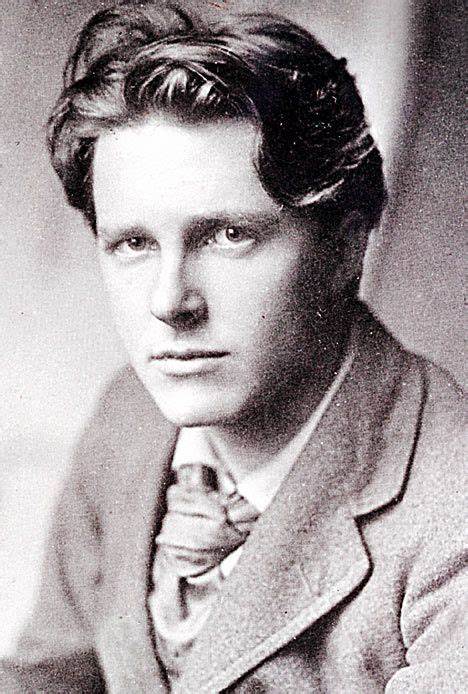
By far the best take on this unique event. In August 1914, just as the western part of World War I was beginning, a group of poets came together in a cluster of Gloucestershire villages. Some came and went, others lived there anyway, and another couple stayed just for the month. Those that had families brought them with them. The ostensible purpose, of four of them at least, was to oversee the poetry journal they had set up. The gathering is important because the fourth and final issue of New Numbers, published the following spring, contained Rupert Brooke's war poems including 'The Soldier' which was to make him, for one week only, the most famous living poet in the world and thereafter the most successful poet that has probably ever lived. His royalties, which he left to Walter de la Mare (who wasn't at Dymock) and Lascelles Abercrombie and Wilfrid Wilson Gibson, who both lived there, funded them for the rest of their lives and, even though Btooke has been dead 111 years now and is long out of copyright, the interest on his bequest may still be funding poets today.
The fourth New Numbers poet was John Drinkwater. He was a middling poet at best and didn't need Brooke's monetary support. He had a day job as director of the Birmingham Repertory Theatre, the first purpose-built repertory theatre in the world, funded by Birmingham millionaire Barry Jackson. In 1918 Drinkwater would hit the bigtime with his play Abraham Lincoln, a massive success on both sides of the Atlantic. Street covers this in his book, which is fair enough, because all the Dymock poets wrote plays - and the famous poet who lived close by, John Masefield, had broken through as a playwright before jump-starting the revival of popular English poetry with The Everlasting Mercy (actually set in one of the 'Dymock' villages) in 1911.
That village was Ledbury, where Masefield was born and where the other wing of the Dymock poets were to be found in August 1914. One wasn't English, the other wasn't yet a poet, and Street rightly gives a significant amount of scrutiny to their side of the story. Robert Frost and Edward Thomas were much older, rising forty. Frost, later the 'American Poet Laureate' who recited at Kennedy's inauguration (Masefield, of course was the English one at the time), hadn't broken through in his homeland. So in 1912 he moved his family to England, initially settling in a bungalow in Beaconsfield. In London he met the poets who gravitated to the Poetry Bookshop in Bloomsbury. Frost attended the opening; Gibson was actually living above the shop at the time. Initially Frost was swept up by his compatriot Ezra Pound, but Imagism was not Frost's style and he soon moved on to Gibson, and through Gibson, Abercrombie. Abercrombie was already living in Dymock (technically Ryton). Gibson, Abercrombie, Drinkwater and Brooke were all heavily featured in the first Georgian Anthology (1913), an enormous success which funded the bookshop for the next twenty years. Because the editor, Edward Marsh, chose to publish his contributors alphabetically Abercrombie came first and the other three were all well to the front and thus more likely to be read. Gibson, who had been publishing for almost twenty years by this point, was independently breaking through in America.
Ar the end of 1912 Gibson got married. His American earnings enabled him to move out of his room above the bookshop, and he naturally chose to rent near his friend Abercrombie (who had been able to rent in Ryton because his sister had married the lord of the manor). In 1914 Frost, who had managed to publish two books of verse, joined them, only a mile or so across the fields in Ledbury. In October 1913 Frost had met the leading poetry critic of the day, Edward Thomas, who had done wonders for the sales of Gibson, Abercrombie, Brooke, Drinkwater and Frost himself. Thomas, who was profoundly depressed and in danger of breaking down under the pressure of hack journalism, became incredibly close to Frost. He visited Ledbury many times in 1914 and decided to rent a local farmhouse for the whole of August. The Ledbury group mingled with the Dymock group. Thomas's other emotional support, the future children's writer Eleanor Farjeon came for a week or so. And Brooke came down in the hectic weeks between his return from America and enlistment. One evening they were all together in Gibson's home, The Old Nailshop.
Thomas, at this time, had never written a poem, but Farjeon and Frost persuaded him to try. By the time he was killed in action at Arras on April 9 1917 he had written 147 poems and had a collection about to come out. All of this Street manages to cover in 160 pages. Of course there are things that could be developed further - personally I would and shall keep the plays for a separate monograph - but as a reliable, thorough and impeccably sourced account of a fascinating interlude I have not found anything better (and, believe me, I have read dozens).