Total Pageviews

Showing posts with label John le Carre. Show all posts

Saturday, 14 March 2026

The Seventh Floor - David McCloskey


 The critics hail the new le Carre ... and, for once, they're right.  Strictly speaking, at the heart of The Seventh Floor is the old le Carre, as McCloskey freely admits in the acknowledgements at the end.   He takes the essential element of the great Smiley double-tap and, incredibly, makes them better.   No mean feat for only his third novel.

It's the hunt for a suspected mole inside the CIA.   Artemis Proctor is forced out of the Agency after twenty-five years by the incoming directorate.  She finds work wrestling alligators at her cousin's theme park in Florida.  Yes, Proctor is very different from George Smiley; but like him she cannot give up on spycraft.   She knows that any mole has to be one of her own tightknit group in the Russian unit.   Also, one of her team, Sam Joseph, has been taken and tortured by the Russians, having been betrayed by the mole.   On his release (and subsequent retirement) Proctor and Joseph team up to investigate.

To say much more about the plot risks giving too much away.   Suffice to say it is clever, twisty and thoroughly thought through.   I would like to talk about McCloskey's skill as a writer.   His characters are complex and deep.   They all have lives, of a sort, outside spying.   Artemis Proctor is a powerhouse, all the cliches of a debased Bond crammed into a tangle-haired Amazon barely five feet tall.   McCloskey also gives us the Russian side - better-mannered but more ruthless and both willing and able to play the long game.   McCloskey's prose is refined, his dialogue spot-on. 

It came to the denousement and I thought, Wait, there's forty or more pages still to go.   And I thought, oh no, McCloskey's plodding through what happened next, tying up all the loose ends.   Well, I tried to reassure myself, it could be worse.   It could have been a taster from the next in the series...   How wrong I was.   McCloskey was playing with me like a cat with a fatally injured bird.   Yes, ends were tied up.  But what a twist!   Absolutely brilliant.

On the front cover General David Petraeus calls McCloskey "The best contemporary spy novelist", and I'm not inclined to argue wit  h the US commander in Iraq and Afghanistan whose retirement job was as CIA Director.  In other words, the man with the office on the seventh floor at Langley.

Wednesday, 31 December 2025

The Secret Life of John le Carre - Adam Sisman


 I read Sisman's biography when it came out, hotly followed by le Carre's own autobiographical memoir The Pigeon Tunnel, which was obviously meant to eclipse Sisman's work, even though le Carre had co-operated with it and even proof read it.   At le Carre's request Sisman excised the salacious bits on a promise that he could publish a revised, expanded edition once those it would upset had died.

This left Sisman with a problem.   David Cornwell became rich and famous in his early thirties with his pseudonymous debut The Spy Who Came in from the Cold (1963).   For the next half century he continued to produce bestselling novels but lived a deeply dull semi-reclusive life.   The only interesting thing about him in later life were his endless extra-marital affairs.

This raised a secondary problem.   Cornwell/le Carre was a deeply unpleasant person, an untrustworthy friend, an unreliable source of information, a duplicitous philanderer, an egoist with a slightly inflated concept of his own talent (he was extremely good at writing but lacked the humanity necessary for the Nobel Prize he felt was his due).

The Secret Life is a reworking and reconsideration of what was excised from the biography.   Since le Carre died in December 2020 (followed soon after by his second wife Jane) several of the mistresses have come forward.   One, Susan 'Suleika' Dawson, published her own memoir in 2022.   Sisman had contacted them all over the years but because he has a text by Dawson to forensically examine his coverage of that affair far eclipses the others, which seems to me a little unfair.

What most interested me was Sisman's account of working with his subject, who just happened to be the son of a conman, a professional fabricator of truth as a low-level spy and prominent author, afflicted with both priapism and a degree of monomania.   Sisman's account of where his obligations as an unofficial biographer is in itself worth acquiring The Secret Life.

Thursday, 27 April 2023

Judas 62 - Charles Cumming


 I have blogged before about how highly I rate Charles Cumming.   He is by some distance the best British spy novelist, very much the successor to John le Carre.   For me, Judas 62 confirms his status.  I have enjoyed everything I've read by Cumming, which is most of his work, but Judas 62 is so contemporary and so deeply plotted that I think he has hit a new high.

Judas 62 is the successor to Box 88 which I haven't yet read.  Box 88 is a specialist Secret Service operation combating biological weapons.   Lachlan Kite was tapped on the shoulder whilst still a studentt at Edinburgh in the early Nineties; now he is the senior man in London.   It is the summer of 2020 and the pandemic is raging.   News comes through that one of Box's former moles, now living as a retired academic in the States, has been murdered - assassinated, in facr, with Novichock in the same brand of eye medicine I use (AAAGH!).   The victim, Palatnik, was on Putin's Judas list, the traitors to the state greenlit for reprisal killing.   Kite, too, is on that list, at position 62, not as Lachlan Kite but as Peter Galvin, the alias he lived under when, in the long vacation of 1993, he went to Russia to extract their top biological scientist Yuri Aranov, acting on information supplied by the now deceased Evgeny Palatmik.

So we have two stories ingeniously intertwined, the Galvin-Aranov mission of 1993, and Kite's 2020 scheme to entrap the FSB agents responsible for Palatnik's murder.  Aronov, thirty years older but not a day more mature, is to be the bait because the KGB man in backwater Voronezh in '93, Mikhail Gromik, is now the officially retired ex-KGB oligarch living in the United Arab Emirates, secretly in charge of implementing the Judas list.   The proof of that is Galvin's name on the list.  Only Gromik knows who got Aranov out of Russia, but all that Gromik knows about him is the fake name.

As I say, it's brilliantly done - 500 pages that never once flag.   I must get hold of Box 88 and I genuinely can't wait to find out where the series goes next.

Wednesday, 17 August 2022

Silverview - John le Carre


John le Carre's final novel, which his son Nick Cornwell tells us in an afterword sat in a drawer for some time, is in some ways in line with his other late novels - for example, A Legacy of Spies - in that it involves old hands revisiting a past they have tried hard to escape.  In other ways it harks back to his very first novels such as , say, A Murder of Quality; the scale is confined, largely to a small, unspecified seaside town in East Anglia.  To this backwater Julian Lawndsley has fled from his successful City career to open a bookshop.  Here he meets (or is approached by) the amiable, slightly eccentric Edward Avon, long since retired from some sort of development role in Eastern Europe.  Edward's wife Deborah is dying.  She is, apparently, a famous Arabist who worked for some sort of think tank.  It's all very vague.  Oddly, Edward claims to have known Julian's father at public school.  Julian's father was a churchman who renounced God and went on a well-reported dive into debauchery, disgrace, and ultimately penury.  Edward claims to have got in touch with his old friend, offering assistance.  Julian still has his father's collection of letters.  There isn't one from Edward Avon, although there is one which might offer a clue.

Meanwhile Stewart Proctor, Head of Domestic Security, receives an important letter at a safe house in London.  Letters are very old school and thus are the preferred means of communication among old hands.  Edward, for example, persuades Julian to deliver one by hand to a very beautiful old lady whom he meets at the Everyman Cinema in Belsize Park.  He buys the stationery which allows her to write a sealed reply.  On his return to his bookshop he finds a written invitation to supper from Deborah Avon.

I have to say, the whole thing is wonderfully well done.  I have enjoyed several of le Carre's later novels but Silverview may well be the best of them.  I especially liked the last line, from the Avons' daughter Lily to Julian: "And that's the last secret I'll keep from you."  How classy is that?

Tuesday, 21 December 2021

The Secret Pilgrim - John le Carre

Billed as the last of the 'Smiley' novels, The Secret Pilgrim (1990) is actually the story of 'Ned', a Circus spy whose mostly second-division career is built under the aegis of Smiley.  As his career winds down Ned is put in charge of the Sarratt nursery for fledgling agents.  It occurs to him to invite the retired Smiley to give an after dinner speech to the students.  He never really believes that the secretive master will actually come, but he does, and he speaks freely.  But it is Ned's experiences which illustrate Smiley's points.  Thus what we have is an episodic sequence from Ned's career interspersed with commentary and context by Smiley - not at all an easy device to pull off, but Carre, being himself a master, does so without apparent effort.  He also succeeds in making it moving.  Ned, like Smiley, runs spies and interrogates traitors.  For Smiley it was Karla and the ultimate traitor, Bill Haydon; for Ned it is lesser fry - conflicted men and women, culminating in the tremendously sad, tremendously lonely Foreign Office underling Cyril Frewin, whom Ned has to win over and destroy just days before handing in his credentials.

Smiley, too, hands in his credentials.  "It's over," he says, "and so am I. ... Please don't ask me back ever again."  The Cold War has ended, but Smiley and his creator set us up for the new enemy, unfettered capitalism, as deadly to the common interest of mankind as any nuclear bomb.  The best le Carre novel I have read in years.  Genuinely superb.

Friday, 19 June 2020

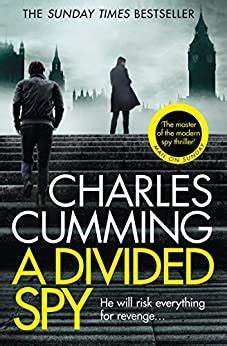
A Divided Spy - Charles Cumming


I've said it before and I'll say it again. Charles Cumming is the new British master of spy fiction. He is comparable with le Carre and Deighton. His range is wider than the former, his writing slightly more refined than the latter. Both octogenarian masters are brilliant constructors of plot and Cumming is near as dammit their equal.

A Divided Spy is the third Thomas Kell novel. It has a sense of ending about it but I am hoping it is just the third of a sub-trilogy within a longer series. It ties up storylines from A Foreign Country and A Colder War (both, of course, reviewed on this blog) and introduces a discrete, highly contemporary story about Islamist terror strikes on UK soil.

What more can I say? It is brilliant, thrilling, a masterpiece of its genre, compulsory reading for aficionados.

Saturday, 9 May 2020

The Honourable Schoolboy - John le Carre


The Honourable Schoolboy (1977) is the middle and least-known of le Carre's Smiley Trilogy of the 70s. Framed by Tinker, Tailor, Soldier, Spy and Smiley's People, it suffers because it has never been adapted for the screen, but it is every bit as good as the novels which bookend it. This is the operation which will define Smiley's tenure as head of the Circus. Trying to untangle the mess inherited from the mole Bill Haydon, Smiley finds the case of Hong Kong tycoon Drake Ko and his brother Nelson, who might be about to defect from China. Unable to know who he might be able to trust in the field, Smiley sends the Circus 'occasional' Jerry Westerby, son of the Press baron (hence the 'Hon') and himself a journalist.

Jerry is the character involved in most of the action here, and very good he is too. On the face of it a lumbering lazy giant, he is in fact fiercely loyal to his personal code of honour and the mentor who recruited him back in the day, George Smiley. Next to Smiley, Jerry Westerby might just be the best le Carre character ever. The novel also benefits from a meaningful female lead, Lizzie Worthington, who hoped to make her looks her fortune in the East but who has ended up something of a courtesan and a drug mule.

Meanwhile Smiley oversees matters from afar (London, until the last couple of chapters) where he negotiates the delicate politics needed to continue the Circus after the scandal. Connie Sachs is back as one of his key advisers, along with the profoundly eccentric Doc de Salis. Peter Guillam is, of course, Smiley's righthand man, and there is a minder, Fawn, who I don't believe ever reappears but who is darkly memorable here.

The book is immensely long (well over 600 pages) and extraordinarily detailed. It's a long time since I read Tinker Tailor and Smiley's People (a good forty years) but I don't remember them being quite this good. I suppose they have now become something of a stereotype for British spy fiction, whereas the Hong Kong setting and Chinese communists are still a rarity. It is, without doubt, a masterpiece of its genre.

Monday, 13 January 2020

Nightfall Berlin - Jack Grimwood

Jack Grimwood is one of several up-and-coming British spy writers. I have reviewed several of Charles Cumming's novels on this blog and rate him second only to the master, John le Carre. Jack Grimwood isn't quite that good but he is not far off.

Grimwood is happy to acknowledge his debt to the master, and does so in the book. His continuing character, Tom Fox, is a brilliant character - a former priest turned undercover assassin for British Intelligence. The setting is the 1980s, with the Iron Curtain starting to rust. Mrs Thatcher is halfway through her reign of terror and Fox's father-in-law is one of her ministers. It is five years or so since Sir Anthony Blunt was unmasked as a traitor. More recently, Peter Wright's Spycatcher claimed there were more Soviet agents in Parliament and the Security Services.

 Nightfall Berlin sends Fox into East Berlin to bring home the ageing defector Sir Cecil Blackburn. Everything is arranged but when Fox calls to collect Blackburn for the final time, he finds the old boy with a crowbar through his chest and his minder, who just happens to be the nephew of the KGB Rezident in Berlin, strangled beside him. Everyone, including Blackburn's girlfriend and his daughter, believes Fox killed them. Worse, back in England, someone abducts Fox's young son and demands Blackburn's memoirs as ransom. Fox doesn't have the memoirs. The papers were burnt in the old man's fireplace.

It's a cracking read. Grimwood is another who has realised the importance of thrills in thrillers. And the final shootout in the Berlin zoo is a whiteknuckle ride. This second in the series is highly recommended. I, meantime, will set about finding the first, Moskova.


Thursday, 19 December 2019

Trinity Six - Charles Cumming


I don't understand why Charles Cumming isn't promoted on the same scale as John le Carre, because he certainly is the frontrunner to inherit the great man's position as number one scribe of British spycraft.

Trinity Six is closer to home than most of Cumming's work, Britain-based, albeit his protagonist, UCL lecturer Sam Gaddis, gets about during the course of his fictional journey. He kind of inherits a project about the much-mooted sixth man of the Thirties communist cell at Trinity College Cambridge. He meets the man in the know (or is he?) and begins his research - only to see a key witness gunned down in front of him, only for Gaddis himself to gun down the assailant.

It seems the British SIS is not the only organisation of its ilk with an interest in suppressing the Sixth Man story. The revelation of why is splendid when it comes. The working out of the plot - a fine example of the biter bitten - is masterly. What is wrong with British TV? Why is nobody snapping up Cumming's work for must-see broadcasting?

Tuesday, 6 August 2019

The Man Who Was George Smiley - Michael Jago

The title says it all. John le Carre admits basing his most famous character on John Bingham, his mentor during his brief time at MI5. Le Carre had to quit when his books became famous, Bingham didn't because the books he had been writing for over a decade had not been so successful. He was a noted author, nevertheless, and lots of people looked forward to the new Bingham novel in the Fifties. Unlike le Carre, Bingham didn't hide behind a pseudonym. Indeed, in his heyday, most people knew he was also Baron Clanmorris in the Irish peerage.


Bingham's ancestors are one of the fascinating elements of the book, especially his useless father Maurice and snobbish mother Leila, who spent much of their married life in seaside boarding houses. Bingham's own children were more successful - his daughter Charlotte was one of the scandalous young female authors of the Swinging Sixties, a big bestseller whilst still in her teens.

Bingham was something of an accidental intelligence officer. He was a newspaper columnist when war broke out and Maxwell Knight took him on. He quickly became Knight's deputy in the war against rightwing Nazi sympathisers in the UK. Knight left the service soon after the war but Bingham kept coming back, serving through the Cold War, the Blunt affair and the Troubles in Northern Ireland. He kept on writing but could not replicate his initial success or get anywhere near le Carre's fame. In truth, he will go down in history as the model for Smiley.

This is an unusual tack for a biographer to take and I must say Michael Jago pulls it off remarkably well. He is particularly good on the umbrage taken by Mrs Bingham/Lady Clanmorris, herself a published writer and performed playwright, who felt it was unfair that her husband's character should be hijacked with no recompense.

An excellent book, thoroughly researched and full of insights into the 'Circus' of the Sixties and Seventies.

Friday, 27 October 2017

Typhoon - Charles Cumming


Typhoon is the fourth of Cumming's post Cold War spy novels. It comes straight after The Spanish Game, which I reviewed earlier this year and was greatly impressed by. It shares some of the same elements - revolutionary terrorism in a forlorn corner of an apathetic nation - but here the nation is China and the minority the Uighurs of Xinjiang province. I have to be honest, I had never heard of the Uighurs, and in a way I guess that's Cumming's point. I also have to admit, I did not love Typhoon.


It's not the theme, setting or essential plot that bothers me - it is certainly not the writing which is as good as Cumming always is - it's the structure. Cumming has chosen two major events of China's emergence into the free market world, the hand-back of Hong Kong in 1997 and the Beijing Olympics in 2008, and decided to link them. The narrative is thus in two halves. This is not in itself a problem. The problem is that nothing thrilling happens in 1997 except the domestic difficulties of spy life, and the first half is therefore far too long. Others might have tried for the same effect through flashback but I don't believe it would have worked any better - probably worse. The problem is there is far too much backstory and it's just not interesting enough. The second half, on the other hand, is almost entirely brilliant, the plot racing along nicely. The end, I'm afraid, is a bit of a dud, sadly underwritten. Cumming cuts away from the action too soon. He has already given the game away in fact, in an irritating prologue involving an even more irritating occasional narrator, a writer called Will. Will serves no purpose whatsoever as he is not present at 99% of the action. The only purpose he does serve is, as I indicated a few sentences ago, he strips the narrative of jeopardy. We know from the start that the hero, the good honest spy Joe Lennox, survives whatever is coming later.


Reading Typhoon, I was constantly reminded of Le Carre's The Perfect Spy, which I have been reading sporadically for well over a year and just cannot come to terms with. One the one hand I hate it for its endlessly looping narrative and lack of narrative drive, on the other I have to admire the sheer skill that has gone into writing it. Being compared with Le Carre is no bad thing. Maybe Typhoon is Cumming's Perfect Spy, not the most enjoyable of his output but an essential landmark in the development of a great writer.

Tuesday, 16 May 2017

Blood of Victory - Alan Furst


The more Furst I read, the more I'm impressed. The cover blurb from the Sunday Times likens him to Robert Harris and Sebastian Faulks. I like Harris, I have so far steered clear of Faulks, but for me the closest comparison is with John le Carre. High praise, I know, but they both immerse us in their world of espionage; they write obliquely, almost furtively; and they both have an aura of insider knowledge. Le Carre's relatively brief involvement with the SIS is well known and covered in various reviews on this blog (if anyone is wondering, I'm still trying to force myself to finish reading The Perfect Spy). Furst identifies himself as a journalist; presumably he has cultivated links and sources in the spy world. What he can't have, of course, is any first hand knowledge of clandestine activities in the Balkans during the first half of World War II. Yet that is his world in all the novels of his that I have read. How would you even start to research such a topic?

There is no apparent overlap between the novels (again, subject to the proviso that I haven't read them all) and Furst makes things even more difficult for himself by having non-English or non-American protagonists - in this case I A Serebin, onetime Soviet hero, writer of delicate fictions set in Odessa, and now a leading figure of the International Russian Union (that is to say, non-Soviet emigres) in Paris. Serebin finds himself seduced (literally) into a multinational plot to disrupt German oil supplies from Romania. The scheme is incredibly complex and I lost track completely. It didn't matter a jot - for me, the convolutions are the point. What mattered to me was Serebin, a splendidly-drawn character, sentimental in his care for a former lover, now dying, and utterly indifferent to the dangers he faces. Unlike so many lesser writers in the genre Furst does not lose focus on his hero. Serebin is there on page one and he is front and centre in the action sequence at the end. I was more than captivated by his current lover Marie-Galante, a femme anyone would risk fatality for.

For me then, Alan Furst is in the top two or three exponents of spy fiction. The big excitement is that he is still getting better with each new novel.

Monday, 2 January 2017

The Pigeon Tunnel - John le Carre

As I noted last week, the curious thing about John le Carre (or, rather, one of several curious things) is that no sooner had he cooperated with Adam Sisman on the unfortunately flawed biography than, within a matter of months, he produced his own memoir, complete with the title he has given to almost all his earlier books at one time or another.


It goes without saying that he covers much of the same ground - his con-man father Ronnie, his brief career as a spy, working on the films of his books. It's no great surprise that he does it better, because he is a far superior writer. He also does it in exactly half the length, which surely cannot be a coincidence and - this is the surprise - he reveals the aspect of himself which Sisman insisted upon (at length) but could not demonstrate. That is to say, his humour. Yes, after fifty years in print, John le Carre proves himself to be not only witty but, on occasion, laugh out loud. At eighty-four, moreover, he shows himself to be a born raconteur, something he perhaps inherited from his father.


What he has done is perhaps cruel. Sisman obviously sweated blood building his tome. Fact is, though, if you want to know anything about the man behind the pseudonym, or if you simply want an entertaining tour round the life of a successful author in the second half of the 20th century, forget the back-breaking biography and take up the memoir.

Tuesday, 27 December 2016

John le Carre, The Biography - Adam Sisman


There are a couple of problems that writing a biography of a still living, still practicing creative artist always present. Additional problems face the biographer of an artist who is, to a certain extent, a fictional construct in his own right.

Le Carre is, of course, a pseudonym. In the early days, when interviewed in the le Carre persona, David Cornwall gave conflicting accounts of his secret service experience. Since then he has channeled enormous amounts of autobiographical material into his fiction, especially concerning his scapegrace father Ronnie, who crops up all over the place and is the dominant character in le Carre's most autobiographical (and for me, most exhausting novel) A Perfect Spy, which I have been wrestling with for months. The Perfect Spy was le Carre's thoroughgoing attempt to purge the Ronnie factor from his life. It is also in many ways his last Cold War novel. And that is where, in an ideal world, Sisman should have left it.

Sadly he gives us another 200 pages of the later career, which le Carre has spent anatomising the state-controlled corruption of globalisation with its arbitrary wars and exploitation of so-called 'emerging economies'. How can anyone take a view on a work so vividly in progress? Who can say how it has effected its creator while the creator is still creating? Well Sisman can't, that's for sure. Instead we get 200 pages of what is essentially tactics and results - le Carre's regular switches of agent and publisher, the setting up and closing down of the company to manage his copyright and royalties, the production company he now owns with his sons, and swathes of reviews from all the usual suspects. My teeth positively ached when Sisman gave us the petty feud between le Carre and Salman Rushdie, now happily resolved.

It is, of course, an authorised biography. Le Carre worked with Sisman as, throughout his career, he has worked with scriptwriters on the films of his books. The question arises, how truthful is le Carre? How truthful can anyone be who has so thoroughly fictionalised his own life? Sisman himself makes the point towards the end: David Copperfield, he reminds us, was Dickens' most autobiographical novel, but that doesn't make it autobiography. With le Carre the question becomes even more complicated because no sooner had Sisman's breezeblock landed in 2015 than le Carre published his own 'autobiography' The Pigeon Tunnel, which is next on my reading list. Funnily enough, Sisman describes an earlier attempt by le Carre to anthologise the various autobiographical fragments he has produced over the years. Le Carre abandoned the project. Is The Pigeon Tunnel the same material reworked? We shall soon see.

As for this, like so much of le Carre's middle period output, especially The Perfect Spy, it is much too long. I nevertheless warmed to character of David Cornwell, still furious after more than fifty years. And I warmed somewhat towards Sisman who scrupulously (unlike so many contemporary biographers) left himself out of the story. It is the definitive biography to date. It would have been a lot better in two volumes.

Sunday, 29 May 2016

Our Game - John le Carre

First the Wall came down, then the Soviet Union fell apart. The Nineties were a decade in which old enemies lost their edge, former certainties simply evaporated. Eastern Europe suddenly comprised new counties and potential states we had never heard of and knew absolutely nothing about. Chechnya, South Ossetia and, most relevant to le Carre's 1995 novel, Ingushetia - which I have still never heard of.

Many spy writers went out of business overnight, or turned to period espionage fiction. Le Carre, the great master of the form, used his genre to explore the uncertainties. Tim Cranmer is an old-style spy - Winchester, the Treasury - put out to grass. Fortunately he is stinking rich, his inheritance including a Somerset manor and vineyard. His schoolfriend Larry Pettifer, the enfant terrible of Soviet Studies in his day, was Cranmer's agent and later double agent. Old Wykehamists look after one another, and Cranmer has found flighty Larry a sinecure at Bath University. Larry has repaid the favour by absconding with Timbo's trophy girfriend Emma. Then Larry is reported missing. The police call on Cranmer. This comes as surprise to Cranmer, who thought he might have killed his friend some weeks before he went missing.

Has Larry gone back to the Game? Has he involved Emma? Cranmer sets out to find them, his quest taking him from Paris to the wild homeland of the Ingush. I'm not sure that the enigma is ever fully resolved  but what we do get is a vivid picture of one of the world's largest landmasses, a political empire, at the moment of implosion, and the black hole lurking beneath.

Our Game is not le Carre's finest novel. It is not an easy read - it is by no means an easy subject - yet it contains some of the master's finest writing.  He has to stretch his vocabulary in order to pin down the themes that emerge as the exercise progresses.  It is therefore a key work, not only within le Carre's oeuvre, but within the spy genre itself.

And this cover, on the Penguin Classic ebook, has to be the best of any le Carre ever...


Wednesday, 13 January 2016

A Colder War - Charles Cumming

Cumming first came to prominence with A Foreign Country, which won the CWA Ian Fleming Steel Dagger for best thriller of the year and the Bloody Scotland crime book of the year, both in 2012.  The protagonist of that book, the forty-something disgraced SIS operative Thomas Kell, returns in A Colder War.


The premise is similar.  Still under investigation for his role in unlawful rendition and torture Kell is called back to action by the misfortune of an old friend and colleague, in this instance Paul Wallinger, chief British spy in Ankara, is killed in a dubious flying 'accident' immediately after a high profile operation he was running with the Americans goes spectacularly tits-up.

It's a mole-hunt with the personal undertones - Kell becomes passionately involved with Wallinger's daughter, and she becomes unexpectedly involved with the mole-hunt.  We know who the mole is fairly early in proceedings but Cumming is nevertheless able to maintain the suspense levels to the very end.  He has, in many ways, taken up the spy world where John le Carre left it.  Kell is not entirely dissimilar to George Smiley, though he does have a much more active personal life.  Cumming is now a major player in the genre.  I look forward to Kell's next appearance.  In the meantime I must try one of Cumming's standalone novels, perhaps the first, A Spy by Nature.

Monday, 29 December 2014

A Delicate Truth - John le Carre


John le Carre gets better with age.  A Delicate Truth was published in 2013 when he was 82.  It is his 23rd novel and for my money one of his best.  What keeps him going, I suspect, is disgust with the state,  It used to be the conflicting states of East and West but now it is the controlling, deceitful and above all secretive state of Britain (and, to an extent, our American owners) that gets his goat.  And boy, is le Carre's goat well and truly got.

Three years before the novel's 'present' - that is to say, back in the dying dog days of New Labour - a long serving Foreign Office civil servant is persuaded to go and observe a clandestine op in Gibraltar.  The mission is definitely off the books; even the SAS are acting as a pro tem mercenaries.  'Paul', as he is then known, is acting as the Minister's red telephone.  Officially it's a success.  The dubious international target is captured and taken off to one of America's secret interrogation centres.  But, this being le Carre, that's all spin.  In fact the op was a disaster.  Still, spin covers all that.  The minister leaves parliament for a cushy job in the private sector, the government changes and nobody is any the wiser.

Except. ... the rising star minister was given a rising star private secretary.  The private secretary was excluded from all knowledge of Operation Wildlife and, for his own protection, secretly recorded the discussions.

Now, three years later, everything unravels.

The key point, though, is that the government might have changed but the way it operates hasn't.  The book is full of wonderful vituperation from le Carre, himself of course a former insider, about the spreading web of secrecy, the ever-increasing number of bankers, arms dealers, international arms merchants etc who are granted special access to the corridors of power.  In an ideal world the intelligence services serve the nation, not the government of the day, and the civil service acts as a buffer between ministers and the corrupting world of private finance.  Neither of these things are true in contemporary Whitehall and le Carre has a boundless well of insidious double dealing at his disposal.

A great novel from one of Britain's best.  A classic of the genre.

Saturday, 20 September 2014

A Foreign Country - Charles Cumming


I've been keeping an eye out for Cumming's work since he won the CWA Steel Dagger, and the Bloody Scotland Scottish Crime Book of the Year for this very novel in 2012.

As I have stated several times on this blog, spy fiction is not my first choice and I can only tolerate the very best.  Fortunately, Cumming is up there with the very best.  Much more literate than Fleming and not as tendentious as le Carre can sometimes be.

The storyline here is unrolled through a number of clever twists, none of which strain the credulity.  Essentially, it is this: the incoming female head of MI6 vanishes; Thomas Kell, the spy who was effectively thrown into the cold, is given the off-the-books task of tracking her down with the vague promise of reinstatement if successful.  This means we don't have to endure too much office in-fighting and can get down to the chase through Tunisia and France.

The plot deepens, the target changes more than once, and the pace never once relents.  Cumming has stripped down the backstory of his characters to the bare minimum needed to engage our empathy.  Thus he can devote all his authorial energy to making his thriller thrilling.  He succeeds.

I am definitely up for more.  The Trinity Six sounds intriguing...

Saturday, 16 November 2013

Slow Burner - William Haggard


More classic British espionage from the so-called "adult Ian Fleming", this from 1958 when naked women with guns were considered exceptionally racy (and, in fairness, the introduction of this one is done with considerable relish).  Haggard's secret service (the Security Executive) consists of Colonel Russell, his deputy Major Mortimer, and a secretary, all in a suite of rooms somewhere in Whitehall.  Haggard's world is the world of the civil service - the world he himself inhabited - a world of not-quite-good-enough former public schoolboys.  Indeed it might be more accurate to describe Haggard as the father of le Carre's Smiley.  This is a world where you can deduce a chap's regiment by the length of his stride.  Where policemen salute and spy masters doff their bowler in return.

The story here is a good one - the potential loss of Britain's post war super fuel, the Slow Burner of the title.  There is some high spirited scientific mumbo jumbo and two women, one more proper than she needs to be and the other nowhere near.  There are even intimations of sex.  Great fun.

Monday, 8 July 2013

The Mission Song - John le Carre


You quickly realise that le Carre's starting point is the 'Scratcher' Thatcher attempted coup in Equatorial Guinea in 2004.  You know, therefore, that the really guilty parties are never going to be brought to account and that the Establishment will protect its own.  This is what gets le Carre's goat and why he is driven to write the novel, but his challenge is distract you from what you already know, and this he achieves with his narrator/protagonist Salvo, son of a mission priest and now the go-to man for interpreter services in more or less any African language you fancy.  His talents have brought him to the periphery of the UK secret services and it is they who send him undercover to the Wonga list plotters.  It's Salvo's conversational voice that keeps us hooked, especially as he falls for the nurse Hannah and leaves his wife Penelope, upcoming (and likely down-going) star of the British Press.

As always, le Carre has begun with meticulous research but the book is best when its in Salvo free flow.  I can't think of a more engaging and likeable protagonist in any other le Carre book.  An object lesson, then, in the wonders of first-person narrative.