Total Pageviews

Showing posts with label British spy fiction. Show all posts

Thursday, 4 June 2026

A Prince and a Spy - Rory Clements


 I have reviewed many of Rory Clements' wartime spy series on this blog.   I have enjoyed them all.   This, from 2021, may be the most enjoyable.   Clements sticks to his genre; his mastery of period detail is second to none.   Sometimes he builds his story around a true historical event, as is the case here, with the death in an RAF flying boat accident over Scotland, of HRH George Duke of Kent in 1942.   I was aware of this incident - indeed, I recently watched a TV documentary about it.   But I had somehow got it confused with the defection of Rudolf Hess, which was actually the year before.   Ah well, Clements has straightened me out.

Any royal death by accident draws conspiracy theorists like flies to marmalade.   Clements develops a rather ingenious alternative explanation.   Prince George wasn't secretly flying somewhere, he was returning from a secret meeting somewhere.  On that simple but brilliant inversion the entire novel is constructed.

Professor Tom Wilde has been seconded from Cambridge to the nascent American OSS in London.   With an infant son at home, this puts a massive strain on his domestic arrangements.   He gets involved with the case because President Rossevelt wants to pay official American respects to the late Prince, whose own infant son (Prince Michael) is the President's godson.   So Tom heads for Scotland with an official guarddog in the shape of gay, dandruff-ridden Walter Quayle.   Quayle gets beaten up after propositioning a local lad, which temporarily leave Tom ftee to explore certain anomalies surrounding the crash site.   These include another local lad who claims to have found a woman's body there.

In fact Tom has already met the woman in question, who is very much alive.   He has also been reunited with her platonic boyfriend, a former student of his, who committed suicide in front of him on a train home to Cambridge.   Tom also runs across the young woman's father, the boyfriend's former tutor, whom he finds murdered and dying.   Tom is seen covered in the father's blood and therefore becomes the main supsect for the murder.

That's already quite a slice of plot and there are several levels more.   Clements handles it all with aplomb.  Mainly this is due to his brisk pace - at the end of the day it is, after all, a thriller.   There are fascinating minor characters, several of them associated with a colourful London nightspot, based I suspect on David Tennant's legendary Gargoyle Club.

Sunday, 13 July 2025

The Labyrinth Makers - Anthony Price


 Number 26 in the new thirty-strong run of Penguin crime and espionage modern classics, this drew my eye with the legendary green cover.   Anthony Price was a high-grade journalist who wrote on the side and The Labyrinth Makers was his first novel in 1970.   It won him a Silver Dagger from the Crime Writers Association, and no wonder.

Twenty-five years on from World War 2, we are deep into the Cold War.   Dr David Audley is a reclusive desk operative for the Secret Service, specialising in the Middle East.   Then a wartime RAF Dakota is unearthed during construction work for a natural gas pipeline and Audley finds himself inexplicably switched to a multi-agency investigation.   The plane and its pilot are no mystery: everybody has been looking for Flight Lt John Steerforth and his Dakota since they vanished during the Berlin Airlift in September 1945.   Until now they were assumed lost at sea.   But Steerforth evidently managed to nurse his plane back to England after ordering his crew to bale out over the North Sea.   The question is, what became of his cargo?

Because John Steerforth was not only a decorated war hero, he was a post-war smuggler.   For him the ruins of Berlin were a honey-pot of looted goodies and Steerforth might, by accident or design, have hit upon a very special treasure indeed.   The Russians, from whom it was stolen, have never given up looking for Steerforth's plane.   Now it has been found, they are very interested indeed.   And because they are interested, those higher up the intelligence food chain in London are also interested.   And they have decided, for reasons unknown, that David Audley is the man they need on the ground.

The snag is, the crates found in the wrecked Dakota are not the crates the Russians are mad keen on recovering.   They are decoys, filled with building rubble.   Which means that Steerforth must have stashed them on the day before the doomed flight, somewhere near his isolated base in Cambridgeshire because there was no time for one man working alone to move and bury so much treasure.   Which is why Audley has been winkled out of seclusion.   He might have no experience of field work but he does have a gift for lateral thinking.

The Labyrinth Makers is a great read, a classic espionage thriller of its era, smartly written with genuinely interesting characters.   Faith Steerforth, for example, the late Flight Lieutenant's daughter, is not just sex interest, as she would have been in Ian Fleming or even John le Carre circa 1970.   She helps Audley solve the mystery.   Likewise our supposed villain, the Soviet masterspy Nikolai Andrievich Panin, whose reputation is cleverly built up until he finally turns up thirty pages from the end, is no one-dimensional Fleming villain or even the far complex Karla; he wants the stolen booty back because he suffered the ignominy of losing it in 1945.   His only plan for the treasure is to donate it to a German museum.   The two files of old intelligence files which Steerforth took with it by mistake, Panin is quite happy to burn right here and now.

A real find, this.   I want more and quick internet searches reveal there is quite a lot more.   Price even has another Dagger-winning novel in the Penguin series.   His Other Paths to Glory is at lucky number thirteen in the list.

Tuesday, 26 September 2023

A Shadow Intelligence - Oliver Harris


 I picked up A Shadow Intelligence by chance.   It seemed like the sort of thing I'd be interested in.   I certainly was.   I was fascinated.   Oliver Harris is more than a continuation of English spy fiction; he is the next generation.   The cyber warfare being waged in A Shadow Intelligence is so deep and complex that much of the time I didn't have a clue what was happening - yet Harris's writing skill and the compelling voice of his protagonist Elliot Kane, kept me hooked for all 438 pages of the ebook.

Kane is MI6 but has wandered somewhat off from the mainstream.   He has spent his career under cover in exotic countries far afield.   He is back in England when he learns that his colleague and lover Joanna Lake has disappeared in Kazakhstan.   Immediately before vanishing she sent Kane a video in which he was in a hotel room with a dubious man.   The thing is, it wasn't him, he doesn't recognise the room or know the man.   He notices the date on a newspaper in the clip is a couple of weeks hence.

Naturally Kane gives his official spook surveillance the slip and heads off to Kazakhstan, the ninth largest country by area with one of the smallest populations per hectare.   A massive oil field has been discovered.   International corporations are flooding in - on the heels of their various official and non-official (or 'shadow') intelligence agencies.   Kane signs up with one of these and contacts the others.   He also brings his own resources to bear.   It all comes together in a spectacular climax.

Harris has clearly done his homework.   Whether what he describes is feasible or not doesn't matter a hoot.   It soon will be and Harris has plugged in to the contemporary AI paranoia.   He writes exceptionally well.   His pacing is both relentless and extraordinary.   A Shadow Intelligence is the first of his spy novels.   I shall certainly look out for the next, Ascension (2021).   I am also keen to try Harris's Nick Belsey crime novels.

Wednesday, 30 August 2023

The Scarlet Papers - Matthew Richardson


 Apparently a debut spying novel, The Scarlet Papers is very impressive indeed.   Matthew Richardson has tackled all the major tropes of the British genre and acquitted himself splendidly.   Moles within the SIS, seedy postwar compromises, double agents, triples, illegals, even the real-life embodiment of super-evil, Mad Vlad.

Max Archer, failed MI6 applicant turned failed academic, is summoned to meet the legendary Scarlet King, first and only female C, active in the field from 1946 all the way to 1992.   Now in her 90s, it seems she wants to publish her tell-all autobiography but needs Max, author of two failed books on Philby and other traitors, to fact-check it.

Obviously, a recipe for disaster.   The powers-that-be can't have that sort of thing coming out.  Some of Scarlet's secrets are big enough to bring down governments, let alone their creepy secret agencies.   The chase is on and it's Max who finds himself on the front-line, with only a dual national private intelligence operative to help him.

Again, Richardson handles this remarkable well.  The theme is preposterous, but then so are all actual spying scandals.   Richardson has not only done his homework, fleshing out the narrative with historical parallels, but he brings it right up to date with the botched Skripol poisoning - one off-the-books op for Scarlet, post-retirement, is accompanying the swapped Skripol to the UK.

The best thing, though, is that the action is suitably thrilling.   I enjoyed The Scarlet Papers hugely and will be searching the shelves for more by Mr Richardson.

Thursday, 27 April 2023

Judas 62 - Charles Cumming


 I have blogged before about how highly I rate Charles Cumming.   He is by some distance the best British spy novelist, very much the successor to John le Carre.   For me, Judas 62 confirms his status.  I have enjoyed everything I've read by Cumming, which is most of his work, but Judas 62 is so contemporary and so deeply plotted that I think he has hit a new high.

Judas 62 is the successor to Box 88 which I haven't yet read.  Box 88 is a specialist Secret Service operation combating biological weapons.   Lachlan Kite was tapped on the shoulder whilst still a studentt at Edinburgh in the early Nineties; now he is the senior man in London.   It is the summer of 2020 and the pandemic is raging.   News comes through that one of Box's former moles, now living as a retired academic in the States, has been murdered - assassinated, in facr, with Novichock in the same brand of eye medicine I use (AAAGH!).   The victim, Palatnik, was on Putin's Judas list, the traitors to the state greenlit for reprisal killing.   Kite, too, is on that list, at position 62, not as Lachlan Kite but as Peter Galvin, the alias he lived under when, in the long vacation of 1993, he went to Russia to extract their top biological scientist Yuri Aranov, acting on information supplied by the now deceased Evgeny Palatmik.

So we have two stories ingeniously intertwined, the Galvin-Aranov mission of 1993, and Kite's 2020 scheme to entrap the FSB agents responsible for Palatnik's murder.  Aronov, thirty years older but not a day more mature, is to be the bait because the KGB man in backwater Voronezh in '93, Mikhail Gromik, is now the officially retired ex-KGB oligarch living in the United Arab Emirates, secretly in charge of implementing the Judas list.   The proof of that is Galvin's name on the list.  Only Gromik knows who got Aranov out of Russia, but all that Gromik knows about him is the fake name.

As I say, it's brilliantly done - 500 pages that never once flag.   I must get hold of Box 88 and I genuinely can't wait to find out where the series goes next.

Sunday, 20 November 2022

Palomino Blonde - Ted Allbeury


 This is billed, ludicrously, as Tad Anders Book 2 when in fact Tad Anders is barely a bit-part player.  The hero here is Ed Farrow, who lives on a boat moored on the Thames in the heart of London.  The focus, however, is James Hallet, a young science prodigy who has made his fortune from a single patent but who has now, accidentally, stumbled on a super-weapon, codenamed Omega Minus, which every superpower, East and West, is itching to get its hands on.  The trouble is, the technology only costs a few pounds; the secret is intellectual, locked inside Hallet's head or possibly in his computer.  This being 1975, the computer is not exactly portable.

Agents from the KGB and CIA head for London.  Hallet meets a beautiful Danish girl, the titular blonde, for whom he would happily give up everything he has - wife, family, fortune, even Omega Minus, which becomes the stake when the KGB under  rising star Sergei Venturi kidnap Kristina Olsen, take her to the Polish Embassy (then, of course, part of the Soviet bloc) and torture her.  It becomes Colonel Farrow's task to prevent Hallet giving up Omega Minus and rescue the girl who, of course, has been planted on Hallet by the CIA.  This Farrow does in a remarkably brutal but utterly convincing way.

Allbeury, we must remember, was a real long-serving spy.  Thus his descriptions of how the secret service agencies work comes across as 100% credible.  He is clearly on top of the technology involved and in Ed Farrow he has a character as compelling as James Bond or 'Harry Palmer'.   Personally I was taken with the politicians in Palomino Blonde: proper, hard=as-nails professionals who mean exactly what they say and who have the authority to deliver.  Whatever happened to them?

Wednesday, 5 October 2022

Ashenden - W Somerset Maugham


Ashenden is said to be the fictive version of Maugham's experience as a semi-professional intelligence agent in World War I.  As a famous author, middleaged, and long-term expat, Maugham's presence in Switzerland, France and Italy was unquestioned.  As he famously sociable and civilised, he could easily mix with people of all sorts.  So, therefore, does Ashenden.

The fascinating thing for me was that some of the spies Ashenden tangles with in these stories are easily identified.  Guilia Lazzari, for example, is surely Mata Hari.  Others, I would love to be able to identify. Was Maugham really in Russia during the Kerensky government?  If so, who was Mr Harrington and who was Alexandra Alexandrovna?

Published in 1928, Ashenden is Maugham at the height of his powers.  The writing, characterisation and narrative structure are all superb.  To anyone who hasn't tried Maugham before, could there be a better introduction?  I think not. 

Wednesday, 17 August 2022

Silverview - John le Carre


John le Carre's final novel, which his son Nick Cornwell tells us in an afterword sat in a drawer for some time, is in some ways in line with his other late novels - for example, A Legacy of Spies - in that it involves old hands revisiting a past they have tried hard to escape.  In other ways it harks back to his very first novels such as , say, A Murder of Quality; the scale is confined, largely to a small, unspecified seaside town in East Anglia.  To this backwater Julian Lawndsley has fled from his successful City career to open a bookshop.  Here he meets (or is approached by) the amiable, slightly eccentric Edward Avon, long since retired from some sort of development role in Eastern Europe.  Edward's wife Deborah is dying.  She is, apparently, a famous Arabist who worked for some sort of think tank.  It's all very vague.  Oddly, Edward claims to have known Julian's father at public school.  Julian's father was a churchman who renounced God and went on a well-reported dive into debauchery, disgrace, and ultimately penury.  Edward claims to have got in touch with his old friend, offering assistance.  Julian still has his father's collection of letters.  There isn't one from Edward Avon, although there is one which might offer a clue.

Meanwhile Stewart Proctor, Head of Domestic Security, receives an important letter at a safe house in London.  Letters are very old school and thus are the preferred means of communication among old hands.  Edward, for example, persuades Julian to deliver one by hand to a very beautiful old lady whom he meets at the Everyman Cinema in Belsize Park.  He buys the stationery which allows her to write a sealed reply.  On his return to his bookshop he finds a written invitation to supper from Deborah Avon.

I have to say, the whole thing is wonderfully well done.  I have enjoyed several of le Carre's later novels but Silverview may well be the best of them.  I especially liked the last line, from the Avons' daughter Lily to Julian: "And that's the last secret I'll keep from you."  How classy is that?

Tuesday, 21 December 2021

The Secret Pilgrim - John le Carre

Billed as the last of the 'Smiley' novels, The Secret Pilgrim (1990) is actually the story of 'Ned', a Circus spy whose mostly second-division career is built under the aegis of Smiley.  As his career winds down Ned is put in charge of the Sarratt nursery for fledgling agents.  It occurs to him to invite the retired Smiley to give an after dinner speech to the students.  He never really believes that the secretive master will actually come, but he does, and he speaks freely.  But it is Ned's experiences which illustrate Smiley's points.  Thus what we have is an episodic sequence from Ned's career interspersed with commentary and context by Smiley - not at all an easy device to pull off, but Carre, being himself a master, does so without apparent effort.  He also succeeds in making it moving.  Ned, like Smiley, runs spies and interrogates traitors.  For Smiley it was Karla and the ultimate traitor, Bill Haydon; for Ned it is lesser fry - conflicted men and women, culminating in the tremendously sad, tremendously lonely Foreign Office underling Cyril Frewin, whom Ned has to win over and destroy just days before handing in his credentials.

Smiley, too, hands in his credentials.  "It's over," he says, "and so am I. ... Please don't ask me back ever again."  The Cold War has ended, but Smiley and his creator set us up for the new enemy, unfettered capitalism, as deadly to the common interest of mankind as any nuclear bomb.  The best le Carre novel I have read in years.  Genuinely superb.

Wednesday, 3 November 2021

Slough House - Mick Herron


Slough House has been deleted from the Regent Park mainframe.  The Slow Horses are being tailed.  Ex-Slow Horses are being tracked down and killed.  Jackson Lamb, for all his innumerable faults, is not going to tolerate things happening to his joes - which is bad news for those who commit such affronts.

Diana Taverner, first desk at the Park, has meanwhile dabbled with privatisation.  Not for personal gain, of course, but because the GRU have been sending over idiots to spread toxic chemicals around English cities.  This turns out to be a mistake on many levels, not least of which is that, in her hour of need, she has to turn to Jackson Lamb.

Also back in the frame is Sid (Sidonie) Baker, who once took a bullet for River Cartwright, is back from the dead, hiding out at the country house River just inherited from the Old Bastard.  She thinks she is being pursued by Mormon missionaries.  The Yellow Vests are venting on the streets of London and Jackson Lamb meets a gay American of restricted growth who believes his boyfriend has been murdered on the orders of Vladimir Putin.

Mick Herron's alternative take on the Secret Service is back for a seventh anarchic romp - the best to date in my opinion.  The critical take on contemporary Britain is absolutely on the nose and there were many laugh out loud moments.  Herron is also excellent on the suspense, where needed, and the car chase through benighted rural Kent was beautifully done.  A masterpiece of its kind.

Friday, 22 October 2021

Berlin Game - Len Deighton


I didn't read Deighton's spy novels when they came out.  I'd been put off spy fiction by reading James Bond, which, when I reached the age of eleven or twelve, struck me as being childishly poor.  I also didn't like the movie of The Ipcress File when I was around the same age - not because it was childish but because I couldn't make head nor tail of it.  I did read Deighton's other work over the years SS-GB and XPD, for example, and I really enjoyed them.

Anyway, Berlin Game is the first in the first trilogy of the Bernard Samson series.  Samson is a mid-ranking member of the Department who is unlikely to rise higher, being neither Oxbridge educated nor ex-military.  He has, however, a skill set indispensable in the current crisis.  He was born and brought up in Berlin, where his father was stationed after the war.  He speaks Berlin German like the native he is.  The perfect candidate, then, to venture into East Berlin and extract Brahms Four, the agent who has been supplying the Department with vital economic data for years.  Also, Bernie owes the man - it was Brahms Four who saved him in Wiemar, back in the day.

It's dangerous.  Bernie's wife Fiona, who also works in the Department, doesn't want him to take the risk, especially when it becomes apparent that someone high up on the UK side is leaking to the KGB.  Finding the mole is one of the things that spurs Bernie to accept the task.  So it's back to Berlin, to his old friends, former colleagues and new enemies.

Deighton pulls the story off magnificently.  Lots of interesting characters, double-crossing and general intrigue.  The masterful laying out of detail is to my mind one of the secrets of Deighton's sixty-year success.  He portions it out just right - not laying it on with a trowel when it interests him (like Fleming) and skipping where it doesn't, but always judiciously, building our mind map brick by brick.  I read this and believed I could smell Berlin in the early Eighties.  Brilliant.

Thursday, 22 April 2021

Consequence of Fear - Ted Allbeury


 Ted Allbeury (1917-2005) was that rare thing among spy writers - a real one.  Yes, John le Carre and Ian Fleming were spies but not in the sense that Allbeury was.  Fleming, for example, was never in the field.  Allbeury on the other hand, was SOE, parachuted into France and remaining there until the end of the war.  Le Carre (David Cornwall) was in the field during the Cold War and therefore risked arrest.  Allbeury was actually captured by the Russians in the act of recruiting agents.

As to writing ability, Allbeury is certainly much better than Fleming.  He lacks Fleming's ability to fetishize the trappings of spycraft but perhaps makes up for it with better ideas for world threats.  In Consequence of Fear, for instance, written in 1979 and thus substantially before Chernobyl, the focus is a nuclear disaster which the Russians have covered up for two decades.

James Boyle was a spy in the war.  As such he ran Otto Lemke, a German spy captured in Croydon with a radio set, who for the rest of the war broadcast false material to his homeland in return for a train of young women willing to sleep with him.  Thirty years later Boyle is a QC who has just been offered a judgeship.  Lemke is an East German sports journalist who has somehow got hold of detailed documentation about the nuclear spill.  He is willing to trade this for asylum in the US with his latest teenaged girlfriend.  On one condition - he wants James Boyle to manage his defection.

So, under cover of offering legal advice to a TV company planning to broadcast the Moscow Olympics in 1980, Boyle heads for Russia.

I was impressed with how easily Allbeury guides his reader through the very convincing intricacies of Cold War political posturing.  The story does not develop as would generally be expected (and here Allbeury comes close to the standards of mid-career le Carre) and the end came as a complete surprise.  I shall certainly read more.


Thursday, 25 June 2020

Running Blind - Desmond Bagley

I had, of course, heard of Desmond Bagley. He was a big noise in the Sixties and Seventies. I had not realised that he died comparatively young (59) in 1983. I had never read any of his books. Then I was pointed in the direction of this linked double-bill (the 'Slade' novels) in ebook for only £1.99.

It was certainly money well spent. Written in 1970, Running Blind hasn't dated at all, presumably thanks to Bagley's habit of keeping things simple on the surface and deep beneath. Alan Stewart, the hero, comes to us with considerable back story, so much so that I was startled to realise there were no earlier instalments.

Stewart owns a Scottish glen but was brought up in Sweden. He is a retired British spy, having fallen fall of his department head, Slade. He spends a lot of time in Iceland, has an Icelandic home, an Icelandic girlfriend, and speaks the language. Hence he is asked by Slade to deliver a small package to a contact there. Stewart interprets this as a peace offering, a potential route back into espionage, and agrees.

Once in Iceland, he is ambushed. Everyone seems to know he is there, and carrying something important. He is chased across the volcanic landscape and soon realises the man in pursuit is the former KGB agent Kennikin. For Kennikin the chase is personal; in Stewart's last mission he accidently emasculated the Russian. Surely, in all the circumstances, Kennikin is also on the inactive list. So who has sent him to Iceland?

I was fascinated to learn that Running Blind was Bagley's first spy thriller. You'd never guess.

Friday, 19 June 2020

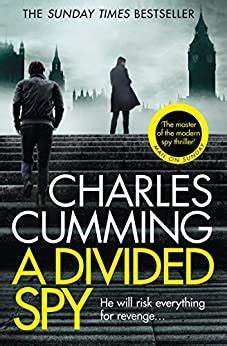
A Divided Spy - Charles Cumming


I've said it before and I'll say it again. Charles Cumming is the new British master of spy fiction. He is comparable with le Carre and Deighton. His range is wider than the former, his writing slightly more refined than the latter. Both octogenarian masters are brilliant constructors of plot and Cumming is near as dammit their equal.

A Divided Spy is the third Thomas Kell novel. It has a sense of ending about it but I am hoping it is just the third of a sub-trilogy within a longer series. It ties up storylines from A Foreign Country and A Colder War (both, of course, reviewed on this blog) and introduces a discrete, highly contemporary story about Islamist terror strikes on UK soil.

What more can I say? It is brilliant, thrilling, a masterpiece of its genre, compulsory reading for aficionados.

Saturday, 9 May 2020

The Honourable Schoolboy - John le Carre


The Honourable Schoolboy (1977) is the middle and least-known of le Carre's Smiley Trilogy of the 70s. Framed by Tinker, Tailor, Soldier, Spy and Smiley's People, it suffers because it has never been adapted for the screen, but it is every bit as good as the novels which bookend it. This is the operation which will define Smiley's tenure as head of the Circus. Trying to untangle the mess inherited from the mole Bill Haydon, Smiley finds the case of Hong Kong tycoon Drake Ko and his brother Nelson, who might be about to defect from China. Unable to know who he might be able to trust in the field, Smiley sends the Circus 'occasional' Jerry Westerby, son of the Press baron (hence the 'Hon') and himself a journalist.

Jerry is the character involved in most of the action here, and very good he is too. On the face of it a lumbering lazy giant, he is in fact fiercely loyal to his personal code of honour and the mentor who recruited him back in the day, George Smiley. Next to Smiley, Jerry Westerby might just be the best le Carre character ever. The novel also benefits from a meaningful female lead, Lizzie Worthington, who hoped to make her looks her fortune in the East but who has ended up something of a courtesan and a drug mule.

Meanwhile Smiley oversees matters from afar (London, until the last couple of chapters) where he negotiates the delicate politics needed to continue the Circus after the scandal. Connie Sachs is back as one of his key advisers, along with the profoundly eccentric Doc de Salis. Peter Guillam is, of course, Smiley's righthand man, and there is a minder, Fawn, who I don't believe ever reappears but who is darkly memorable here.

The book is immensely long (well over 600 pages) and extraordinarily detailed. It's a long time since I read Tinker Tailor and Smiley's People (a good forty years) but I don't remember them being quite this good. I suppose they have now become something of a stereotype for British spy fiction, whereas the Hong Kong setting and Chinese communists are still a rarity. It is, without doubt, a masterpiece of its genre.

Monday, 13 January 2020

Nightfall Berlin - Jack Grimwood

Jack Grimwood is one of several up-and-coming British spy writers. I have reviewed several of Charles Cumming's novels on this blog and rate him second only to the master, John le Carre. Jack Grimwood isn't quite that good but he is not far off.

Grimwood is happy to acknowledge his debt to the master, and does so in the book. His continuing character, Tom Fox, is a brilliant character - a former priest turned undercover assassin for British Intelligence. The setting is the 1980s, with the Iron Curtain starting to rust. Mrs Thatcher is halfway through her reign of terror and Fox's father-in-law is one of her ministers. It is five years or so since Sir Anthony Blunt was unmasked as a traitor. More recently, Peter Wright's Spycatcher claimed there were more Soviet agents in Parliament and the Security Services.

 Nightfall Berlin sends Fox into East Berlin to bring home the ageing defector Sir Cecil Blackburn. Everything is arranged but when Fox calls to collect Blackburn for the final time, he finds the old boy with a crowbar through his chest and his minder, who just happens to be the nephew of the KGB Rezident in Berlin, strangled beside him. Everyone, including Blackburn's girlfriend and his daughter, believes Fox killed them. Worse, back in England, someone abducts Fox's young son and demands Blackburn's memoirs as ransom. Fox doesn't have the memoirs. The papers were burnt in the old man's fireplace.

It's a cracking read. Grimwood is another who has realised the importance of thrills in thrillers. And the final shootout in the Berlin zoo is a whiteknuckle ride. This second in the series is highly recommended. I, meantime, will set about finding the first, Moskova.


Thursday, 19 December 2019

Trinity Six - Charles Cumming


I don't understand why Charles Cumming isn't promoted on the same scale as John le Carre, because he certainly is the frontrunner to inherit the great man's position as number one scribe of British spycraft.

Trinity Six is closer to home than most of Cumming's work, Britain-based, albeit his protagonist, UCL lecturer Sam Gaddis, gets about during the course of his fictional journey. He kind of inherits a project about the much-mooted sixth man of the Thirties communist cell at Trinity College Cambridge. He meets the man in the know (or is he?) and begins his research - only to see a key witness gunned down in front of him, only for Gaddis himself to gun down the assailant.

It seems the British SIS is not the only organisation of its ilk with an interest in suppressing the Sixth Man story. The revelation of why is splendid when it comes. The working out of the plot - a fine example of the biter bitten - is masterly. What is wrong with British TV? Why is nobody snapping up Cumming's work for must-see broadcasting?