Total Pageviews

Showing posts with label ebook. Show all posts

Thursday, 9 October 2025

The Weight of the Dead - Brian Hodge


 A novelette, a work of fiction longer than a short story, shorter than a novella, typically between seven and seventeen thousand words: that is what Brian Hodge has written here.   It turns out to be the perfect length.   Less would have been inadequate, more would have been padding.   It is a form I really must experiment with myself.

The Weight of the Dead is not post-apocalyptic, it is post-frazzle.   Within living memory the Day the Sun Roared caused a power surge which burned out all electrics, instantly turning the Technological World into what survivors called the World Ago.   Without tech or transport humankind reverted to nomadic lifestyles.   A generation later they began to settle into fortified villages, like the one Melody Banks lives in.   Melody is fourteen; the male of the species is being to notice her.   One such, Ted Harkin, became inappropriate, causing Melody's father Grady to beat his brains out.   Now Grady must pay the price.

The villagers are not barbarians.   They do not have the death penalty.   Instead, Grady Banks must bear the weight of his crime - literally.   Harkin's corpse is fastened to him and he is banished into the woods outside the defences until such time as his burden is lifted, either by death or putrefaction.  Obviously Melody can go out and visit, take her father food and necessary supplies, but she cannot take anything that might free him of Ted's corpse.

The woods are not entirely safe.   Myths and rumours have already evolved about the people who wander out there and what they might have become...

A really skilful, beautifully written and controlled, example of short weird fiction.

Sunday, 6 September 2020

Ghost in the Machine - Ed James


There are times when what you need is a straightforward police thriller, preferably Scottish.  And having finished the 600+ pages of Mr Biswas was one.  Two days leisurely read; great characterisation, interesting plot and sound resolution.  Perfect.

Ed James's series (one of several) is set in contemporary Edinburgh and features newly-appointed DC Scott Cullen.  Cullen is a great device for James.  He's only around 30 and has a long career in front of him (and there are already several other novels in the series).  What James really does well is giving his hero the right number of gaffes and crucial discoveries.  He places him square at the centre of the action and keeps him there.  He has not saddled Cullen with a drink and drug problem, or an ex-wife or any of the usual stereotypical problems.  Instead, he is a normal guy with a normal guy's everyday problems - enough to give him three-dimensional realism but not enough to get in the way of the plot.

The supporting characters are equally good and I look forward to downloading Scott Cullen 2 to my Kindle, the next time I just need a solid, professionally-crafted, deeply pleasurable read.

Tuesday, 11 August 2020

The Red Scarf - Gil Brewer


Classic noir from a classic noir author - that is to say, alcoholic and frustrated by his lack of success.  Gil Brewer drank himself to death in 1983, barely sixty years old.  Still, he had managed to more or less support himself and his family with his writing, entirely for the pulp paperbacks. The Red Scarf was published by Mystery House in 1958 and falls round about the middle of his oeuvre.  Roy Nichols and his wife Bess have gone about things the right way, the American way, starting out with nothing and working hard, damned hard, to build their little nest-egg and get into business.  They have bought a nice little motel right where a brand new highway is planned.  But then the highway is put on hold and they are living hand to mouth.  In desperation, Roy has headed up to Chicago to try and tap his brother Albert for a loan.  Albert, of course, will do no such thing.  Roy is down to his last few dollars - can't even afford the bus home.  So he cops a ride with a couple of grifters, Teece and Vivian.  They have a car, they have drink, Vivian has curves in all the preferred places and there is a briefcase of stolen money, held together with the red scarf of the title, Vivian's good luck talisman, which turns out to be not so lucky after all.

Plot is clearly paramount with Brewer and he does it really well, the fugitives holed up in Nichols' motel with Nichol's suspicious wife, the cops and the mob both hot on their trail.  The prose is proficient and the end perfectly satisfactory.  A paradigm of the genre - and only half the fun to be had from this Stark House Classic Noir ebook.

Thursday, 17 October 2019

In a House of Lies - Ian Rankin


The odd dud is inevitable when you are as prolific as Ian Rankin, and this is undoubtedly one of his. It seems to be based on two celebrated podcasts about murder, the Adnan Syed case which made Serial a worldwide hit and the murder of Daniel Morgan in London in 1987. Basically we have the murder of a private detective and the key clue about how long a car was parked where it was found which hinges on the analysis of soil and grass. Note to Rankin: You're a crime writer; never assume your crime readers are less informed than you are.

The second problem is that Rankin continues to employ the detective triad which, for me at least, is no longer interesting or indeed credible: Rebus, Malcolm Fox and Siobhan Clarke. It is essentially a good idea. Now he is retired Rebus can be even more of a wild card; Clarke has to obey the rules or her long association with Rebus will hold her back; and Fox polices the police. The problem is, they all come with baggage from up to 21 previous outings, or, in Fox's case, from two novels in which he was the replacement for Rebus. This means a certain number of secondary characters have to revisited, even if there is no plotting need. If Rankin isn't at the very top of his game, this can lead to an imbalance between investigation and back story. Needless to say, in Rebus #22, Rankin isn't at the apex of his ability.

It's readable - Rankin is always readable - but the problems are overwhelming. Both the A plot and the B subplot are fundamentally unbelievable; no one kills or accepts the blame for killing for such trivial reasons. And the novel itself is about 25% too long. I hope Rankin recovers form for the next Rebus. I for one could not take another misfire, especially as recent instalments have been so good.


Wednesday, 18 September 2019

Handsome Brute - Sean O'Connor


Probably the best researched book on sex killer Neville Heath, the 'handsome brute' of the title. Heath was brutish only in the way he treated the women he picked up in the transient world of London hotels in the immediate postwar period. He whipped them and he murdered two. But he was obviously debonair and charming - these women weren't idiots - and his wife in South Africa never accused him of violence. They divorced because he had married under a false name and was a convicted minor criminal.

O'Connor takes a critical view of his subject but doesn't really go into his mental state, issues raised at his trial, appeal, and in the Press. How deluded was he, if at all? That is and always was the question. He had a traumatic childhood with the death of a younger brother. He clearly had talent as a pilot and was undoubtedly brave in action. Because of his dishonesty he was court-martialed three times, yet did well in both the RAF and its South African equivalent. He was determined to serve. Was this heroism or a death wish? How do we differentiate between the two?

A book, therefore, that tells the tale thoroughly but leaves questions unanswered, which is not always a bad thing. Well worth looking out for.

(Great cover image BTW.)

Tuesday, 5 March 2019

Majic Man - Max Allan Collins


Majic Man (1999) is the tenth of Collins's Nate Heller series. If you think that's a lot, you seriously underestimate Max Allan Collins. A glance at the list on his website will soon put you right. For someone who has written so much, I am amazed at the standard Collins consistently achieves. Majic Man is no exception.


The thing with Heller is that he has been involved in every American major crime/unsolved mystery in the second half of the 20th century. Now, in retirement, he is committing his secrets to paper.


The stories are therefore based on fact. The fact comes from a reasonable amount of research - and Collins names his sources in quite a useful literature review at the back.


The year is 1949 and PI Nate is hired by James Forrestal, President Truman's Defense Secretary because he believes someone is out to get him. Certainly the powers-that-be are on his case. Very soon he is forced out of office on health grounds and confined to the psychiatric unit at Bethesda Naval Hospital in Maryland. Is this because he was a keen financier of Hitler before the war - or because of something he knows from his time in government?  And by the way, this much is all historical - that's Forrestal's photo on the cover.


The cover also gives away the second string of the novel. Is the Roswell Incident, the 'UFO' crash and possible military capture of a surviving alien, what Forrestal knew about? Nate heads for New Mexico to investigate. Nate  and presumably his author - reach fascinating conclusions. The entire novel is fascinating thanks to the way Collins combines history and (disputed) fact with all the tropes of postwar noir crime fiction.


I really enjoyed Quarry's Choice last year and I loved Majic Man. Fortunately there are heaps of Collins's mammoth oeuvre still to tackle.

Sunday, 17 September 2017

The Hand-Reared Boy - Brian Aldiss

The Hand-Reared Boy, part one of Aldiss's Horatio Stubbs trilogy, purports to be the autobiographical coming-of-age memoir of a sexually-precocious teenager on the eve of World War II. Horatio, we assume, is Aldiss thinly coated. But is it? Aldiss, who died last month at the grand age of 92, is clearly not called Horatio and I doubt very much he had a brother called Nelson. Horatio, it is very clear, was born in 1922; he is seventeen when war breaks out in 1939. Aldiss, however, was born in 1925. So what is going on? What is real personal experience, and what is novelistic construct?


That is essentially what kept me going with this ebook - that, and Aldiss's plain-speaking prose style. What is basically a pubescent marathon of masturbation is rendered extremely readable. I remember reading it when it first came out, when I was Horatio's age, in 1970. It didn't interest me because I had all the usual teenage emotions, hopes and guilt about sex but I didn't have siblings and I didn't attend a public school. In fact, it put me off Aldiss for a considerable period. My feeling at the time was, this is an impossibly middleaged man (who was 45, the same age Horatio declares himself to be as he writes) with a moustache like my dad's, who was trying to cash in on the somewhat sordid British take on the sexual revolution of the Sixties. Reading it now, much older and with much more impressive facial foliage of my own, knee-deep in an age of Neo-Puritanism, I read with more experience, technical knowledge, and compassion.


Is Sister Traven, the school nurse, who relieves the pressure for so many of the boys in her care, based in any way on a real person? Did Aldiss, like Horatio, really interfere with his younger sister? As a senior Youth Magistrate I have sent boys into youth custody for doing exactly that. As a non-family person, now with no relatives whatsoever, what the hell goes on in ostensibly 'normal' families?


I bought the other two volumes in an Amazon Kindle deal on the day Aldiss died, so we shall see what develops.

Sunday, 5 February 2017

Clinch - Martin Holmen

This is real winner, which I happened upon by signing up to the Pushkin Press newsletter.
Holmen brings something radically new to Nordic Noir - a period piece set in the early days of classic American Noir. Genius!

Harry Kvist is a down-at-heel former boxer in Stockholm 1932. His main source of income is repossessing bicycles from renters out of funds. The Great Depression in Stockholm is excruciatingly hard. The streets are full of tramps and madmen. Envious eyes are cast at the rise of Hitler's Nazis, who seem to herald a resurgence of the common man.

One December night Harry accepts an out-of-town commission to go and collect a debt from one Zetterburg. Harry strong-arms the guy and arranges to return the next day for the money. But Zetterburg is found dead in his flat and Harry, who is not entirely unknown to the city constabulary, is brought in for questioning. He was seen by a nosy neighbour leaving Zetterburg's building.

Fortunately, he has a potential alibi - a prostitute he passed the time with while waiting for Zetterburg to come home. He was also seen elsewhere in the city at key times, cruising the gay bars. Because Harry's not-so-secret secret is that he prefers rough sex with young men. Very rough.

Anyway, Harry is released and sets out to track down Sonja the bowlegged prostitute. Along the way he comes across a one-eyed Austrian who seems intent on killing him. Then he happens upon a former movie siren who also likes it a little rough.

The book is first-person, present tense, the only way to take your Noir. Holmen has a style all his own, which works brilliantly. He conjures up Stockholm with a glamorous veneer that is only paper-thin. His cast of supporting characters is set with jewels like Harry's landlord Lundin and the prissy proto-Nazi detective Olsson. And the femme fatale, the blowsy drug-addled Doris, is heartbreakingly fatal,

Clinch is the first in a trilogy of Kvist novels, apparently. Next up is Down for the Count. You can count me in!

Sunday, 29 May 2016

Our Game - John le Carre

First the Wall came down, then the Soviet Union fell apart. The Nineties were a decade in which old enemies lost their edge, former certainties simply evaporated. Eastern Europe suddenly comprised new counties and potential states we had never heard of and knew absolutely nothing about. Chechnya, South Ossetia and, most relevant to le Carre's 1995 novel, Ingushetia - which I have still never heard of.

Many spy writers went out of business overnight, or turned to period espionage fiction. Le Carre, the great master of the form, used his genre to explore the uncertainties. Tim Cranmer is an old-style spy - Winchester, the Treasury - put out to grass. Fortunately he is stinking rich, his inheritance including a Somerset manor and vineyard. His schoolfriend Larry Pettifer, the enfant terrible of Soviet Studies in his day, was Cranmer's agent and later double agent. Old Wykehamists look after one another, and Cranmer has found flighty Larry a sinecure at Bath University. Larry has repaid the favour by absconding with Timbo's trophy girfriend Emma. Then Larry is reported missing. The police call on Cranmer. This comes as surprise to Cranmer, who thought he might have killed his friend some weeks before he went missing.

Has Larry gone back to the Game? Has he involved Emma? Cranmer sets out to find them, his quest taking him from Paris to the wild homeland of the Ingush. I'm not sure that the enigma is ever fully resolved  but what we do get is a vivid picture of one of the world's largest landmasses, a political empire, at the moment of implosion, and the black hole lurking beneath.

Our Game is not le Carre's finest novel. It is not an easy read - it is by no means an easy subject - yet it contains some of the master's finest writing.  He has to stretch his vocabulary in order to pin down the themes that emerge as the exercise progresses.  It is therefore a key work, not only within le Carre's oeuvre, but within the spy genre itself.

And this cover, on the Penguin Classic ebook, has to be the best of any le Carre ever...


Sunday, 20 September 2015

Under the Skin - Michael Faber


Under the Skin was Faber's first novel, published in 2000, when it won the Saltire First Book of the Year Award.

I would suggest that we have here is a fable about factory farming.  Human beings are selected, cut from the herd, force-fed in underground pens and ultimately processed as food for the elite of another, extraterrestrial civilisation.  But those who do the processing are merely the social rejects of that civilisation and, in the case of just two - the pioneer Essin and our protagonist Isserley - they have themselves been mutilated beyond belief, to resemble an earthly man and woman.

Essin, who does not trouble us much, manages the remote Highland farm which provides cover for the subterranean processing plant.  Isserley drives up and down the road network preying on hitchhikers.  Her orders are specific: they must be decent specimens, unlikely to be missed, and always male.

Faber's masterstroke, which elevates the book from simple sci-fi, is making Isserley female.  She is not a woman, although she looks more or less like one thanks to mammoth surgery, but she is female, the only female in the expeditionary force.  She is thus apart from her own kind.  But she was always apart.  When she was younger, on her native planet, she was considered beautiful.  Elite males promised her the world but always let her down.  In the end, her only escape from the Estates - the bottom rung of her underground society, was the experimental surgery which turned her into what she considers a freak and left her in constant pain.  Isserley knows she can never go home because then she would definitely be a freak.  She can pass a 'vodsel' (earthly human) but she can never be one - her surgery is not that convincing, as a would-be rapist discovers.  Then she learns that her unsought, unique status on the farm might be under threat.

I read the ebook and don't know quite how long the print version is.  I would say, however, that the text is just long enough.  Faber's prose style is perfectly judged and his descriptions of the Highland are both fresh and beautiful.  A millennium must-read.

Tuesday, 28 April 2015

Disunited Kingdom - Ian MacWhirter


The story of "how Westminster won a referendum but lost Scotland" from a distinguished Scottish journalist tells us everything we weren't allowed to know south of the Border.  We all knew, for instance, that Cameron's instant backtrack on devo-max the morning after the vote was so callous that it almost certainly lost him next week's General Election and equally surely guaranteed that Scotland's disassociation will lead to a federal Britain in the coming decade.  My view of that possibility?  Good.  Can't happen soon enough, provided England is divided into regions too.

What MacWhirter tells me which I didn't know is how many community groups sprang up spontaneously in Scotland to take the campaign out of the hands of the professional politicians and, more importantly, bypass the lies and smears of Britain's poisonous rightwing Press.  MacWhirter became drawn into this alternative movement and found himself moving from an instinctive unionist to a sceptical nationalist.  His personal story mirrors the national narrative.

This is how a political campaign should be run.  There are lessons for us all here.  I cannot recommend this beautifully written and deeply insightful book strongly enough.  It should be on the school curriculum both sides of the Border.

Monday, 1 December 2014

Disappeared - Anthony Quinn


Disappeared is Anthony Quinn's first novel, and allowances must be made.  On the positive side, a story about the 'disappeared' of the Ulster Troubles is current and compelling.  Quinn's descriptions of the shores of Lough Neagh are spellbinding and sometimes downright beautiful.  On the negative side, the plot is preposterous, there are far too many characters to keep track of, and pretty well all of them are more interesting than Quinn's lacklustre protagonist DI Celsius Daly yes, the name is the only interesting trait).  On the whole, the positives just outweigh the negatives.  I read it to the end, otherwise it wouldn't be here on my blog.  The denouement was a bit disappointing - somewhat of a deus ex machina.  Also, am I right in thinking that diesel isn't easily flammable, thus not the weapon of choice for your averagely intelligent teenage arsonist?

Personally, I won't be revisiting Inspector Daly again in a hurry.  That shouldn't put anyone else off - I hated the first Rebus novels when they came out, and look what happened with them.

Tuesday, 3 June 2014

The Third Plantagenet - John Ashdown-Hill


John Ashdown-Hill was the genealogist-historian who tracked down people descended from Richard III's female relatives though not, of course, from Richard himself.  This meant the DNA in the skeleton dug up in the car park of Leicester Social Services could be matched, confirming the remains of the crooked-back man killed in battle, always said in the historical records to have been buried where he was found, was indeed the missing king.

The dig was funded by the Ricardians, of whom Ashdown-Hill is one, who were appalled when the 'Tudor propaganda' deformity was there before their very eyes.  The implication, of course, is that everything else Thomas More said about Richard might also be true, in particular that he murdered his nephews, the Princes in the Tower - just like every contemporary chronicler, including those who wrote before 1485, said he did.

The Ricardians, quite openly, have an agenda - to restore the king's reputation.  This can lead them into odd yet fascinating digressions, which is what interested me about Ashdown-Hill's latest book.  His thesis is that the Duke of Clarence, the surviving brother between Edward IV and Richard, was not the scheming, self-promoting, untrustworthy blot on the landscape who screams out at us from the pages of history (and I'm talking here to real history; that recorded at the time).  Thus, for Ashdown-Hill every Plantagenet male other than Clarence and Richard was illegitimate and excluded from the crown.  I'm no fan of the British royal family and their endless progeny but I know for a fact some of them were married - I've seen them marry on the telly.

His other problem is that Clarence has left very few traces behind him (though, to be fair, he has an awful lot of actual direct descendants thanks to his daughter Margaret Countess of Salisbury).  Even his bones seem to have vanished from his tomb.  Thus everything has to be reconstructed or hypothesized.  The result is great fun in every sense.  Ashdown-Hill provokes argument, which is what books should do from time to time.  I don't agree with some of his theories (frankly, I don't agree with any of them) but I am confident that what he identifies as facts are indeed reliable.  I enjoyed it, and there are plenty of other modern histories of the period I can't say the same about.

Wednesday, 23 April 2014

The Papers of Tony Veitch - William McIlvanney


This is the second of McIlvanney's Laidlaw Trilogy, held by many to be the spring from which Tartan Noir flowed, though I credit the TV series Taggart equally.

McIlvanney is not a genre writer but an award-winning literary writer who found crime fiction as one way of expressing his preoccupations and interests.  Thus Veitch is not really a crime novel - it really doesn't matter who did what to whom.  It is a study of a once mighty city, brought to its knees by Mrs Thatcher, where the hard man has always been as well-regarded as the provost or the Rangers centre-forward.  Jack Laidlaw is as hard as any of villains he hunts down.  The plot drives the narrative but it is the language that makes it sing. Here are just a few of my favourites:

"A lot of the people he dealt with, Milligan thought, must have been home in bed before their self-congratulation went sour and they realised that Macey had been taking the mickey out of the mickey they thought they were taking out of him.  He was so simple he could have sold life insurance in heaven."

"Put a monkey in a toy uniform, Macey thought, and it will try to pull rank."

"She wis a kind wumman, mamither.  Woulda bought extra cheese if she'd knew there wis a moose in the hoose."

"It was a place so kind it would batter cruelty into the ground."

The original ... and in many ways the best.

Hard Truths is a short ebook of an interview with McIlvanney by the contemporary star of Tartan Noir, Tony Black.  It is actually a book of interviews with crime writers chopped up to flog separately on Kindle - a smart idea.  McIlvanney, still going strong at 77, has just got a new publisher, Canongate, who have republished all his work in smart new editions and as ebooks.

He says of Laidlaw, "A detective story, if you get it right you'll have a plot that's going to make people read on but along the way give them serious observation and a sense of the society the novel is passing through."  And of Tartan Noir, "I don't that it'll be the ultimate expression of Scottish culture, folk will come along and do more but I think it's great that there's an area where the value, the significance of the written word is appreciated."

The good news is that, more than twenty years since he finished the Laidlaw Trilogy, McIlvanney is toying with the notion of a prequel, "before he became quite so aggressive", and a "twilight" post-retirement Laidlaw.  We can but hope.

Thursday, 16 January 2014

Old Gold - Jay Stringer


I hit upon this ebook via Amazon's 99p deal of the day, a great way to find new writers you might want to follow across all formats in the future.

I was amazed to realise Old Gold is Stringer's first novel, such is the level of accomplishment and the amount of background his characters come with.  To start with, it has an interesting new twist on modern noir - because it's set in Stringer's native Black Country, the West Midlands, specifically Wolverhampton (check out those mean streets, Mr Chandler!).  Our hero, Eoin Miller, also comes with a twist I've never come across before, in that he's half gypsy.  Other than that he's not untypical of modern noir protagonists - he's an ex-cop, separated from his wife, a heavy drinker, who does investigative work for the local drug barons.

The story is layered, complex and, ultimately, irrelevant - because in proper noir the crime is merely the device which drives our characters forward.  Noir is all about character.  Miller intrigues, he beguiles.  He gets beaten up more than once and nearly killed.  The subsidiary characters are well-drawn and fully three-dimensional, even the ones who will never return.  So many writers, new and established, don't bother with that these days yet it makes all the difference between formulaic pap and genre literature.

I loved this book.  I definitely want more.

Monday, 30 December 2013

Sawbones - Stuart MacBride


A very short book which today would be an ebook but which back in 2008 was that rarest of publishing birds, the stand-alone novella.  Just 114 pages - and that only by virtue of many chapters and only 40 characters a line - Sawbones is off the beaten track for MacBride, a serial killer story set in Iowa with a couple of extra-violent hoodlums as our heroes.  It romps merrily along - MacBride can do pitch-black crime on either side of the Atlantic - and comes to a suitably grisly end.

Well done http://www.barringtonstoke.co.uk/ for publishing novellas in the first place.  Extra congratulations for being a publishing house dedicated to books designed for children and adults who have difficulty reading.

Thursday, 11 July 2013

The Holy Father - Tony Black

 
This short, festive ebook showcases the other side of Black and demonstrates why he is so often compared to Irvine Welsh.  It's humour, and it's very, very black. It's Christmas Eve and underemployed carpenter Joe is visited by the late Rangers Wizard of the Wing, Davie Cooper.  Davie brings tidings from the Big Man: Joe's girlfriend Mary-doll is up the duff with the next messiah.  Davie's now got wings, so it must be true.
 
Joe and Mary duly trek across town following the star.  Along the way they encounter three not-so-wise jakeys who bring gifts of a sort.  It's laugh out loud funny on occasion, regularly rude, and perfectly suited to the short ebook form.  Any more and it would risk turning trite.

Tuesday, 9 July 2013

The Swag Man - Howard Jacobson


Swag Man is a short memoir/long article published as an Amazon Kindle Single by the Tablet Magazine (a new read on Jewish life).

The Swag Man in question, we assume, is Howard's father Max, a huckster on the Manchester markets, always on the verge of making millions or going bankrupt, but never quite managing either.  Howard, of course, was dragged into service for Max's routines, and had no aptitude for it whatsoever.  But the true hero, the Swag Man made spectacularly good, is Frank Cohen, apprentice to Max, hero to Howard, DIY entrepreneur, collector of YBAs and co-founder, in April 2013, of the free to enter Dairy Art Centre in Bloomsbury.

What Jacobson gives us, in under fifty pages, is a snapshot on Jewish advancement in Manchester in the second half of the twentieth century, the last time someone could rise from the street markets to a Cheshire mansion, or in the author's case, the Booker Prize and sub Stephen Fry national treasuredom.  Two decades of Blair and Cameron and that awful prune Clegg have put a thorough-going stop to social mobility.

Thursday, 13 June 2013

Natural Causes - James Oswald


This is the first mainstream novel from Oswald, who has previously written fantasy.  The paperback has just come out and the second Inspector Tony McLean novel, The Book of Souls, comes out on July 4.  I read the ebook version.

You google Natural Causes and you get a lot of stuff about the opening chapter.  I don't know how it works in the paperback but in the ebook Oswald has deleted the controversial opening, which was actually a pitch for a competition, but includes it as an appendix with an explanation.  For me, a version of the shock-open or something else entirely should have been considered.  It took me ages to get hooked on the story.  Don't get me wrong, the writing is good, the characters interesting, but there are far too many of them and I kept forgetting who was who.  I was interested - I wasn't gripped.  Fortunately, perhaps, Natural Causes is 400+ pages and by about halfway (the hit-and-run) I was hooked.  Certainly, I will give Book of Souls a go.

Funnily enough, Oswald is co-judge of the Crime in the City short-story competition with Craig Robertson, another up-and-coming Tartan Noir exponent who promised much but didn't quite grab me as I would wish to be grabbed.  One thing very much in Oswald's favour, though, is his sense of irony.  His crime-writing mentor is manifested in Inspector McLean's 'apprentice', DC Stuart MacBride.

Sunday, 24 March 2013

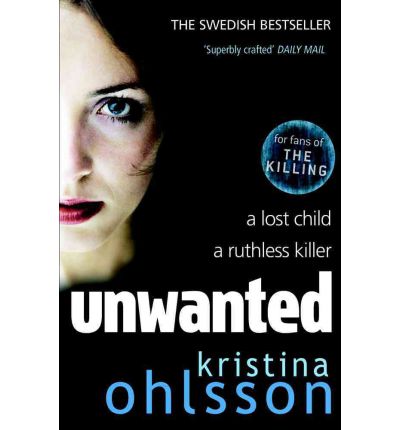
Unwanted - Kristina Ohlsson


Unwanted is the debut from former Swedish anti-terrorism officer Kristina Ohlsson.  One might assume it would therefore be a thriller; instead it is a fairly mundane police procedural about a psycho-killer on the loose.  As the cover implies, it has been designed to cash in the post-Killing wave of Nordic Noir.  And, to an extent, it has its own Sarah Lund in the shape of Fredrika Bergman, a civilian police detective (we can but assume they exist) with a mildly idiosyncratic love-life.

Now Fredrika might make an interesting protagonist.  Unfortunately the concept of protagonist seems to have passed Ohlsson by, along with the time-honoured tradition of describing what our main characters look like.  What we get therefore is a team which is not actually a team: leader Alex Recht, who we are told is a legend but never does anything to warrant legendary status, Fredrika, and traditional low-grade plodder Peder Rydh, who has the traditional troubled homelife.  Peripheral team members are glossed over as if their first name is sufficient.  Some aren't even that developed.

The poor quality of technique is a shame because the idea is a good one.  It would be better if, when the psycho is finally cornered, we had any meaningful insight into his psychology.  Personally, given we get stream-of-consciousness from various associated characters, I would have included some from his well-warped perspective.  Instead we get an overlong epilogue in which we are told what happened next for our police friends - I for one didn't care and would have left things as near the climax as I could.

The writing itself is functional, which is all it needs to be.  There are a few typos and some sloppy proof-reading (in the ebook version, anyway), which again smacks of the quick cash-in.

All in all, interesting enough to warrant trying the second in the series, Silenced, which came out in English last month (the third, The Disappeared, is due out in August).  I would consider the ebook, I would certainly borrow from the library, but I wouldn't dream of buying the full-price paperback.