Total Pageviews

Showing posts with label Charles Cumming. Show all posts

Tuesday, 28 January 2025

Kennedy 35 - Charles Cumming


 I've been a fan of Charles Cumming since A Spy by Nature.   I especially enjoyed the Thomas Kell series and The Trinity Six.   The Box 88 novels, of which Kennedy 35 is the third, are on another level entirely.   The idea is of a super-secret organisation based primarily in London and New York - 'The Cathedral' and 'The Stadium' - operating worldwide, a blend of MI6 and the CIA but answerable to neither.   In each of three novels we follow Lachlan Kite at the beginning of his career in the Nineties and today as head of the senior wing in London.   In each novel the past and present collide, which calls for a masterclass in plotting by Cumming.

In this case we start in the mid-Nineties.   Kite is trained but on-hold, awaiting the call to service, meanwhile enjoying life with his girlfriend from university, Martha Raine.   The call comes.   Kite is summoned to Senegal.   He is to travel, with Martha as cover, posing as backpackers, and deliver a package to a Box 88 group planning to seize one of the prime movers behind the Rwandan genocide, Augustin Bagaza, and his mistress Grace Mavinga, known (with good reason) as Lady Macbeth.

Kite is supposed to deliver the package and go.   But Martha falls ill.   Kite is concerned about his contact, a French journalist called Philippe Vauban, who, as the only man who can authoritatively identify the target, seems a little ... odd.   So Kite leaves Martha in the care of an old friend from public school, a Senegalese playboy, Eric Appiah (who we know is trying to contact Kite in the present day) and gets more involved in the op.   In the end, Kite ends up cornering Bagaza and Grace in a nightclub.   Kite's job is to spook Bagaza into running, which he does.   Box 88 will do the rest.

The plan backfires horrifically.   Grace shoots and kills one of the local Box operatives.   Vauban goes mad and does to Bagaza what Bagaza did to his victims in Bagaza.   Grace escapes.   The French secret services do their best to cover up the whole episode because President Mitterand had financed the genocide.

Thirty years later, Eric Appiah contacts Kite in London to tell him he is working off-the-books with a French agent to bring Grace Mavinga to account.   Since Dakar, Grace has been living with a renegade French former spy called Yves Duval.   Together they have set up a phenomenonally successful money laundering scheme for terrorists.   Eric and his partner are on the verge of bringing the couple down - but an American blogger and podcaster has got hold of the original Dakar disaster story, including the names of Martha and Kite.

Before Kite and Eric can meet to discuss the situation, Eric falls from a towerblock in London.   Things were serious already.   Now they get personal.

Kennedy 35 is as good as anything Cumming has done previously.   Cumming is already the best British spy author and Kennedy 35 enshrines that status.

Thursday, 27 April 2023

Judas 62 - Charles Cumming


 I have blogged before about how highly I rate Charles Cumming.   He is by some distance the best British spy novelist, very much the successor to John le Carre.   For me, Judas 62 confirms his status.  I have enjoyed everything I've read by Cumming, which is most of his work, but Judas 62 is so contemporary and so deeply plotted that I think he has hit a new high.

Judas 62 is the successor to Box 88 which I haven't yet read.  Box 88 is a specialist Secret Service operation combating biological weapons.   Lachlan Kite was tapped on the shoulder whilst still a studentt at Edinburgh in the early Nineties; now he is the senior man in London.   It is the summer of 2020 and the pandemic is raging.   News comes through that one of Box's former moles, now living as a retired academic in the States, has been murdered - assassinated, in facr, with Novichock in the same brand of eye medicine I use (AAAGH!).   The victim, Palatnik, was on Putin's Judas list, the traitors to the state greenlit for reprisal killing.   Kite, too, is on that list, at position 62, not as Lachlan Kite but as Peter Galvin, the alias he lived under when, in the long vacation of 1993, he went to Russia to extract their top biological scientist Yuri Aranov, acting on information supplied by the now deceased Evgeny Palatmik.

So we have two stories ingeniously intertwined, the Galvin-Aranov mission of 1993, and Kite's 2020 scheme to entrap the FSB agents responsible for Palatnik's murder.  Aronov, thirty years older but not a day more mature, is to be the bait because the KGB man in backwater Voronezh in '93, Mikhail Gromik, is now the officially retired ex-KGB oligarch living in the United Arab Emirates, secretly in charge of implementing the Judas list.   The proof of that is Galvin's name on the list.  Only Gromik knows who got Aranov out of Russia, but all that Gromik knows about him is the fake name.

As I say, it's brilliantly done - 500 pages that never once flag.   I must get hold of Box 88 and I genuinely can't wait to find out where the series goes next.

Friday, 19 June 2020

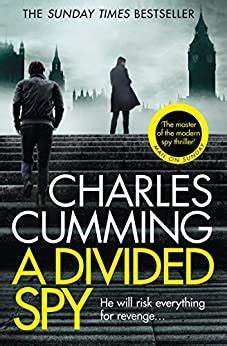
A Divided Spy - Charles Cumming


I've said it before and I'll say it again. Charles Cumming is the new British master of spy fiction. He is comparable with le Carre and Deighton. His range is wider than the former, his writing slightly more refined than the latter. Both octogenarian masters are brilliant constructors of plot and Cumming is near as dammit their equal.

A Divided Spy is the third Thomas Kell novel. It has a sense of ending about it but I am hoping it is just the third of a sub-trilogy within a longer series. It ties up storylines from A Foreign Country and A Colder War (both, of course, reviewed on this blog) and introduces a discrete, highly contemporary story about Islamist terror strikes on UK soil.

What more can I say? It is brilliant, thrilling, a masterpiece of its genre, compulsory reading for aficionados.

Monday, 13 January 2020

Nightfall Berlin - Jack Grimwood

Jack Grimwood is one of several up-and-coming British spy writers. I have reviewed several of Charles Cumming's novels on this blog and rate him second only to the master, John le Carre. Jack Grimwood isn't quite that good but he is not far off.

Grimwood is happy to acknowledge his debt to the master, and does so in the book. His continuing character, Tom Fox, is a brilliant character - a former priest turned undercover assassin for British Intelligence. The setting is the 1980s, with the Iron Curtain starting to rust. Mrs Thatcher is halfway through her reign of terror and Fox's father-in-law is one of her ministers. It is five years or so since Sir Anthony Blunt was unmasked as a traitor. More recently, Peter Wright's Spycatcher claimed there were more Soviet agents in Parliament and the Security Services.

 Nightfall Berlin sends Fox into East Berlin to bring home the ageing defector Sir Cecil Blackburn. Everything is arranged but when Fox calls to collect Blackburn for the final time, he finds the old boy with a crowbar through his chest and his minder, who just happens to be the nephew of the KGB Rezident in Berlin, strangled beside him. Everyone, including Blackburn's girlfriend and his daughter, believes Fox killed them. Worse, back in England, someone abducts Fox's young son and demands Blackburn's memoirs as ransom. Fox doesn't have the memoirs. The papers were burnt in the old man's fireplace.

It's a cracking read. Grimwood is another who has realised the importance of thrills in thrillers. And the final shootout in the Berlin zoo is a whiteknuckle ride. This second in the series is highly recommended. I, meantime, will set about finding the first, Moskova.


Thursday, 19 December 2019

Trinity Six - Charles Cumming


I don't understand why Charles Cumming isn't promoted on the same scale as John le Carre, because he certainly is the frontrunner to inherit the great man's position as number one scribe of British spycraft.

Trinity Six is closer to home than most of Cumming's work, Britain-based, albeit his protagonist, UCL lecturer Sam Gaddis, gets about during the course of his fictional journey. He kind of inherits a project about the much-mooted sixth man of the Thirties communist cell at Trinity College Cambridge. He meets the man in the know (or is he?) and begins his research - only to see a key witness gunned down in front of him, only for Gaddis himself to gun down the assailant.

It seems the British SIS is not the only organisation of its ilk with an interest in suppressing the Sixth Man story. The revelation of why is splendid when it comes. The working out of the plot - a fine example of the biter bitten - is masterly. What is wrong with British TV? Why is nobody snapping up Cumming's work for must-see broadcasting?

Friday, 27 October 2017

Typhoon - Charles Cumming


Typhoon is the fourth of Cumming's post Cold War spy novels. It comes straight after The Spanish Game, which I reviewed earlier this year and was greatly impressed by. It shares some of the same elements - revolutionary terrorism in a forlorn corner of an apathetic nation - but here the nation is China and the minority the Uighurs of Xinjiang province. I have to be honest, I had never heard of the Uighurs, and in a way I guess that's Cumming's point. I also have to admit, I did not love Typhoon.


It's not the theme, setting or essential plot that bothers me - it is certainly not the writing which is as good as Cumming always is - it's the structure. Cumming has chosen two major events of China's emergence into the free market world, the hand-back of Hong Kong in 1997 and the Beijing Olympics in 2008, and decided to link them. The narrative is thus in two halves. This is not in itself a problem. The problem is that nothing thrilling happens in 1997 except the domestic difficulties of spy life, and the first half is therefore far too long. Others might have tried for the same effect through flashback but I don't believe it would have worked any better - probably worse. The problem is there is far too much backstory and it's just not interesting enough. The second half, on the other hand, is almost entirely brilliant, the plot racing along nicely. The end, I'm afraid, is a bit of a dud, sadly underwritten. Cumming cuts away from the action too soon. He has already given the game away in fact, in an irritating prologue involving an even more irritating occasional narrator, a writer called Will. Will serves no purpose whatsoever as he is not present at 99% of the action. The only purpose he does serve is, as I indicated a few sentences ago, he strips the narrative of jeopardy. We know from the start that the hero, the good honest spy Joe Lennox, survives whatever is coming later.


Reading Typhoon, I was constantly reminded of Le Carre's The Perfect Spy, which I have been reading sporadically for well over a year and just cannot come to terms with. One the one hand I hate it for its endlessly looping narrative and lack of narrative drive, on the other I have to admire the sheer skill that has gone into writing it. Being compared with Le Carre is no bad thing. Maybe Typhoon is Cumming's Perfect Spy, not the most enjoyable of his output but an essential landmark in the development of a great writer.

Friday, 23 June 2017

The Spanish Game - Charles Cumming


Cumming is 21st century British spy fiction at its best. The Spanish Game (2006) is an early novel (his third) but is fully accomplished. Alec Milius is living in Madrid, not really on the run, but hiding out from the espionage world which he flirted with in an earlier novel with disastrous results all round.


Gradually he gets drawn back. He becomes involved with ETA, the Basque Separatists, and the secretive but real rightwing GAL. This is the tricky part of any spy story - why does the hero bother? This is where Cumming shows his mastery. Milius gets involved because he is working for an ex-pat banker who needs a report for a client on the likelihood of Basque autonomy. The boss, Julian Church, sets up a meeting with colourful Basque politician Mikel Arenaza. Alec and Mikel bond during a night on the town in San Sebastian. Mikel arranges to meet up with Alec in Madrid. He calls from the airport to say he is on his way, but never arrives. Naturally Alec is curious. Inevitably he has the skillset to investigate...


To be fair, the story takes a while to get going. There seems to be too much backstory in the early chapters but believe me, it has to be there to justify the ending - which is downright brilliant. Cumming already had his character from previous novels and again he deals with it innovatively, by building our understanding of Alec's state of mind, the paranoia which means he simply cannot go straight to authorities with his theories about Mikel. Cumming is very, very clever - by some distance the best spy novelist of his generation.

Wednesday, 13 January 2016

A Colder War - Charles Cumming

Cumming first came to prominence with A Foreign Country, which won the CWA Ian Fleming Steel Dagger for best thriller of the year and the Bloody Scotland crime book of the year, both in 2012.  The protagonist of that book, the forty-something disgraced SIS operative Thomas Kell, returns in A Colder War.


The premise is similar.  Still under investigation for his role in unlawful rendition and torture Kell is called back to action by the misfortune of an old friend and colleague, in this instance Paul Wallinger, chief British spy in Ankara, is killed in a dubious flying 'accident' immediately after a high profile operation he was running with the Americans goes spectacularly tits-up.

It's a mole-hunt with the personal undertones - Kell becomes passionately involved with Wallinger's daughter, and she becomes unexpectedly involved with the mole-hunt.  We know who the mole is fairly early in proceedings but Cumming is nevertheless able to maintain the suspense levels to the very end.  He has, in many ways, taken up the spy world where John le Carre left it.  Kell is not entirely dissimilar to George Smiley, though he does have a much more active personal life.  Cumming is now a major player in the genre.  I look forward to Kell's next appearance.  In the meantime I must try one of Cumming's standalone novels, perhaps the first, A Spy by Nature.

Saturday, 20 September 2014

A Foreign Country - Charles Cumming


I've been keeping an eye out for Cumming's work since he won the CWA Steel Dagger, and the Bloody Scotland Scottish Crime Book of the Year for this very novel in 2012.

As I have stated several times on this blog, spy fiction is not my first choice and I can only tolerate the very best.  Fortunately, Cumming is up there with the very best.  Much more literate than Fleming and not as tendentious as le Carre can sometimes be.

The storyline here is unrolled through a number of clever twists, none of which strain the credulity.  Essentially, it is this: the incoming female head of MI6 vanishes; Thomas Kell, the spy who was effectively thrown into the cold, is given the off-the-books task of tracking her down with the vague promise of reinstatement if successful.  This means we don't have to endure too much office in-fighting and can get down to the chase through Tunisia and France.

The plot deepens, the target changes more than once, and the pace never once relents.  Cumming has stripped down the backstory of his characters to the bare minimum needed to engage our empathy.  Thus he can devote all his authorial energy to making his thriller thrilling.  He succeeds.

I am definitely up for more.  The Trinity Six sounds intriguing...