Total Pageviews

Showing posts with label Len Deighton. Show all posts

Wednesday, 5 January 2022

Mexico Set - Len Deighton


 The second novel of the first Bernard Samson trilogy, Mexico Set is a straight follow-on from Berlin Game.  The dust from the shock ending of the first novel is still settling.  Bernie has been cleared of suspicion - officially, at least - but he still feels he's on probation.  He's in Mexico City with Dicky Cruyer, who has got the Berlin Desk at London Central which should, by rights, have been Bernie's.  They are there because there's a disgruntled KGB operative called Erich Stinnes, who might just be ready to defect.  He approached Werner Volkmann and his young wife Zena in a German club.  Stinnes said he'd mistaken her for a famous beauty (whose brother Bernie and Werner just happened to know, growing up in Berlin).  A genuine mistake or a coded message?

Ultimately, Bernie gets the job of enrolling Stinnes.  He knows this is his only chance to recover his career.  But what if it's all a con?  What if Stinnes is actually out to enrol Bernie?  And why is everyone, friend or foe, apparently dead set on banjaxing Bernie's operation?

It all ends in a genuine Mexican stand-off, which is truly thrilling - and also multilayered.  Deighton's mastery shows in the way he ends the novel.  No what-happened-next, no analysis and absolutely no unravelling or regathering of loose ends.  He always knew he had a third novel for that.  And a second trilogy... maybe a third.

A second instalment, then, that is every bit as good as the first.

Friday, 22 October 2021

Berlin Game - Len Deighton


I didn't read Deighton's spy novels when they came out.  I'd been put off spy fiction by reading James Bond, which, when I reached the age of eleven or twelve, struck me as being childishly poor.  I also didn't like the movie of The Ipcress File when I was around the same age - not because it was childish but because I couldn't make head nor tail of it.  I did read Deighton's other work over the years SS-GB and XPD, for example, and I really enjoyed them.

Anyway, Berlin Game is the first in the first trilogy of the Bernard Samson series.  Samson is a mid-ranking member of the Department who is unlikely to rise higher, being neither Oxbridge educated nor ex-military.  He has, however, a skill set indispensable in the current crisis.  He was born and brought up in Berlin, where his father was stationed after the war.  He speaks Berlin German like the native he is.  The perfect candidate, then, to venture into East Berlin and extract Brahms Four, the agent who has been supplying the Department with vital economic data for years.  Also, Bernie owes the man - it was Brahms Four who saved him in Wiemar, back in the day.

It's dangerous.  Bernie's wife Fiona, who also works in the Department, doesn't want him to take the risk, especially when it becomes apparent that someone high up on the UK side is leaking to the KGB.  Finding the mole is one of the things that spurs Bernie to accept the task.  So it's back to Berlin, to his old friends, former colleagues and new enemies.

Deighton pulls the story off magnificently.  Lots of interesting characters, double-crossing and general intrigue.  The masterful laying out of detail is to my mind one of the secrets of Deighton's sixty-year success.  He portions it out just right - not laying it on with a trowel when it interests him (like Fleming) and skipping where it doesn't, but always judiciously, building our mind map brick by brick.  I read this and believed I could smell Berlin in the early Eighties.  Brilliant.

Friday, 19 June 2020

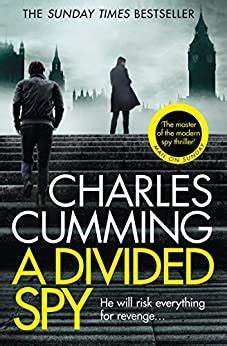
A Divided Spy - Charles Cumming


I've said it before and I'll say it again. Charles Cumming is the new British master of spy fiction. He is comparable with le Carre and Deighton. His range is wider than the former, his writing slightly more refined than the latter. Both octogenarian masters are brilliant constructors of plot and Cumming is near as dammit their equal.

A Divided Spy is the third Thomas Kell novel. It has a sense of ending about it but I am hoping it is just the third of a sub-trilogy within a longer series. It ties up storylines from A Foreign Country and A Colder War (both, of course, reviewed on this blog) and introduces a discrete, highly contemporary story about Islamist terror strikes on UK soil.

What more can I say? It is brilliant, thrilling, a masterpiece of its genre, compulsory reading for aficionados.

Thursday, 30 May 2019

City of Gold - Len Deighton


City of Gold is late period Deighton, from 1992. I don't remember hearing about it at the time and wonder if it wasn't the greatest hit. That said, even mediocre Deighton is better than most people's best and this novel is by no means mediocre.

The setting is Cairo, early 1942. Rommel is advancing on the city. The Allies cannot stop him. He seems to know their plans before they do. There is an obvious reason for this. Someone is leaking information. Major Cutler is heading for Cairo to find out who. He has a prisoner with him, Jimmy Ross, facing court martial for killing an officer. Cutler suffers a heart attack. Ross switches identities with him. He only intends to be Cutler temporarily, just until he can find a way of escaping properly, but events get the better of him. He finds himself wholly dedicated to finding the source of Rommel's information and in love with a beautiful girl called Alice.

Ross is by no means the only person pretending to be someone else. Cairo is full of people playing a role, whether it is the deserter Wallingford, pretending to be a special duty naval officer but in fact building a black market empire, or Dalrymple who has not formally deserted, just failed to answer orders. Then there are the sort of people who tend to gravitate to places like Cairo whether there's a war on or not. The Jewish financier Solomon, his Muslim opposite number Mahmoud and, best of all, the flamboyant Prince Piotr Nikoleiovich Tikhmebrazoff. On the fringes of this shady group is Peggy West, an English nurse whose husband Karl is supposedly working with the Zionist Jews in Palestine.

You can be confident Deighton has done his research. He tells us about it in his introduction to this 2010 reissue. The book is packed with colour and detail. Of course he knows his military history - Deighton has built a second career in the field. The story crackles along. Most of the storylines are resolved at the end. That said, it's not SS-GB.

Friday, 18 October 2013

Hurry On Down - John Wain


This is the book that is said to have started the Angry Young Men on their angry way.  Actually, it's more of a Movement thing, very slightly (1953) predating Amis and Larkin.  In essence, it's a classic English comic picaresque, the misadventures of Charles Lumley in the first year or so after leaving university.  What makes it different is that Charles has no mission (other than to find a mission) and sets himself firmly on a downward trajectory - accidentally becoming a window cleaner, car delivery driver (and crook), hospital orderly, chauffeur, nightclub bouncer and radio gag-writer.  What I especially liked was the dense quality of the writing.  I've always found Kingsley Amis somewhat glib and superficial whereas Wain seems to be always aware of the relationship between art and character.  There are some marvellous lines here, for example: "His life was a dialogue, full of deep and tragic truths, expressed in hoarse shouts by red-nosed music-hall comics."  Brilliant - a bona fide classic of the mid twentieth century.  This should be on the school curriculum.

And by the way, check out that superb cover art by Len Deighton.

Saturday, 31 August 2013

Moriarty - John Gardner


Three decades after the first two volumes (The Return of Moriarty and The Revenge of Moriarty), Gardner's third and final volume of the 'memoirs' of the Victorian super-criminal were published posthumously.  The immensely prolific Gardner died in 2007 and Moriarty appeared a year later.

Back in the day, Gardner was very famous - I remember the amount of publicity given the first two volumes, a stark contrast with the zero publicity afforded the third.  He was the first English writer to spoof the Bond genre (with his Sixties series of Boysie Oakes novels) only to be hired to by Fleming's executors to write to continuation Bonds in the Eighties.  He ended up writing fourteen original Bonds and the novelisations of two films, License to Kill and Goldeneye.  I remember reading the first, Licence Renewed but don't remember any more.  Certainly, they can't be any worse than Fleming's because Gardner is a much better writer, so it might be worth having a look.

The good news is that loads of Gardner's works are coming out in ebooks.  The Bonds are available now in America but not here yet.  The five Kruger novels are available here published by Bello, Pan's digital arm.  (I did not know that.)  The other great news is that Gardner has such a spiffy website, so his executors are clearly making an effort to keep his work alive.  Good on them.

Anyway, back to this book...  I loved Return and Revenge back in the Seventies and, only the other week, was musing on how good they were.  Then I went to the library and found this.  Did it excite me as much?  No, but I'm older and more miserable.  Did I enjoy it?  Yes, absolutely - great fun.  Did I admire it?  Again, yes - the thing about Gardner is the way he shows he has done his research without clouting you round the head with it in the manner of Len Deighton. 

I think digital Gardners will be joining my digital bookshelf ere long.

Monday, 5 November 2012

The Woman from Bratislava - Leif Davidsen


Albeit published by Eurocrime (a division of Arcadia Books) this is actually a post Cold War spy thriller - a multiviewpoint thriller, moreover, stretching to 450+ pages.

As so often with the genre, I was veered between tedium and delight.  The prologue is awful and unnecessary whereas the third strand (Irma's secret life) is necessary but deliberately unreliable.  It might have been better to use the Irma material as a prologue and ditch the self-conscious training lecture altogether.  The book really motors along when seedy lecturer Teddy (who encounters the titular woman in Bratislava) and secret policeman Per are driving the narrative.

Davidsen is a well-known Danish journalist specialising in Eastern Europe.  Boy does he know his stuff!  The book is worth reading for the info on Serbia and Bosnia alone.  His style here is more Deighton than le Carre - he really wants us to know he has seen these emerging nations first hand.  It is a clever ploy that the book isn't really about what happened after the fall of Communism.  Instead it's rooted in the shame that all occupied countries, including Denmark, have to deal with when they regain control of their destiny - what do you do with those citizens who joined the wrong side?

Apparently another of Davidsen's novels is available in English - The Serbian Dance.  I shall look out for it.  The translation here, by Barbara J Haveland, is very readable.  It could have done with better proof-reading, though.

Thursday, 20 September 2012

Billion Dollar Brain - Len Deighton


I've never really considered Deighton's spy novels because they are eternally linked with Michael Caine and I've not been much of a Caine fan (Get Carter excepted) since the movie of Funeral in Berlin bored me rigid as a film-fanatical ten year-old.  But I discovered Deighton's WW2 novels two years ago and couldn't resist this vintage edition when I found it outside my favourite book shop.

Deighton's work has certainly worn better than that of Ian Fleming.  Fleming was never much of a writer (I have revisited his work in the last couple of years); nor was Deighton in the early years - but Deighton has a much better sense of story, pace and tension, and a slightly better grasp of characterisation.  If nothing else, his fictions are more democratic.  Not everybody is public school or rich.  Not all the women are sex-crazed.

The 'brain' itself - a computer so big, it has to be stored inside a mountain - is so absurdly outdated that it simply doesn't matter.  Deighton gets away with it because he has taken the trouble to research his concept.  The Cold War has also gone; again, it doesn't matter because we trust Deighton when he tells us how important it seemed at the time.

I love the settings - from seedy Soho to Finland - all described in detail with the stamp of personal knowledge.  Even if it turns out Deighton just made the whole thing up, his writing style convinces us it's true.  It's not a mystery story but the twist at the end about the femme fatale was a cracker.

Period piece, yes - but none the worse for that.  Actually, I suspect Billion Dollar Brain is more enjoyable as a period piece than it was as a slightly futuristic thriller.