Total Pageviews

Showing posts with label radio drama. Show all posts

Tuesday, 25 June 2024

The Mad Islands - Louis MacNeice


 The Mad Islands is a radio play from 1962.   It is a fantasy derived from tropes of Irish mythoogy, with echoes of St Brendan and Hy-Brazil (spiced with a healthy borrowing from Hamlet).   Muldoon is off on a quest to find and kill the man, the Lord of Eskers, who killed his father.   His crew is a motley group led by the professional seafarer Ursach but including a jester and Muldoon's foster-brother.   They are soon joined and assisted by a being half-woman, half-seal and absolutely perfect for radio, called Skerrie.  Skerrie acts as their guide around the various islands, all of which are inhabited or ruled by people who are mad one way or another.   The hermit on his rock is religiously mad.  Sisters Branwen and Olwen are mad about their cats and even madder about the possibility of men.   The Miller of Hell is omnipresent.   It's all light and fantastical until the twist at the end, which is eminently satisfying.   Not up there with MacNeice's finest - The Dark Tower and Person From Porlock - but close enough.

Sunday, 3 July 2022

La Boutique - Francis Durbridge


Francis Durbridge (1912-98) dominated British detective fiction from the 1930s to the advent of the likes of P D James and Ruth Rendell in the 'Seventies and 'Eighties.  He wrote books but his true dominance was the radio serial and, later, TV.  Paul Temple was his calling card for more than sixty years, originally on radio, then on stage, and finally on TV, where each series was so prestigious it used to be announced as 'Francis Durbridge presents."  His scripts were translated and adapted for broadcast all over Europe.  In 1967 he was commissioned by the European Broadcasting Union to produce a series capable of being broadcast by all member nations.  La Boutique, in five episodes, is the result.

Durbridge here dispenses with Paul Temple.  Our hero instead is Superintendent Robert Bristol of Scotland Yard, summoned back from holiday at his sister's hotel in Venice after his composer brother Lewis is murdered in London.  At the heart of the case is the titular fashion outlet owned by Lewis's ex-wife and run by her oddly possessive female friend.

It must be forty years since I had heard or watched anything by Durbridge.  But these are radio scripts and thus explicitly my bag.  They are very impressive.  Durbridge doesn't waste time on fancy dialogue but he is an absolute master of radiophonic techniques, switching fluently from present time to flashback, from Venice to San Francisco.  And the all-action denouement was genuinely thrilling.

Williams & Whiting Books have scored a major coup getting hold of the Durbridge rights, and Melvyn Barnes provides a useful introduction.  The scripts themselves are unfussily presented and there is a nice collection of contemporary press cuttings at the end.  I will be buying more - the problem is, deciding which next.

Friday, 19 April 2019

Spaceways - Charles Eric Maine

I was reading Arthur C Clarke's Prelude to Space (reviewed below) in the 1953 paperback when I was struck by one of the ads in the back. Spaceways (never heard of it) was "originally a radio play, broadcast by the BBC in 1952 with immense success. Later it was made into the first British science-fiction film." As regular visitors must know by now, my doctorate is in radio drama and, as I say, I had never heard of Spaceways. As for movies, what about The Shape of Things to Come (1936)? That was science fiction, surely? It was certainly British (London Films). Anyway, I had to investigate further. Firstly I bought the book.


Not as good a cover as the Clarke paperbacks of the same era. The science is not as heavy as in Clarke, but ironically that results in it being closer to what actually happened - rockets taking off vertically in the middle of nowhere, rather than Clarke's fancy of horizontal runways. Maine, however, is a much better novelist than Clarke. His characters not only have inner lives, they have sex lives too, something the early Clarke would never countenance. In fact Spaceways is a genre hybrid, a noir-ish murder mystery based on the eternal triangle and set on a space research facility in the Nevada desert. Oh yes, I should have mentioned that. The pseudonymous Maine was British but this is an entirely American novel.


The other thing I should mention is that the novel is not directly based on the radio play. The radio play was turned into a Hammer movie, written by Maine, which he then turned into this book. I have looked up the credits for the radio broadcast, which seems to me to use the framing device of a court trial. It lasted 75 minutes, as did the film. The protagonist of the novel, Barry Conway of the Security Division of Special Services, is not in either the radio play or the movie. The movie seems to have a different plot to either the play or the novel. The central plot device, however, remains the same.


One of the key scientists is having a torrid affair with the wife of a senior colleague. The wife has cheated on the husband before, and he has responded violently. On the morning before the launch of the first space rocket (the novel is specifically set in 1955) the husband turns up for work with a black eye. When the rocket is safely heading for orbit, from which it will never return, it is discovered that both the wife and her lover are missing. The theory is that Hills, the cuckold, has killed them and stowed their bodies aboard the rocket. On that basis he stands trial, only to cause a sensation when he offers to prove his innocence by flying the second prototype rocket and bringing back the original. This is what happens - with an almighty twist, which I won't spoil for anyone who wants to seek out this curiosity for themselves - albeit I have as yet no idea whether it was remotely the same in either the play or the film.


And I do intend to take this further. The movie is easily available on DVD but the play will be harder to track down. In the meantime I have discovered that Maine did the same trick with other stories. Timeslip aka The Atomic Man is the movie version of his novel The Isotope Man, both of which I have already acquired.


As for the suggestion that Spaceways was the first British science fiction film, my interim theory is that whoever wrote the blurb in the back of the Pan was drawing a distinction between the post-Hiroshima technology-based fiction of Clarke, Maine and their contemporaries, and the purely speculative future fiction of Wells and Verne. Interestingly, directly underneath the blurb for Spaceways is an ad for The Time Machine and The Man Who Could Work Miracles (the latter a celebrated BBC radio drama of 1934, adapted by Laurence Gilliam). This describes H G Wells as, specifically, a "Pioneer of Space Fiction".


In the meantime, check out the long-forgotten Mr Maine. He really does merit rediscovery.

Thursday, 16 March 2017

The Growth of Milk Wood - Douglas Cleverdon


There are several things we all need to know about Under Milk Wood. Let's be clear, I am of the opinion that everybody needs to know Under Milk Wood as a towering slice of mid Twentieth Century verse. That said, there are a couple of factors we should always bear in mind when enjoying it.

First off, it is not a play. It has none of the hallmarks of a play, even experimental plays, which in English-speaking drama it predated. It is, specifically, a dramatic feature for radio, a form invented by the BBC in the 1930s and exported all around the world as the standard audio drama form during and shortly after World War II. American radio drama is in fact drama features. Radio drama in every Commonwealth country is likewise drama features. In every country they took as their model - often, indeed, as the first proper radio drama broadcast - The March of the '45 by D G (Geoffrey) Bridson. Bridson was a features man. He wrote and produced features. The March of the '45 is a feature. Confusingly, he also wrote plays, but that's another story.

Douglas Cleverdon was also a features man. He produced and put together features. He is the man who put together the first script for Under Milk Wood, broadcast in January 1954, two months after the death of its creator Dylan Thomas. Cleverdon also put together other versions for various stage productions. Thomas himself had written other material for Under Milk Wood, which Cleverdon chose not to use but which others have used since, notably the so-called 'Guide Book' section, which featured in the most recent radio revival I know of, directed by Alison Hindell in 2003.

Cleverdon was very much the champion of Under Milk Wood, the standard-bearer, but he was never the final arbiter. Thomas made Dr Daniel Jones his literary executor. Jones wrote the music for the songs but also ruled out some of the bawdier elements that Cleverdon wanted to include and which Thomas himself had included in the readings he gave in America, immediately prior to drinking himself to death. Recordings of the American sessions exist. A version of the BBC broadcast was released by Argos in 1954. A complete recording of that broadcast is available from the BBC itself. Other recordings exist. Dent put out a script which differed from the broadcast, also in 1954. Thomas himself had published extracts before he died.

The point is, Under Milk Wood was never finished. It is my firm conviction that Thomas would never have finished it. It was his drink-ticket (rather than his meal ticket) and even if he had lived to be a well-pickled centenarian he would have continued churning out variants so long as anyone was willing to pay for them. As it is, there are dozens of alternatives in existence - and that is what Cleverdon sets out to describe here.

It is a book for the specialist, granted, but given the status Under Milk Wood enjoys across various aspects of contemporary culture, I believe it is a book every specialist should have in their collection. And most don't - thus we get the ill-informed pontificating about the purity of Thomas's vision which diminishes the sheer generosity of what he actually wrote.

Thomas is the only modern writer for whom, like Shakespeare, we have variants, all of them (unlike Shakespeare) written by Thomas himself and intended to form part of the emerging whole. There is no canonical version - and if anything gets anywhere near a canonical version, I contend it should be the US recordings made after he gave Cleverdon the script upon which the first broadcast was based. Thereafter it is simply a question of personal taste.

Cleverdon also addresses the key question of what differentiates a radio feature from a radio play. It is a question I have to expound on every time I write about classic radio plays and now I can add the producer of the best-known feature to my repertoire.
Nobody outside the BBC (and, indeed, comparatively few inside) can be expected to distinguish between a radio play and a radio feature. A radio play is a dramatic work deriving from the tradition of the theatre, but conceived in terms of radio. A radio feature is, roughly, any constructed programme (that is, other than news bulletins, racing commentaries, and so forth) that derives from the technical apparatus of radio (microphone, control-panel, recording gear, loud-speaker). It can combine any sound elements - words, music, sound effects - in any form or mixture of forms - documentary, actuality, dramatized, poetic, musico-dramatic. It has no rules governing what can or cannot be done. And though it may be in dramatic form, it has no need of a dramatic plot.
In short, Cleverdon maintains that Under Milk Wood began as a radio play called The Village of the Mad but became a feature because Thomas couldn't devise a satisfactory plot.


I should also point out, in closing, that Cleverdon discusses the variants up to 1969, the date of publication. Other variants have arisen since.

Wednesday, 20 January 2016

The God of Glass - Peter Redgrove

We're into the dark meat here, only for those of obscure tastes.  Redgrove, of course, is best known as a poet, but he also wrote lots of fiction and drama.  God of Glass was originally a radio play, in which form it won the 1978 Imperial Tobacco award for best original radio play.  That is what brought it to my attention. As regular followers will know I am a Doctor of Radio Drama, perhaps even the only Doctor of Radio Drama.  My current exploration of the original radio work of Ted Hughes brought up the link with Redgrove (which is very apparent in this novelisation).  I haven't tracked down the radio script yet, but I will, and I have just acquired some more of Redgrove's plays which I will review here in due course.

Anyway, first and foremost The God of Glass reminds us that the Seventies were a long, long time ago.  I was doing my first Drama degree when the play was commissioned and dropping out in my native Lancashire witch-country when it was produced.  I remember those times but I had forgotten the sort of ultra-sexualised earth-goddess cult which Hughes and Redgrove explored in their work, even though I was living in the middle of it and knew many pre-New-Age practitioners.  I probably forgot about it because it was so over-the-top and - as the cover image of the 1979 original hardback above suggests - bloody.

Geoffrey Glass is an African man who, released from a life sentence, appears in Cornwall as a perfectly civilised shaman.  The village is being plagued by pubescent girls in the throes of demonic possession.  The vicar is killed in a failed exorcism (this was the era of The Exorcist, remember) and Glass, who hasn't been involved in any way before - that is to say, he did not create the possessions - joins in the cure with more success.  He is espoused by the mothers of the victims and soon a Glass movement is spreading across the country.  Glass becomes a national icon - only to submit himself to the judgement of his peers, the officers of his movement, chiefly from the Cornish village where it all began, when his past comes to light.  Then, in a worldwide live telecast, all hell literally breaks loose.

As to why it is subtitled "A Morality", who better than Redgrove himself to explain?

...because it seeks, by adopting the mode and idiom of a horror story of exorcism, to redirect attention to the serious themes of adult rebirth, and the dire consequences of masculine non-participation n feminine blood-mysteries, behind the usually conventionalised currency of the modern supernatural tale.
It is all very, very weird.  Even the style - disjointed chapters, of startlingly different length, with occasional poetry thrown in - is unique.  How anything like this was achieved on BBC radio I cannot imagine.  But I was completely hooked and am intrigued to explore further.  This is writing on the furthest frontier, not just in its day but now.  Further dispatches from the front will follow.

Tuesday, 22 October 2013

The Fort - Storm Jameson


I've got to be honest: my copy doesn't have a cover and I've borrowed the above image from the ever-reliable Fantastic Fiction.  Also, I only bought it because the title cropped up during some academic research I'm doing on another forgotten bestseller of the Thirties and Forties, Eric Linklater.

One reviewer described it at the time as a hybrid of a play and a short story.  No it's not, it's a novella and I'm sure the word was current in 1941.  Jameson wrote it in the couple of months immediately after the fall of France in June 1940.  It is set, specifically, on June 13.  A wounded English officer has taken refuge in the cellar of a French farmhouse.  Also hiding there is a French officer and two of his junior officers.  During the night another English soldier arrives and a German is captured.

What the story is really about is Jameson's utter contempt for the defeatist element of the French nation.  She does not make the mistake of over-egging the heroism of the English nor portraying the young German as just a mindless fanatic.  She is convinced both of the justice of the war (despite having been co-founder of the Peace Pledge Union in the late Thirties) and the damage it will surely do to the world.

The ending is a surprise which would have been much more powerful at the time.  As it happens, it is exactly the effect my subject Linklater pulls off at the end of his first radio 'conversation', The CornerstonesThe Fort was also adapted for radio in 1942.  You have to try and imagine the effect the ending had on British listeners enduring the Blitz.

Friday, 11 October 2013

Come Unto These Yellow Sands - Angela Carter


Angela Carter was a true enthusiast of radio drama which she found ideally suited to her gothic sensibilities.  For Carter, radio was the natural home of her fantastical creations.  So what we have here are the radio versions of Company of Wolves, Vampirella and Puss in Boots, plus the title play, a magnificent dramatic feature on the Victorian artist, madman and murderer, Richard Dadd.  I suspect I saw the same exhibition of Dadd's work from the madhouse that Carter did, sometime around 1973.  I too fell under the spell of The Fairy-Feller's Masterstroke.  We all did.

What Carter achieves here is a seamless meld of fact and disordered fantasy.  Doctors and Dadd's former friends discuss his condition whilst characters from his paintings - Oberon, Titania and the Fairy-Feller himself - discuss their own reality.  Magnificent.  Very few radio plays nowadays attempt anything remotely so ambitious, and the situation is likely to get worse as we goes weeks on end without Drama on 3 and the plays on 4 become every more like bad TV.  So transport yourself back to the late Seventies and early Eighties when Carter was working in radio and remember that they did these things differently back then.

For a longer, more scholarly review click here.

Sunday, 21 October 2012

Dylan Thomas in America - John Malcolm Brinnin


The classic account of the poet's last days, written by the American poet who organised his US reading tours and produced the first live performances of Under Milk Wood a year before British audiences heard it.  It adds adds several layers to the standard impression of the roistering Welsh bard.  For a start it is in no sense hagiographic; even though it was published in the US in 1955, barely a year after Thomas succumbed to alcohol poisoning in New York in November 1953, Brinnin offers a study of a man at war with himself, conflicted between art and self-indulgence, who often behaved appallingly but who was also appallingly treated by those closest to him.  What brings the book startling to life is the realisation that Brinnin has fallen in love with Thomas, hence the enmity of Dylan's legendary wife Caitlin, who is not gently depicted but who nevertheless endorses the book with a foreword.  The final, unflinching account of Dylan's last days, comatose in St Vincent's hopsital whilst Caitlin trashes the waiting room and brawls with nuns in the throes of a drunken mental collapse which soon sees her banned from the hospital and voluntarily committed to a psychiatric hospital, is truly eye-watering.

The book's greatest strength is that Brinnin confines himself solely to what he witnessed or uncovered.  There is no mention of anything before February 1950 when, as the newly-appointed Director of the New York Poetry Centre, Brinnin invited his idol to visit the Big Apple.  What particularly interested me was the alternative account of the creation of Under Milk Wood.  Brinnin encounters the work already part-written but still has to pressure Thomas into making it ready to be read publicly and subsequently acted.  At the same time, of course, though Brinnin knows nothing of it, the BBC was having exactly the same problem.  In a sense Brinnin and America win because they get to see Thomas read his own work and perform it with actors.  Brinnin also tells us that Thomas was still making changes and writing new material until his health finally collapsed.  Thus what Brinnin saw in New York in October 1953 was almost certainly different to what the BBC broadcast in January 1954, neither version was a finished work and neither was entirely what the poet had envisaged.

This classic Aldine paperback from 1956 is a companion piece to the February 1954 Aldine edition of Under Milk Wood on which I have based all my scholarly writing about the work.

I do this because we can pretty sure this is text that Douglas Cleverdon put together for the BBC production.  (My research has demonstrated that other published texts, even those published after the broadcast, differ significantly from the performed texts.) Others - including Cleverdon - have since re-edited and generally tinkered, usually making it less impactful in my view.  Surely the only text better than this - or, more precisely, closer to Dylan's last view of what it should be - would be the text performed in New York at the end of October 1953.  I wonder if that exists anywhere?

Odd, isn't it, that the publishers only seemed to have the one photo of Dylan?

Monday, 13 August 2012

La Manivelle/Lettre Morte - Robert Pinget


La Manivelle is only real known because Pinget's friend Samuel Beckett translated it (The Old Tune, available in all his collected works and the British Library complete radio plays recording). Well ... actually he did a lot more than translate it. Even the characters' names are changed and the action is relocated from Paris to Dublin. That makes a difference and, like it or loathe it, there is no way of judging what is Pinget and what is Beckett without comparing the two - which is why as a serious student of modern drama or just Beckett alone you need to have this bi-lingual edition. The other play included here, Lettre Morte, is a one-act stage play and no translation is provided. There is a translation available by the BBC radio producer Barbara Bray, who also translated the 'suite radiophonique' About Mortin. If you really want to know why it's unfair that Pinget has been eclipsed by Beckett, you should check out About Mortin.

Thursday, 31 May 2012

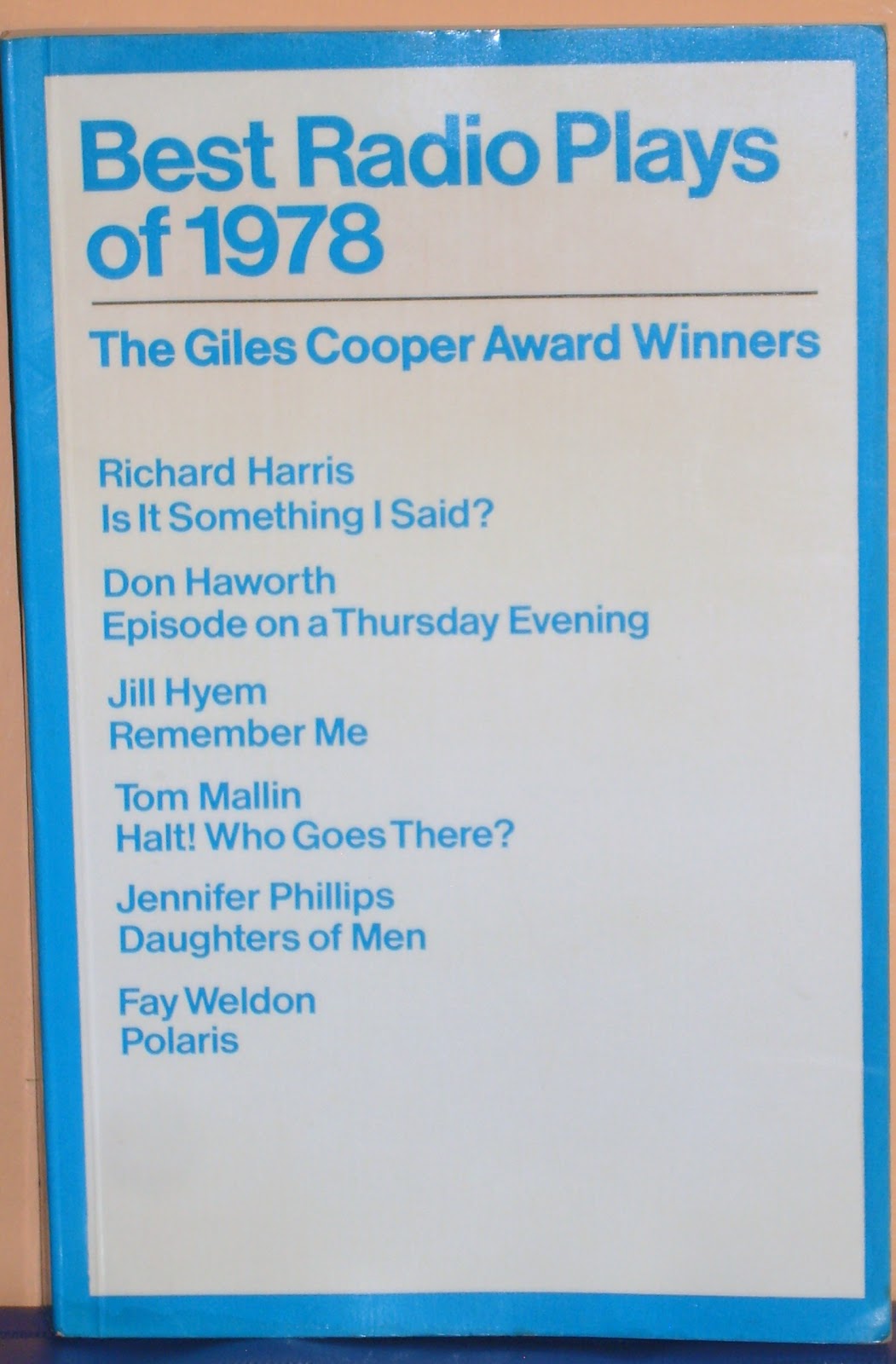
Best Radio Plays of 1978


Eyre Methuen's collections of each year's Giles Cooper Award Winners are an invaluable source of quality British radio scripts, often by major writers of the period.  Fay Weldon, of course, is a major writer of any period.  Her play Polaris for the Afternoon Theatre slot on Radio 4, about the pressures of service on a newly-married couple, is brilliantly done.  The submarine captain, endlessly banging on about his food, is deftly characterised in a few lines.

Richard Harris's Is it Something I Said?  struck me as a fairly cynical twist on John Mortimer's celebrated Lunch Hour.  Don Haworth, born in the same as I was, was a radio drama master.  His plays are always interesting, often slightly off-beam, as this one is, and invariably surprising. 

Tom Mallin was a fascinating character; primarily a visual artist, he scored a major hit with his stage play Curtains (1970).  Halt! Who Goes There?, the Mallin play given here and orginally broadcast in the cutting-edge Drama Now slot, was his sixth and final radio original.  It's about Arnold, marooned in a fascistic convalescent home after his cancer op.  Tom Mallin died of cancer in 1977, before the play was performed.  He was only 50 years old.

Jill Hyem, co-creator of the radio soap Waggoners Walk, is another prolific radio dramatist.  Remember Me is typical of the now defunct Saturday Night Theatre slot, the sort of thing that is now probably a four-hour/two-part TV mini series.  It's enjoyable and slightly daft.

Jennifer Phillips wrote Daughters of Men for the Monday Play, another key slot that has been callously let go.  The Friday Play, which was threatened with abandonment last year but is still clinging on, filled the gap to a certain extent.  Daughters, certainly, could be played there.  To my mind it was the most stimulating play in this collection.  It is about the social worker preparing court reports in a child custody battle.  The denouement is truly shocking, even today.  A stage version followed at the Hampstead Theatre Club in 1979.