Total Pageviews

Showing posts with label playscript. Show all posts

Thursday, 14 December 2023

The Slab Boys Trilogy - John Byrne


 The great John Byrne, who sadly left us earlier this month, was hailed as one of Scotland's greatest contemporary artists.   But he originally made his name as a playwright, with The Slab Boys (1978), which deals with his life before getting into art school.   Byrne's fictional persona is Phil McCann, who is 19 years old in 1957 and working in the colour preparation department ('Slab Room') of Stobo & Co, Carpet Manufacturers.   His oppo is George 'Spanky' Farrell and their mutual victim Hector Mackenzie.   All are smitten with the comely Lucille, who shows no interest whatsoever in any of them.

It is a play of coming-of-age at a time when tides were turning.   It is a vivid evocation of the industrial life where young lads had very little to do and therefore indulged in high jinks.   It was notably successful around the UK in the late seventies and two follow-ups ensued, Cuttin' a Rug (1979), which takes place the same evening, at Stobo & Co's Christmas bop, and Still Life (1982) set ten years on, in 1967, and then five years later in 1982.

Cuttin a Rug, I have to say, didn't do it for me.   It was originally a radio play, The Staffie, then it became a stage play (Threads), then The Loveliest Night of the Year and finally this.   On radio I can see it working well.   On stage and on the page it reminds me too strongly of Willy Russell's Stags and Hens, one of very few creative works which I actually despise.   The problem is, it is all action 'off'.   The dance is going on in the ballroom and from time to time we are meant to hear what is going on.   The action we see, however, is in the gents and ladies' cloakrooms (Act One) and then the terrace where revellers go to do whatever.   It is, frankly, overwrought.   Ironically, given it is supposed to be the coming of age of the Slab Boys, the standout characters are tea-lady Sadie and the frustrated spinster Miss Walkinshaw.

Still Life, on the other hand, is much more successful.   Phil is now a working artist, albeit unsuccessful.   Spanky is still at the carpet factory but is trying to make it as a musician.   Spanky has married the divine Elaine and they have a baby daughter.   The setting is the Paisley cemetary.   The funeral that brings them together is for poor Hector, done to death with a brick by a man he was having sex with in a cubicle at the swimming baths.

Hector had episodes of mental illness and was sectioned for a time.   Phil's mother had lifelong mental issues (as did Byrne's mother, and with reason - Byrne believed he was the product of incesr between his mother and her father), which gives Phil a reason for attending.   Spanky has simply seen it in the paper.  The narrative thread of Slab Boys was, will Phil get accepted at the art school?   The thread of Still Life Act One is, will Spanky's upcoming appearance on Juke Box Jury lead to better things?

It does, and in Act Two we are still in the cemetery but Spanky is just off a plane from the States where he is a major rock star.   Phil is still a jobbing painter but now he is married to Lucille and has adopted her daughter with Spanky.   He is back in the cemetery to see the memorial stone for his mother.   The play works well.   The jokes are dark but the main characters have all mellowed and the ending is upbeat. 

It should be noted, there is a fourth instalment, making it a tetralogy - Nova Scotia (2008), which I have got hold of but haven't yet read.   Menawhile, surely someone is planning to revive The Slab Boys?  A great play should never die.

Tuesday, 28 November 2023

Original Sin - Peter Gill


 Having rediscovered the work of Peter Gill, who was big when I was a drama student first time round, with The York Realist, reviewed below, I was keen to read more.   I picked up Original Sin, first produced at the Sheffield Crucible in May 2002.   This is, in fact, the edition published to accompany the premiere.

Original Sin is Gill's take on Frank Wedekind's Pandora plays, Pandora's Box and Earth Spirit, which I had tried to find when I was originally a drama student and couldn't find.  I still haven't read them but they are now on my must-read lisr.

Pandora, of course, is famously Louise Brooks in the Pabst movie.   Gill shifts the timeframe back to the era of Oscar Wilde.   Gill's object of desire is Angel, who has risen from the gutter to be the adored idol of society.   He has been raised by newspaper magnate Lionel Southerdown and is now being painted by society artist Eugene Black.  From there, everything falls down.   Black kills himself for love of Angel and Southerdown manipulates Angel into shooting and killing him.

Angel flees to France with his adopted brother, Henry Southerdown, now his lover.   Henry is ruined in a Stock Exchange scandal and Angel ends up touting for trade in a Whitechapel slum, where he shares the ultimate, gruesome fate of Wedekind's Pandora.

Gill's play is epic in length, scope and achievement.   Everyone around Angel is motivated by sex and money, yet Gill is such an expert in characterisation that Angel is absolutely no angel.   I kind of always knew his ultimate fate (I might not have read Wedekind's original but I have read a good deal about it) but was intrigued to discover how it came about.   That's the whole point.

I was impressed by The York Realisr.   I was extremely impressed with Original Sin.


Thursday, 19 October 2023

The York Realist - Peter Gill


 Another playscript, this time by writer-director Peter Gill, perhaps best known for staging the plays of D H Lawrence in the Seventies.   The play, originally mounted in 2001 and revived inb 2018, is about a farm worker, George, who is put forward for and gets a part in an amateur production of the York Mystery plays.   He falls for the assistant director, John, who wants George to try turning professional, but George won't leave his mother and family and the farm.   So they continue a secret relationship for several years until John returns to attend Mother's funeral.

It is all expertly done.   The supporting characters are vividly drawn, as is the harsh reality of life on the lowest rung of the agricultural ladder.   The trap George finds himself in is evoked particularly in the character of his brother-in-law Arthur, who has escaped it.   The relationship between George and John is delicately done, but what makes the play stand out is Gill's technique for handling time and memory.   The audience - or in my case the reader - has to pay that bit of extra attention which inevitably makes engagement to a deeper level.

Gill uses the same technique in the two linked plays, The Look Across the Eyes and Lovely Evening, which accompany The York Realist in this 2018 edition.   These are set in Cardiff, where Gill was brought up, in the late Forties and early Fifties (Gill was born in 1939).   They focus on the household of May and Harry, before and after May's death.   In the first play their oldest son Laurence, who is also our narrator, is sixteen.   Laurence the narrator, though, is in his thirties; in both plays, therefore, he is looking back.   In The Look Across the Eyes, May's single brother Jimmy - a docker like Harry - is invited to move in.   He is still there, a permanent fixture with the widower Harry and the adult Laurence.   In Lovely Evening Laurence has taken on May;s household duties, looking after the two ageing brothers-in-law who go about their mysterious and separate evening activities.

So that's three slice-of-life working class dramas in a style I find increasingly appealing.   Gill is a very fine playwright and I'm keen to get hold of more of his published scripts.

Sunday, 15 October 2023

The Governor's Lady - David Mercer


A Methuen Playscript from my youth is always a fun find.   This is extra special in that it's a one-acter from 1965, originally staged by the RSC at the Aldwych as part of a programme called Expeditions Two.

I never considered David Mercer to be either experimental or absurdist, but The Governor's Lady is both.  Lady Harriet Boscoe is the widow of Sir Gilbert, governor of an unnamed African territory on the verge of seeking independence.   Unexpectedly, Gilbert returns.   His manners have deteriorated somewhat.   He now feasts on bananas, smashes crockery for fun, and demands sex.   He has, indeed, reverted to being a gorilla.

It is a one-acter, lasting perhaps half an hour.   But it is in seven scenes with quite complex changes in between.   Yet Mercer, an emerging playwright at the time, handles the stagecraft with astonishing flair.   That is all very well, but what stood out for me was the way he can evoke emotion in such a crowded format, whilst juggling issues of colonial racism which (we should remember) were still controversial in 1965.

In it's small way, The Governor's Lady is a mini masterpiece that would still be worth putting on today - though I doubt we could find two such perfect characters for the leads as Patience Collier and Timothy West.

Monday, 13 March 2023

Death of a Salesman - Arthur Miller


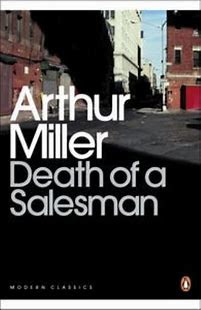
 The classic play from 1947, in a fresh Penguin Modern Classic edition with a besautifully evocative cover.  Miller sets out to do what nowadays seems impossible to conceive - a tragedy played out in suburbia.  Yet he achieves everything he wanted.  I can't remember reading a playscript so moving, with characters that leap off the page.  And as a four-time graduate in drama, let's just say I have read a lot of playscripts.

Willy Loman is a travelling salesman, thirty-five years on the road, but he's coming to the end.  He literally can't keep his mind on the road, which makes him a danger to himself and others.  He can't afford to retire, nor does he want to.  The road is his life.  The road enables him to maintain the illusion he's a big shot, a success.  Being at home is, for Willy, a reminder of failure.  Whatever his successes, real or imagined, as a seller of goods, as a father and provider he's a dud.  His two thirty-something sons are back in their boyhood bedroom, Biff a failed football player back from being little more than a bum out West, and Happy, assistant to a deputy in some dead-end business.  The house Willy has slaved to buy is crumbling, like the car and refrigerator both on hire purchase.

The rwo days we experience in the two acts are when the tragedy builds to its inevitable climax.  All the lies, the pretences, the missed opportunities - all come crashing down.   I didn't spot a flat note in the entire script.  What a challenge for actors!   What a feast for play-goers and those, like me, who can now only bear to read plays, such is the decayed condition of the theatre in Britain.   A reminder of what once was possible.

Tuesday, 21 May 2019

Plays 2 - Stephen Poliakoff


Poliakoff really has a thing about his granddad, doesn't he? It's understandable - a Russian inventor turned British millionaire - but it so heavily stressed in three of the four plays here (and in the new TV series Summer of Rockets, which starts on BBC2 tomorrow night) that you can't help wishing he'd get over it.

Breaking the Silence (stage play, 1984) is fairly and squarely about old Joe P, albeit he's called Nikolai here. Nikolai is a rich Jewish inventor trying to get his family out of Bolshevik Russia whilst at the same time inventing sound film. It's a cracking, hugely ambitious piece which only a state supported theatre (in this case the RSC) could possibly mount. The whole thing is set on a railway carriage which gets shunted further and further away from centres of influence, whilst Nikolai half-heartedly pretends to be an official inspector. Trains are another recurring motif for Poliakoff. Poliakoff the young writer is, as ever, present in the character of Nikolai's son Sasha. Thus we have the perfect Poliakoff prototype: Sasha and the inventive Russian aristos on a Train going nowhere.

Playing with Trains (stage play, 1989) is an obvious continuation of the theme. In this case the inventor-father is British who has become rich by making key improvements to the inventions of others. Then he stakes everything on a revolutionary rail-road vehicle  - and fails. Here, the role of Sasha Poliakoff is shared between Bill's son Danny and the son Bill would like to have had, his co-inventor Mick. There are great ideas at play here but the play itself doesn't convince because it lacks all sense of place. The set is minimal to allow for quick changes, almost as if Poliakoff feels restricted by the stage and wants to move on to TV and film.

She's Been Away (TV film, 1989) is the exception here because it's not Russian, has nothing to do with anyone's grandfather, and the Sasha character isn't in it. It is not Poliakoff's first original work for TV; that was Stronger than the Sun in 1977, followed, inevitably, by Caught on a Train three years later).Lillian is the one who has been away, locked in a mental hospital for decades because of sexual shenanigans as a child. Her nephew Hugh, an honourable and rich man, has decided to do the right thing and provide her with a room in his mansion in Holland Park. Lillian (a late swansong for the great Peggy Ashcroft) is uncooperative, stubborn and resourceful but in the end she saves the day.  This is a charming, sensitive and thoughtful piece which, fortunately for us, Poliakoff continues to produce thirty years on.

Century is an actual movie, directed by Poliakoff, which came out on New Year's Eve 1993. Eccentric Russian granddad is back (played by Robert Stephens whose son Toby succeeds to the role in Summer of Rockets). Instead of Sasha our youthful protagonist is more akin to Stephen Poliakoff's brother, the eminent chemist Sir Martyn. It is New Year's Eve 1899, which Mr Reisner insists is the last day of the 19th century - a quirk which has set him at odds with his local council which rightly argues that the new century begins on January 1 1901. This is a good joke, reflecting the debate which was probably just beginning in 1993 about when we should celebrate the Millennium. Mr Reisner's son Paul is a newly qualified doctor, off to London to join the research institute newly founded by the celebrated Professor Mandry. New hope soon falters, however, when Paul discovers that Mandry is a pioneer of eugenics. That is a stunning turn of events, which Poliakoff handles magnificently, especially when eccentric Mr Reisner blunders in on the climactic confrontation.

Sunday, 20 August 2017

Good & A Nightingale Sang... - C P Taylor

C P Taylor was a Glaswegian Jewish Marxist autodidact playwright who lived and worked in Newcastle and who died ridiculously young in 1981. He was only in his early fifties yet had written some 80 plays for stage, TV and radio, in just 20 years.


Good is his masterpiece, a last-minute breakthrough onto the national stage when the RSC staged it  in London just three months before Taylor's death. It is an examination of the axiom generally attributed to Edmund Burke: All that is necessary for the triumph of evil is that good men do nothing.
Halder is a good man, a university professor who supports his scatterbrained wife and dutifully visits his senile mother in the nursing home. But this is Germany 1933 and the Nazis are on the rise. Halder is dismissive, even mildly subversive. He has a Jewish friend, the psychiatrist Maurice, and a taste for 'degenerate' American-style jazz.


No doubt influenced by his mother's distressing condition, Halder has written a book which can be read as advocating euthanasia. This attracts the attention of Nazi racial purists. They make overtures to Halder, gradually drawing him into their circle. He initially resists, but as time goes on his qualms are overridden by the need to earn a living. His mother is now back living with him, his wife is even more hopeless about the house, and Haldane has started an affair with one of his female students. The Nazis understand these things. They are supportive, even seductive. Slowly, Halder starts to distance himself from his friend Maurice...


Taylor had made himself a master of open staging through his association with studio theatres like the Traverse in Glasgow and the Live Theatre Company in Newcastle. He also worked in community drama, and thus was able to handle large casts and overlapping scenes. Good is a fine example of both disciplines. Halder is onstage almost all the time, accompanied by a live jazz band (a very Taylorean device). The other characters effectively come to him. Very unusually, several scenes overlap, with Haldane switching in and out of conversations with different people in different locations and even at significantly different times. Only a writer at the height of his game could pull this off and it takes a very special actor to accomplish it onstage. The late great Alan Howard, a consummate stage actor and the best Hamlet I have ever seen, created the role in London and New York.


If Good is Taylor's take on Brechtian Epic Theatre, the other play in this Methuen edition deploys many of the same techniques on a more domestic scale. And a Nightingale Sang... (1977) is the story of the working class Stott family of Newcastle, from the day World War II broke out (September 3 1939) to VE Day (May 8 1945). Although the action primarily takes place in the family home, it instantly moves elsewhere (chiefly the bench in Eldon Square where lame spinster Helen meets her married lover Norman for illicit purposes). There are times when two things are happening simultaneously, as when Eric is waiting nervously in the parlour while the women are upstairs with Joyce, trying to persuade her to come down and be proposed to. George Stott, the father, bangs away on the upright piano - all the popular songs - while Mam Peggy consoles herself with Catholicism and Peggy's father Andie wanders from one daughter's house to the other, starting with his dead whippet in a bag and ending up hiding from the amorous widow who wants to marry him.


It's a dialect play - a dialect I have always known and liked, though I daresay it limited the play's chances in the South back in Taylor's lifetime. We are now used to the device of setting a scene (and, better, underscoring the action) with period popular music, but it should be noted that A Nightingale Sang... preceded Dennis Potter's Pennies From Heaven by a full year. There is much more breaking down of the fourth wall in Nightingale than in Good, and appropriately so, given that so much of what we hear is Helen's personal inner life. The final scene, in which she dances, not with faithless Norman who has scurried home to mother and wife in the Midlands, but with Joyce's rapscallion hubbie Eric, features both soliloquy and music - the Nightingale finally does dance - and it is heartbreaking.


Not being active in the business these days, I have no real way of assessing where Taylor's reputation stands today. Wherever, it should be higher. I have other plays of his about the house, collected while he was still alive and writing. I must look them out.

Friday, 11 October 2013

Come Unto These Yellow Sands - Angela Carter


Angela Carter was a true enthusiast of radio drama which she found ideally suited to her gothic sensibilities.  For Carter, radio was the natural home of her fantastical creations.  So what we have here are the radio versions of Company of Wolves, Vampirella and Puss in Boots, plus the title play, a magnificent dramatic feature on the Victorian artist, madman and murderer, Richard Dadd.  I suspect I saw the same exhibition of Dadd's work from the madhouse that Carter did, sometime around 1973.  I too fell under the spell of The Fairy-Feller's Masterstroke.  We all did.

What Carter achieves here is a seamless meld of fact and disordered fantasy.  Doctors and Dadd's former friends discuss his condition whilst characters from his paintings - Oberon, Titania and the Fairy-Feller himself - discuss their own reality.  Magnificent.  Very few radio plays nowadays attempt anything remotely so ambitious, and the situation is likely to get worse as we goes weeks on end without Drama on 3 and the plays on 4 become every more like bad TV.  So transport yourself back to the late Seventies and early Eighties when Carter was working in radio and remember that they did these things differently back then.

For a longer, more scholarly review click here.

Sunday, 6 October 2013

Serjeant Musgrave's Dance - John Arden

 
Classic stage play in the classic Eyre Methuen blue paperback, the badge of quality when I began collecting drama.  Serjeant Musgrave was first performed at the Royal Court in 1959, produced by Lindsay Anderson.  Every element of that sentence is a badge of quality.

 
It was resonant then and it's resonant now because it is more than anti-war play; it is, to my eye anyway, anti pointless colonial wars which also asks the question, what do you do with a standing army in peacetime - why loose it on the working class, of course.  How often have we seen that?
 
For those unfamiliar with Arden's blend of Brecht and folk tradition the writing might seem difficult.  If so, the trick is to read it aloud.  Then it sings.  Arden came towards the end of the Angry Young Men era but he continued writing longer than any of the others and, more importantly, kept his anger stoked to the very end.