Total Pageviews
Saturday, 30 March 2019
Jack the Ripper - Daniel Farson
Farson's 1972 book introduced the barrister Montague Druitt as Number One Suspect. Actually - as is so often the case with this fascinating work - he put the name to the suspect that Leonard Matters had known about and dismissed in the first ever Ripper book (1928). Farson claimed to have seen the famous Macnaghten Memorandum, a note written by the man who took over as head of the Met immediately after the murders ceased. Farson would have us believe that Macnaghten wrote in his official capacity, a summary document to close the file. Actually what Macnaghten did (and Matters proves beyond reasonable doubt) is copy out Major Arthur Griffiths' suspect list from his 1898 Mysteries of Police and Crime (Part 1). Griffiths had overseen prisons but had never served with the police. He did, however, have extensive police contacts and it may well have been that both Griffiths and Macnaghten got their information from the same source. Was that source authoritative? Probably not, given the insistence that police inquiries wound down after Druitt's body was fished from the Thames on December 31 1888, when in fact key frontline investigators believed the Ripper continued killing. Inspector Reid turned up at various prostitute murders well into 1889 and 1890, and Inspector Abberline was apparently convinced that George Chapman (caught and hanged 1903) was the Ripper.
Farson's book is frankly nowhere near as good as Matters' original. Farson never gives us sources we can check whereas Matters always does. Again, the fact is, Matters shows us, almost half a century earlier, how weak Farson's theory really is. Farson's suspect is a reasonable candidate, whereas Matters' nominee is well nigh ridiculous; on the other hand, Matters' research is thorough and documented whereas Farson in the end resorts to absurd assertions. Farson also claimed (I haven't yet checked if the claim is true) that he is the first to produce a photograph of Druitt. He then goes on to shoot himself in the foot. Is that a glint of madness in the eye, he asks. Answer: no it isn't. Is that an incipient moustache? Absolutely not.
Actually, Farson's research, such as it is, was done for a pair of TV documentaries aired over a decade before the book came out (Farson was an early star of ITV). While the programmes were still be edited, the research dossier mysteriously disappeared, which raises rather obvious suspicions. Nevertheless the book was a big success (as the TV version had been) and really ushered in the great wave of Ripperology that persists to this day. It is essential and enjoyable reading. Farson has an engaging style - but I wouldn't trust him as far as I could throw him.
Thursday, 28 March 2019
The War Hound and the World's Pain - Michael Moorcock
The War Hound and the World's Pain (1981) is, I believe, the first of the von Bek series. I say 'believe' because Moorcock continues to revise and rebundle his back catalogue. There is definitely a walloping Von Bek single volume - I have seen it - and some apparent authorities mention a trilogy, though the complete Von Bek seems more than three times the size of this instalment. I therefore decided to go with the series as originally written and published.
I was surprised to find Ulrich von Bek starting out as a mercenary in the Thirty Years War 1618-48. The war was always silly U and went on far too long. Ulrich has certainly had enough, so he abandons his troop and rides off into the wilds of Germany. He finds himself in a forest. He realises that there is no bird song, no stirring of animals in the undergrowth. He finds a palatial castle - stocked with food but utterly uninhabited. Von Bek helps himself. The beautiful Sabrina arrives. He helps himself there, too. After some weeks of this Sabrina introduces him to the castle's owner, the fallen angel Lucifer. Lucifer, it turns out, has also had enough - enough of trying to keep the peace between the dukes of Hell, enough of being at odds with God who once loved him. Lucifer makes a pact with Ulrich. If Ulrich can recover the holy grail, which Lucifer can offer to God as a peace offering, then Ulrich can have his soul back and Sabrina.
Thus the quest begins... taking Ulrich and his companion Grigory Sedenko to the World's End, which mostly turns out to be an alternative world called Mittelmarch which co-exists within and alongside the real world. He fights various hellish enemies, mostly controlled by Johannes Klosterheim, former employer of the boy Sedenko, who is on a similar quest. Von Bek is assisted, from time to time, by Philander Groot, the dandy-magus, an echo of the sort of hero Moorcroft was developing in his rococo period ten years earlier.
The characters here are all well written. I especially enjoyed the angelic Lucifer and, of course, Groot. The story was compelling; at this stage of his career Moorcroft had the gift of writing exactly the amount his concept could bear. Whilst we know the story will continue, which it does in The City in the Autumn Stars, the quest here is self-contained - a good job given that the second instalment didn't arrive until 1986 which, given Moorcock's breathtaking productivity, must have seemed an age to keen readers.
Friday, 22 March 2019
The Ashes of Berlin - Luke McCallin
The Ashes of Berlin is the third of McCallin's Gregor Reinhardt novels. I reviewed the first, The Man From Berlin, earlier this year.
The date is 1947 and Reinhardt, a veteran of both World Wars, has returned to Berlin and his old job as a Police Inspector. The police department is chaos, filled with misfits and plants from each of the occupying powers. Reinhardt might be considered an American plant. He lives with the widow of his old mentor and shares his room with his former Kripo partner Rudi Brauer.
Reinhardt prefers the night shift when he is often alone. One night he is called to a double murder in the American sector. This launches him into an investigation of a serial killer. An officially illegal organisation for supporting former servicemen is involved. The victims all seem to have been associated with an off-the-books wartime operation in North Africa.
By about halfway through it has become clear who is responsible. Reinhardt himself has met the killer but he hasn't managed to see his face. Finding him and thus stopping him becomes the final challenge.
The book is excellently written and I had never a moment's doubt as to the astonishing depth of research on show. For this sort of story, in this setting, I wouldn't know where to begin. The final revelation, though, was a disappointment. Yes, McCallin had planted the clues from the beginning, but the killer's backstory just wasn't convincing for me. This sometimes happens. It by no means puts me off trying the volume I missed (The Pale House) or picking up the next Reinhardt when it comes.
The date is 1947 and Reinhardt, a veteran of both World Wars, has returned to Berlin and his old job as a Police Inspector. The police department is chaos, filled with misfits and plants from each of the occupying powers. Reinhardt might be considered an American plant. He lives with the widow of his old mentor and shares his room with his former Kripo partner Rudi Brauer.
Reinhardt prefers the night shift when he is often alone. One night he is called to a double murder in the American sector. This launches him into an investigation of a serial killer. An officially illegal organisation for supporting former servicemen is involved. The victims all seem to have been associated with an off-the-books wartime operation in North Africa.
By about halfway through it has become clear who is responsible. Reinhardt himself has met the killer but he hasn't managed to see his face. Finding him and thus stopping him becomes the final challenge.
The book is excellently written and I had never a moment's doubt as to the astonishing depth of research on show. For this sort of story, in this setting, I wouldn't know where to begin. The final revelation, though, was a disappointment. Yes, McCallin had planted the clues from the beginning, but the killer's backstory just wasn't convincing for me. This sometimes happens. It by no means puts me off trying the volume I missed (The Pale House) or picking up the next Reinhardt when it comes.
Friday, 15 March 2019
The Three-Body Problem - Cixin Liu
The Three-Body Problem is the first part of the trilogy Remembrance of Earth's Past.
It would be simplistic to compare Cixin Liu to Haruki Murakami, especially as both have written novels with similar-looking titles - China 2185 and 1Q84 respectively. But in truth there are very few similarities other than the fact that we in the West are extremely ignorant of contemporary trends in oriental literature.
Hurakami is a fantasy writer who dabbles in science fiction. Liu is hard-wired sci fi. There is a touch of fantasy in this novel but only as a literary device to introduce the male protagonist to the core idea of the book. Wang Miao is a researcher in nanomaterials, so you get an idea of just how extreme the central premise is. He is introduced to a VR game called Three Body. In the game historical scientists - some so ancient as to be mythical - try to solve the problem of an unstable world which crashes from civilisation to apocalypse and back again. Only the most knowledgeable and persistent players work out the answer and when they do they are invited to share a secret - that the world of the game is real and that the inhabitants of that world have been in touch.
The female protagonist Ye Wenjie watched her astrophysicist father get stoned to death during the Cultural Revolution in 1967. An astrophysicist herself, she is taken to a rural outpost for 're-education'. She starts at the bottom of the hierarchy, working with the basic mechanics of the radio scanner. But she progresses. The work becomes her obsession and she abandons hope of ever re-joining civil society. Eventually she is sufficiently trusted to be allowed into the secret of the real purpose of the scanner - the search for extra-terrestrial life - and she is on duty when the first message comes through.
After twenty years or more, China has changed. It has opened up, to a certain extent, to the West. Ye Wenjie is restored to academia. She develops followers, with whom she creates the Three Body game. She ends up, in the 'present' of the novel, which is a few years in the future, as the secret high priestess of the cult awaiting the arrival of the extra-terrestrials. Other secretive factions, including international security services, are not so keen.
Whilst it is not an easy read, especially for the science-phobic like me, The Three-Body Problem is nevertheless an extraordinary achievement. Cixin Lui is a scientist and obviously knows his stuff. He is equally in command of literary devices: the meta-drama of the game, the seamless sliding through time, even a spot of noir crime. I genuinely have never read a book like this. I simply have to read the next in the trilogy, The Dark Forest.
Sunday, 10 March 2019
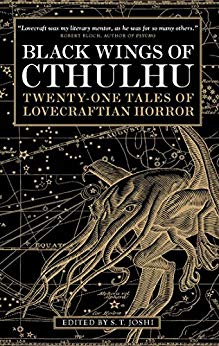
Black Wings of Cthulu (1) - S T Joshi (ed)
It's a measure of the influence of H P Lovecraft that so many others have written in homage. This is a substantial collection of 21 stories of varying length and Joshi has gone on to edit nine more to date - and these, of course, are just in reference to the Lovecraft's Cthulu or Elder Gods stories. He wrote plenty more that are more straightforwardly Gothic.
There are no bad stories here. I can only therefore mention my favourites. Caitlin R Kiernan's "Pickman's Other Model" gets the collection off to a flying start. I liked Sam Gafford's "Passing Spirits" and I loved "Inhabitants of Wraithwood" by W H Pugmire, which also develops Lovecraft's story "Pickford's Model", as does Brain Stableford in "The Truth About Pickman".I tend to prefer the longer stories but the one here that stayed in my mind the longest was "Susie" by Jason van Hollander, which closes the collection and only lasts seven pages - seven pages into which he crams several brilliant twists. Van Hollander also did the cover illustration which perfectly captures the theme.
Tuesday, 5 March 2019
Majic Man - Max Allan Collins
Majic Man (1999) is the tenth of Collins's Nate Heller series. If you think that's a lot, you seriously underestimate Max Allan Collins. A glance at the list on his website will soon put you right. For someone who has written so much, I am amazed at the standard Collins consistently achieves. Majic Man is no exception.
The thing with Heller is that he has been involved in every American major crime/unsolved mystery in the second half of the 20th century. Now, in retirement, he is committing his secrets to paper.
The stories are therefore based on fact. The fact comes from a reasonable amount of research - and Collins names his sources in quite a useful literature review at the back.
The year is 1949 and PI Nate is hired by James Forrestal, President Truman's Defense Secretary because he believes someone is out to get him. Certainly the powers-that-be are on his case. Very soon he is forced out of office on health grounds and confined to the psychiatric unit at Bethesda Naval Hospital in Maryland. Is this because he was a keen financier of Hitler before the war - or because of something he knows from his time in government? And by the way, this much is all historical - that's Forrestal's photo on the cover.
The cover also gives away the second string of the novel. Is the Roswell Incident, the 'UFO' crash and possible military capture of a surviving alien, what Forrestal knew about? Nate heads for New Mexico to investigate. Nate and presumably his author - reach fascinating conclusions. The entire novel is fascinating thanks to the way Collins combines history and (disputed) fact with all the tropes of postwar noir crime fiction.
I really enjoyed Quarry's Choice last year and I loved Majic Man. Fortunately there are heaps of Collins's mammoth oeuvre still to tackle.
Friday, 1 March 2019
The Disappeared - C J Box
The blurb claims Box is "The #1 American Crime Writer". Well, he's not that. Better claims can be made for various others. I suspect most would have Ellroy on their list and of those, I would suggest that Don Winslow rides pretty high in their estimation. That said, Box is a prolific and very successful author who pursues a very American line of crime fiction - rural backwoods, nothing too violent, investigated by a local with a deep family background and impeccable morals.
In this case the backwoods are Wyoming, the investigator Joe Pickett, a game warden who has previously worked as the agent of the state governor. Now there is a new, very different governor but he still wants Joe to probe the disappearance of a British woman entrepreneur from a holiday ranch where it just so happens Joe's eldest daughter works. It also happens that the local game warden has vanished, which gives Joe a reason to provide temporary cover.
The Disappeared is my first Box novel and I liked it. I normally prefer my crime fiction several shades darker and bloodier, but Box is a highly skilled writer who does deep research. His flair for the locale sucks you in and it doesn't matter one jot if you haven't read any of the other 17 Pickett novels; Box provides just enough exposition without you even noticing. I especially liked Joe's friend Nate Romanowski, a loose cannon professional falconer. I like any character who can weaponise a trout. The plot is clever, the subplots subtly interwoven. I will definitely be reading more Box.
Wednesday, 27 February 2019
The Hopkins Manuscript - R C Sherriff
A real rarity, this. One of very few novels by an established writer that has been published under three titles: first as An Ordinary Man, then as The Hopkins Manuscript, and finally as Cataclysm, presumably to cash in on the popularity of John Wyndham and Arthur C Clarke. I'm guessing hardcore sci fi fans were not convinced by the latter. There is a cataclysm all right but in this blend of English comic fiction and dystopia the former has very much the upper hand.
Retired teacher Edgar Hopkins is a member of the Lunar Society. One evening he and his fellow members are given news that world is probably going to end in a few months' time and sworn to secrecy for fear of mass panic among the less enlightened class. Hopkins, who has found himself a rural idyll where he raises prize-winning poultry, enjoys one last winter and a final, luscious spring. Inevitably, given the nature of the cataclysm, news can only be hidden so long. The government (very unlike our own) is determined to preserve the peace whilst preparing for the worst. A massive bunker is built in Hopkins' village. Hopkins, a bit miffed not to be in charge, nevertheless lends a hand because being part of ordinary life is what matters in a time of extreme crisis. He does not, however, go underground on the night the worst happens, but wakes next morning to find a sea-going ship stranded in his inland meadow.
It turns out he is one of the lucky survivors. He takes in a pair of youngsters and an elderly agricultural and begins the long, slow rebuild. Then - in a truly extraordinary twist which I really can't go into because it will give the game away - war breaks out between nations over the thing that caused the catastrophe. This - human fallibility - is what really ends the world. But still Hopkins survives, ending up in his uncle's house in Notting Hill, spending what are surely his final days working on his manuscript. He tells us on page one of Chapter One, "I am writing by the light of a piece of string which I have pushed through a fragment of bacon fat and arranged in an egg-cup." Now that is how you start an end-of-the-world dystopia!
R C Sherriff didn't write many books. He was best known as a playwright, though the simple phrase barely does him justice. His first proper play, Journey's End, was a huge hit in 1927, running at the Savoy for two years. It remains the defining play about World War I. It and Sherriff both went into the movies. He wrote films like The Invisible Man, Goodbye, Mr Chips, Odd Man Out and The Dambusters. And yet he is almost forgotten today. Outrageous. If the writing in The Hopkins Manuscript is typical of his output we are missing a master.
Monday, 25 February 2019
West of Eden - Jean Stein
The subtitle is "An American Place". The place is Hollywood. Stein - herself a Hollywood child as the daughter of Jules Stein, founder of MCA - gives us five chunks of multi-voiced narrative from the earliest times - the arrival of the Doheny family, a decade or so before the movie makers - to round about the Millennium and the final crumbling of the Hollywood Dream.
The Doheny family was into oil. One way or another, the first Ed Doheny was probably the richest man on earth at one time. The story seems to be that he lost a lot when the degree of corruption beneath was revealed, but he still managed to keep enough for all his descendants to pass untroubled by the need to work. Coincidentally, I came across the story of his son, Ned Junior, on the internet the other week. The scandal seems to be that he and his male lover committed suicide together. Oddly, Stein doesn't explore that in any detail. The style she set herself may have prevented it. She has gone for quoting dozens of connected people with no explanatory sections whatsoever. In other words, if the family doesn't want to talk about it, nobody else will either.
She also makes it about the houses these people lived in. Home for the Dohenys was Greystone, the mansion where Chandler set The Big Sleep. Doheny's story is also behind Upton Sinclair's Oil!, now better known as the movie There Will Be Blood.
Angelo Drive was home to Jack Warner, most outré and obnoxious of the Brothers. At the studio he was a god, at home a willing doormat for his domineering wife Ann. Their daughter Barbara was the apple of Jack's eye, so much so that he was willing to exclude Jack Junior from his life. It's a sad and squalid story but nowhere near so sad as that of Jane Garland (Part Three) or Jennifer Jones (Part Four).
The latter hinge on another theme of the book - psychiatry and the ludicrous quacks who practised it in the Sunshine State. Jane Garland was the daughter of a railroad pioneer and Miss Cleveland 1912. There was a considerable difference in age. The old man died when Jane was very young and Mrs G put her daughter in psychiatric hospital. It's not really clear if Jane was mad when she went in. She certainly was when this segment is set - the late Forties. The idea was for the pubescent girl to live at home in the company of civilised young men who would take her out and also act as in-house nurses. Needless to say it didn't work and Jane went back to the hospital. The story has a surprising twist at the end: one of the former nurses believes he saw her out and about in the Seventies. If that's not true, she may well be still in hospital yet. Nobody knows or cares.
Jane was given to standing on her head and revealing her lack of panties. Jennifer Jones was equally opposed to undergarments. Otherwise her story begins as an absolute fairytale. She wanted to be an actress and married the actor Robert Walker when they were both teenagers. Both went to Hollywood. Robert Walker is still famous from movies like Strangers on a Train and The Clock, but he drank himself to death at 32. He was divorced from Jennifer by this time (and two other wives) and she had married the legendary David O Selznick of Gone with the Wind fame. She had also starred in Song of Bernadette and won the Best Actress Oscar on her twenty-fifth birthday.
Jones continued to make movies through the Fifties, all big budget star vehicles. Selznick died in 1965 and Jones married the hugely wealthy businessman and art collector Norton Simon. She retired from movies and pretty much from life. She became a recluse and virtually the prisoner of various unscrupulous head doctors. She said she was in therapy from her early twenties - and she lived to be ninety. Walker had suffered mental problems and her younger son by him, Michael, never recovered from the Sixties and lived an alternative life. Her daughter by Selznick, Mary Jennifer, threw herself off a twenty-two storey building.
And finally we have the Stein family story. The Steins lived at Misty Mountain, apparently sold to Rupert Murdoch, no less, at the time this book came out in 2016. This is the story of the eye-doctor who became an agent, the agency that became a studio, and how the whole thing was sold to the Japanese. It's not the most interesting story but it has its attractions and it has to be there to round out the picture. We have the pre-movie money, the studio era, the independent and the rise of the agents, all united by failure in the end and damage to subsequent generations.
It's a book I don't like the style of, which I never felt really grabbed me - and yet look how long this review is! I guess that says something in itself.
The Doheny family was into oil. One way or another, the first Ed Doheny was probably the richest man on earth at one time. The story seems to be that he lost a lot when the degree of corruption beneath was revealed, but he still managed to keep enough for all his descendants to pass untroubled by the need to work. Coincidentally, I came across the story of his son, Ned Junior, on the internet the other week. The scandal seems to be that he and his male lover committed suicide together. Oddly, Stein doesn't explore that in any detail. The style she set herself may have prevented it. She has gone for quoting dozens of connected people with no explanatory sections whatsoever. In other words, if the family doesn't want to talk about it, nobody else will either.
She also makes it about the houses these people lived in. Home for the Dohenys was Greystone, the mansion where Chandler set The Big Sleep. Doheny's story is also behind Upton Sinclair's Oil!, now better known as the movie There Will Be Blood.
Angelo Drive was home to Jack Warner, most outré and obnoxious of the Brothers. At the studio he was a god, at home a willing doormat for his domineering wife Ann. Their daughter Barbara was the apple of Jack's eye, so much so that he was willing to exclude Jack Junior from his life. It's a sad and squalid story but nowhere near so sad as that of Jane Garland (Part Three) or Jennifer Jones (Part Four).
The latter hinge on another theme of the book - psychiatry and the ludicrous quacks who practised it in the Sunshine State. Jane Garland was the daughter of a railroad pioneer and Miss Cleveland 1912. There was a considerable difference in age. The old man died when Jane was very young and Mrs G put her daughter in psychiatric hospital. It's not really clear if Jane was mad when she went in. She certainly was when this segment is set - the late Forties. The idea was for the pubescent girl to live at home in the company of civilised young men who would take her out and also act as in-house nurses. Needless to say it didn't work and Jane went back to the hospital. The story has a surprising twist at the end: one of the former nurses believes he saw her out and about in the Seventies. If that's not true, she may well be still in hospital yet. Nobody knows or cares.
Jane was given to standing on her head and revealing her lack of panties. Jennifer Jones was equally opposed to undergarments. Otherwise her story begins as an absolute fairytale. She wanted to be an actress and married the actor Robert Walker when they were both teenagers. Both went to Hollywood. Robert Walker is still famous from movies like Strangers on a Train and The Clock, but he drank himself to death at 32. He was divorced from Jennifer by this time (and two other wives) and she had married the legendary David O Selznick of Gone with the Wind fame. She had also starred in Song of Bernadette and won the Best Actress Oscar on her twenty-fifth birthday.
Jones continued to make movies through the Fifties, all big budget star vehicles. Selznick died in 1965 and Jones married the hugely wealthy businessman and art collector Norton Simon. She retired from movies and pretty much from life. She became a recluse and virtually the prisoner of various unscrupulous head doctors. She said she was in therapy from her early twenties - and she lived to be ninety. Walker had suffered mental problems and her younger son by him, Michael, never recovered from the Sixties and lived an alternative life. Her daughter by Selznick, Mary Jennifer, threw herself off a twenty-two storey building.
And finally we have the Stein family story. The Steins lived at Misty Mountain, apparently sold to Rupert Murdoch, no less, at the time this book came out in 2016. This is the story of the eye-doctor who became an agent, the agency that became a studio, and how the whole thing was sold to the Japanese. It's not the most interesting story but it has its attractions and it has to be there to round out the picture. We have the pre-movie money, the studio era, the independent and the rise of the agents, all united by failure in the end and damage to subsequent generations.
It's a book I don't like the style of, which I never felt really grabbed me - and yet look how long this review is! I guess that says something in itself.
Friday, 22 February 2019
Borderline - Lawrence Block
Lawrence Block is eighty years old and has been writing, at a prodigious rate, for sixty of them. Borderline is one of his earliest, from 1958, when he was twenty. It is what Block himself describes as 'mid-century erotica' combined with a significant slice of crime noir.
The border in question is that between Mexico and the United States, which makes the theme alarmingly current in Trumpland America. However it is not about immigration or drug smuggling. It is about a rag-bag of disparate characters who end up in El Paso Texas and get their jollies south of the border in Juarez. We start with Marty, a professional gambler. Then we meet Meg, newly divorced from an under-sexed but rich husband. There's Lily, a teenage hooker on the lam who forms a lesbian double act with stripper Cassie. And finally there's Weaver, the anonymous loser who suddenly finds himself on the front page after murdering a girl. We know they are all going to come together somehow. The how is what keeps us reading. That and the precociously brilliant writing.
The book also operates on a deeper level. Each character is confronted with a personal or moral border which he or she can either cross or not. Marty is smitten with Meg - who wouldn't be? - but he takes her to see Cassie and Lily's floorshow and lets her persuade him to cross his line. Lily is unmoved by sex, presumably because she gets so much of it; she's just stringing her various lovers along until she can get a stash of cash together and dump them all. Weaver can keep his head down, maybe disappear into South America, or he can embrace his new calling and go out in a blaze of notoriety. Guess which he goes for?
I was hitherto only familiar with Block's middle years, chiefly in the Eighties and Nineties. He was still a brilliant writer - talent like his will never fade - but I don't remember huge amounts of sex. That's a pity because he is extraordinarily good at it. I can't remember reading anyone quite as good, though I admit I've never been a huge fan of literary porn. I'm definitely a fan of Block's porn.
I'm also a huge fan of these retro reissues from Hard Case Crime. The covers alone are irresistible. Quarry's Choice, which I reviewed here last year, is one of them, and I'm reading their e-book of one of Max Allan Collins's Nathan Heller series at the moment. They even do comics, for pity's sake! I'm doomed.
Subscribe to:
Comments (Atom)