Total Pageviews

Showing posts with label magic realism. Show all posts

Saturday, 31 August 2024

Quichotte - Salman Rushdie


 It's the breadth of imagination which hooks us in, the depth of thought and compassion that enthrals.  Salman Rushdie may just be the greatest living novelist in English.  Rushdie, however, lives in America, as do both of the heroes in Quichotte.   I say both because Quichotte (pronounced key-shott) is a double picaresque, blending the journeys of the ageing seller of opioids in his quest for the affections of former Bollywood star, now US talk-show host, Miss Salma R, and his creator, the pseudonymous author 'Sam DuChamp' who is trying to put his family back together before he dies.   Both protagonists were born in India and live in America.   'Sam' has a sister who is a British peer, Quichotte has a half-sister who lives in America; both have survived breast cancer.   Sam has an estranged son who has become embroiled with US Security Agencies.   Quichotte conjures up an imaginary son, whom he names (of course) Sancho.

Before we know it, Sancho (like Pinocchio), has become a real boy.   So real that other people can see and speak with him.   Because Quichotte's picaresque also includes Magic Realism.   One of the towns they pass through is being terrorists by mastodons - technically humans turned into rampaging mastodons, some of whom still walk upright and wear green suits.   It is all brilliantly done, all enthused with empathy and a profound humanity.

Quichotte may not be as celebrated as Midnight's Children nor as controversial as Satanic Verses.   It is nonetheless a mini masterpiece, a triumphant autumnal work brimming with life even as its protagonists consciously face death. 

Friday, 3 March 2017

One Hundred Years of Solitude - Gabriel Garcia Marquez


It has to be one of the greatest opening lines in literature: "Many years later, as he faced the firing squad, Colonel Aureliano Buendia was to remember that distant afternoon when his father took him to discover ice." Superb - and the quality does not diminish over the next 400 pages.


Ostensibly One Hundred Years of Solitude is the saga of seven generations of the Buendias, first family of Macondo. In many ways it is the same story, lived over again by succeeding generations.


The men are always (Jose) Arcadio or Aureliano. The Arcadios tend to be seekers after truth who end up going mad. The Aurelianos are more adventurous but equally monomaniacal.  Several of the women, notably the first matriarch, Ursula Iguaran, live more than a hundred years. Ultimately it all ends in near incest when Amaranta Ursula gives birth to Aureliano, son of her nephew Aureliano. The role of the matriarchs is to keep the house going. The women are either earth goddesses or professional virgins. The first Amaranta is a professional virgin; Renata Remedios, known as Meme, mother of the semi feral Aureliano who sleeps with his aunt, becomes a nun after the father of her child is crippled. Remedios the Beauty is so beautiful that one day she is simply carried off to Heaven. Her brother Aureliano Segunda searches the whole of Colombia for a woman very nearly as beautiful as Remedios. The high-born Fernanda bears him three children, eventually, but nevertheless likes to think of herself as virginal. Fernanda is the matriarch, especially since her husband a is living with his mistress, but in fact the house is maintained by her mother-in-law the long-suffering Santa Sofia de la Piedad. Aureliano Segunda's whore, Petra Cotes, is not the first immoral woman to become involved with the family. The third generation brothers, Aureliano Jose and Arcadio, both have sons by the local wisewoman Pilar Ternera, who outlives every generation, attaining the incredible age of 140. Colonel Aureliano Buendia - he of the opening line - has seventeen sons, all by different women, all called Aureliano, during his pointless military adventures.


Time, in Macondo, is more of a pool than a line. We are never told exactly when the hundred years begins or when it ends. We know that trains and movies ultimately arrive. There is a period of prosperity when the banana company builds a new town opposite the old, but that ends with four-and-a-half years of ceaseless rain, which is followed by a drought. Then the winds come and blow Macondo away into the swirl of history.


Let us return to Remedios the Beauty, the one who was carried off to Heaven. That is not a euphemism - she really is carried off by supernatural powers. One Hundred Years of Solitude is one of the masterpieces of magic realism. Other miracles happen. The gypsies and the carnivals bring real magic to town. The gypsy leader Melquiades dies in the time of the first Jose Arcadio Buendia but keeps visiting the house until the sixth Aureliano finally manages to decipher the sanskrit manuscript Melquiades left behind - the prophecy which foretells the fate of Macondo once its hundred years are up.


Magnificent - indisputably a work of genius. Already I want to read it again.

Tuesday, 2 February 2016

Three Brothers - Peter Ackroyd


Perhaps put off by his trivial 'brief life' of Wilkie Collins (reviewed elsewhere on this blog) I have been neglecting Ackroyd's fiction, as indeed has he. The last one I read was either Clerkenwell Tales  or The Lambs of London, both written more than ten years ago.  Since then Ackroyd has 're-written' The Canterbury Tales and Mort d'Arthur (don't need either, thanks) but only two original novels, The Fall of Troy (2006) and The Casebook of Victor Frankenstein (2008), which is a shame because he is an extremely good novelist with a fantastic take on literature and the world.  Hawkmoor, of course, is a classic, and I especially loved Dan Leno and the Limehouse Golem.  Who wouldn't want to read the book behind a title like that?

I'm not going to pretend that Three Brothers (2013) is in that league but it is very readable, captivating, with a touch of a magic to it.

The premise itself is not up to much.  Three brothers, born exactly a year apart, and their early adulthood in London of the Sixties and Seventies.  For brothers so ostensibly linked, they live entirely apart in later life albeit they are linked by the mystery of their mother, who walked out on them when they were pre-teens.  Harry Hanway becomes a Fleet Street editor, Daniel a Cambridge lecturer, and Sam a lost soul, wandering through life.

It is Sam who happens upon his mother and her secret.  That secret in turn links the brothers - unknowingly, because they are not in contact - with other characters, the slum landlord Suppta, the monstrous newspaper proprietor Flaxman, the corrupt politician Askisson, and the pied piper charmer Sparkler.  It is London and its linkages that underpins the story - small worlds within the vastness of the megapolis.

And the magic... The brothers occasionally experience the emotions of their siblings.  Sam finds and then loses a nunnery, which disappears overnight, only to resurface at the very end.  The boys' insubstanstial, inconsequential but dutiful father, whose funeral brings them together for a day, looks back at them as his coffin disappears behind the curtain at the crematorium.  And Harry sees an apparition rise from the body of his sleeping wife.  These instances are left unexplained and therefore fascinate.  They are the making of the book, they justify the other, mundane and worldly coincidences.  They have reawakened my interest in Ackroyd.  I am re-enthused.

Tuesday, 13 May 2014

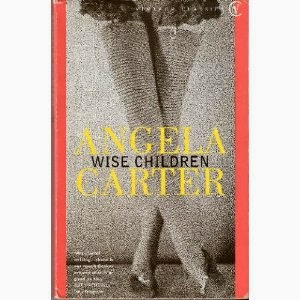
Wise Children - Angela Carter


Carter's last novel, published a year before her ridiculously early death, is a tour de force of wit and imagination.  Dora and Nora are twin by-blows of the Hazard theatrical dynasty.  On the day of their father's hundredth birthday (and that of his long lost twin), Dora sets down her memories of him/them and her and Nora's own career in illegitimate variety theatre.  It's a novel about women but in no derogatory sense a 'women's' novel, any more than Charlotte Bronte or George Eliot are gender-limited authors.  That said, Carter's feminist brio - both characteristics increasingly historical in the age of Katie Price - is what makes the story fizz and spark.  The highlights are too numerous to mention.  Come to think of it, I can't recall any lowlights whatsoever.  A magnificent, truly beautiful book.  What a loss Carter was.