Total Pageviews

Thursday, 28 June 2012

The Song of Names - Norman Lebrecht


Norman Lebrecht is a journalist and broadcaster who has written prolifically on classical music.  This, his first novel, published in 2002, is set firmly within the world of highbrow music.  His narrator, Martin Simmonds, is the middleaged chairman of a company that trades in cheap musical scores, counting off the days to desultory retirement.  His father, who set up the company before the war, was a musical zealot who not only published scores but promoted major concerts and managed emerging talent.

For father and son everything fell apart in 1950 when the old man's ward and most-gifted protege - Martin's adopted brother and hero - David Eli Rapaport (Dovidl) inexplicably vanishes on the eve of his heavily-rpomoted Albert Hall debut.

The structure is smart: the 'present', rolled out in present tense narrative, is actually 1990, allowing Martin to be in his very early sixties and therefore still just about active; the middle of the book, one huge chapter in past tense, is the boyhood and young adulthood of Dovidl, 1939-1950.  This is clever and appropriate without ever straying into the flashy.  Lebrecht has no need to show off his literary craft because the book relies on his encyclopedic knowledge of the classical field and his personal experience of being Jewish.  Yes, some of the Jewishness here is just as esoteric as the music.

Here, as just as taste of this heady confection, is a sentence that particularly struck me from page 241:  "In the intro-extrospective schism that afflicts every belief system, Dovidl won the battle of the navel-gazers."

The Song of Names, as you can see from the paperback cover above, won the 2002 Whitbread First Novel Award.  This is no surprise.  In the entire 311 pages only one false note distrurbed my reading delight, one clever flourish too many, and that - sadly - on page 310.  I wish Lebrecht's editor had persuaded him to think again.  Nonetheless, his second novel is The Game of Opposites (2007) and I'm on the lookout.

Monday, 25 June 2012

Morality Play - Barry Unsworth


Shameful though it is, it took Unsworth's recent death to remind me to check out his work.  I scanned through the list and this one leapt out at me.  It's medieval, which I like, and it's about drama, just like my PhD.  I acquired a copy, jumped in - and was immediately blown away with how well Unsworth writes.  He doesn't lay on the history research with the proverbial trowel, yet there are things here even I didn't know about.  Did medieval players really have a lexicon of hand gestures with which to express emotion?  I genuinely don't know but if they didn't they should have and it sounds absolutely convincing in this text.  It is also a murder mystery with a paedophile serial killer on the loose in County Durham.  But that's not what Morality Play is about.  Unsurprisingly, it's about morality and the moral code of the age, which is obviously different to ours.

Most of all, though, this is high literature, plainly but beautifully written with the editorial control of a true master.  It might only be 188 pages long but there is no way this novel is slight.

Tuesday, 19 June 2012

Traverse Plays - Jim Haynes (ed)


Classic selection of 8 one-act plays from the Sixties.  Not all are original - both Bellow plays are dramatised short stories, but no less effective for the transition, and the Pinget is the famously free 'translation' by Beckett of the original French radio play La Manivelle (known in English as The Old Tune).  Marguerite Duras's La Musica reads like a radio play, with voices 'off' and 'overheard' telephone conversations, but - as far as I can discover - isn't.  I can find almost nothing about George Mully, whose "analytical farce" The Master of Two Servants left me cold and unamused.  C P Taylor's Allergy is amusing enough but for me the two standouts in this collection are the Yukio Mishima (The Lady Aoi) and the Heathcote Williams (The Local Stigmatic).

Mishima's play is startling - when he mentions a 'living phantasm', he really means it, and I can't think of a coup de theatre to match the boat sailing into the hospital room and the way its sail is then used for the denouement.  It is actually a Noh-style play, which explains much but also adds to the wonderment.  Oriental magic realism, perhaps.

Williams likewise regards the stage as a fluid space.  His two principals, Graham and Ray, move seamlessly through several locations.  Their dialogue has a surface gloss of hyper-realism, but it is only realistic in the sense that Edward Bond's dialogue is realistic - what they say is rarely important, what matters is the violence of the ritualised arguments that arise from such trivia.  As so often in Bond, the verbal violence becomes physical as the apparent antagonists collaborate, without any discussion or qualm, in a monstrous assault on a film actor they encounter in a pub.

Both these plays are object lessons in how much can be achieved in one act.  They continue to resonate long after reading and one can only imagine the effect they have on theatre audiences.

None of the plays here seem especially dated but it is sobering to think that only Williams and the Traverse Theatre founder Jim Haynes, who edits and introduces the collection, are still alive.


Sunday, 17 June 2012

Too Much of Water - Bruce Hamilton


Bruce Hamilton (1900-1974) was the older brother and biographer of the much better known Patrick (Rope, Gaslight, Hangover Square etc).  Bruce was a prolific writer of crime thrillers and a long-serving educationalist in Barbados (for which he was honoured in 1964).  Frankly, I'd never heard of him and was attracted to this book by its eye-popping cover - but I know of him now and definitely want to get to know more of his work.

Too Much Water is set aboard a small passenger ship bound for the West Indies.  Hamilton is very good at portraying his world - this is 1957-8 and therefore includes passing mention of Suez - so when he depicts a distinguished black teacher and a white planter you can be sure that the way he sees them is the way they were regarded in their world by their contemporaries.

Other facets of Hamilton's writing are more startling - a pivotal character is called Rottentosser (yes, Rottentosser!) and there is a snippet of dialogue to assure doubters that it is indeed pronounced Rottentosser.  The protagonist, Edgar Cantrell, is a middle-ranking conductor of classical music and his friend (but not his Watson) is a woman-chasing counter-tenor.

The multiple murders seem random.  Obviously they aren't, but I didn't figure out who did it or why before Cantrell told me, and there was a cunning twist or two even after the killer stood revealed.  The plotting is masterly, the writing tone light but not inappropriately facetious.  Absolutely a forgotten classic of its genre.

Tuesday, 12 June 2012

The Whisperer in Darkness - H P Lovecraft


I hadn't read any Lovecraft since I was a boy.  They turned up in collections of horror fiction, but usually the short ones, and reading this collection has shown me that Lovecraft is most successful in novella form, when he has space to develop his cosmic theories, and time in which to layer up his arcane atmosphere.

The early short stories included here - Dagon, The Nameless City, The Hound, The Festival and The Call of Cthulhu - didn't really hit the spot for me.  They only served to set the scene for the four much longer works that follow: The Case of Charles Dexter Ward, The Dunwich Horror, The Whisperer in Darkness and At the Mountains of Madness.  The first two deal with Cthulhu as background only whereas the concluding stories address it head-on.  Indeed, Mountains of Madness, is probably the most detailed exposition of the mythos that Lovecraft wrote.  I particularly enjoyed the clever interplay between the cutting-edge technology of 1930 and the "elder secrets" it uncovers.

Otherwise, Dunwich Horror was my favourite, the story of the alarmingly precocious Wilbur Whateley and his ill-judged, ill-fated trip to Miskatonic University.  Monster he may be, but Lovecraft manages to evoke sympathy for the boy's sad end.

Sunday, 10 June 2012

The Inspector and Silence - Hakan Nesser


This is marketed as Nordic Noir (see the essential comparison to Mankell and Larsson on the front cover).  Nesser is Swedish but his fictional world certainly isn't.  In fact, it isn't really anywhere other than Northern Europe, albeit the series detective, Inspector Van Veeteren, has a Dutch name as do most of the other characters and places.  But it's not Holland.  It's an imaginary amalgam.  And that makes it ever so slightly odd.

The story is a cracker.  Pubescent girls in a loony religious retreat are raped and murdered.  Obviously the pseudo Messiah in charge is suspect number one, but then---

Nesser is clearly highly intelligent - the pages crackle with it and you know that here is a writer who has long, meaningful conversations with his characters.  He handles story structure brilliantly, but this isn't really Noir, more a police procedural.  Even though this predates the Nordic boom (1997) and is well on in the series, Nesser manages to avoid cliche.   Instead of a drink problem, one of his secondary policemen has an artificial leg.  Far from dreading retirement, Van Veeteren can't wait for it.  Indeed, I understand the series continues with him as a private citizen.

OK, I figured out the killer by two-thirds of the way through, but it doesn't really matter because it isn't that kind of novel.  A discovery - I will definitely read more.

Wednesday, 6 June 2012

Pompeii - Robert Harris


I'd previously read Harris's two Cicero novels, Imperium and Lustrum (Conspirata in the US) and liked them well enough, although Harris certainly set himself a challenge with a protagonist who is a professional windbag.

Pompeii (2003) is the first of Harris's Roman novels and I enjoyed it much more.  Again Harris set himself a challenge - it's not as if we don't know how it turns out for the town - but this time he invents a protagonist, the young aquarius of the Aqua Augusta, Marius Attilius Primus, who is ideally placed to subvert our expectations.  Equally, where the Cicero novels had Caesar and the fantastical Pompey as antagonists, here Harris has the splendidly corrupt slave-turned-property-developer Ampliatus, plus the eccentric and heroic Pliny the Elder as the protagonist's protector.

I'll certainly be reading the third part of the Cicero trilogy when it comes out later this year, but I wish Harris would treat us to the further adventures of Attilius.

Thursday, 31 May 2012

The Three Taps - Ronald Knox


Ronald Knox (1888-1957) was an Anglican priest who became a Catholic, justly esteemed for his translation of the Vulgate and briefly notorious for his 1926 radio spoof Broadcasting from the Barricades, which claimed to be describing insurrection in central London and which a lot more listeners believed then ever really believed Orson Welles' remarkable similar War of the Worlds.  He has been remarkably well-served biographically, first by his friend and executor Evelyn Waugh, and later by his neice, the novelist Penelope FitzGerald, whose Human Voices I have written about over on my media and culture blog.

Knox is completely forgotten as a practitioner of English Golden Age detective fiction.  Actually, he formulated the classic rules of the form and was part of "the Detection Club".  He wrote six detective stories of his own, five of which feature the Insurance Company Investigator Miles Bredon, of which this is the first, from 1927.  A Midlands industrialist is found dead in a village pub where he's been on a fishing holiday.  The cause of death is asphyxiation from gas.  Is it murder or suicide?  A walloping great insurance payout hangs on the outcome.

Bredon and his wife Angela are something of an English Nick and Nora Charles (Dashiell Hammett's Thin Man novel and several movie sequels): they wisecrack, they mock one another, they do not seem to have a sex life.  Otherwise the dramatis personae are largely eccentric bachelors of middle age.  The plot is clever (extremely), the writing sparkling throughout.  In short, great fun.  A recommended read.

***********************************************************************

Incidentally, Knox's Ten Commandments or Decalogue, compiled in 1929, are as follows:
  1. The criminal must be mentioned in the early part of the story, but must not be anyone whose thoughts the reader has been allowed to know.
  2. All supernatural or preternatural agencies are ruled out as a matter of course.
  3. Not more than one secret room or passage is allowable.
  4. No hitherto undiscovered poisons may be used, nor any appliance which will need a long scientific explanation at the end.
  5. No Chinaman must figure in the story.
  6. No accident must ever help the detective, nor must he ever have an unaccountable intuition which proves to be right.
  7. The detective himself must not commit the crime.
  8. The detective is bound to declare any clues which he may discover.
  9. The "sidekick" of the detective, the Watson, must not conceal from the reader any thoughts which pass through his mind: his intelligence must be slightly, but very slightly, below that of the average reader.
  10. Twin brothers, and doubles generally, must not appear unless we have been duly prepared for them.
Wonder why no chinaman?

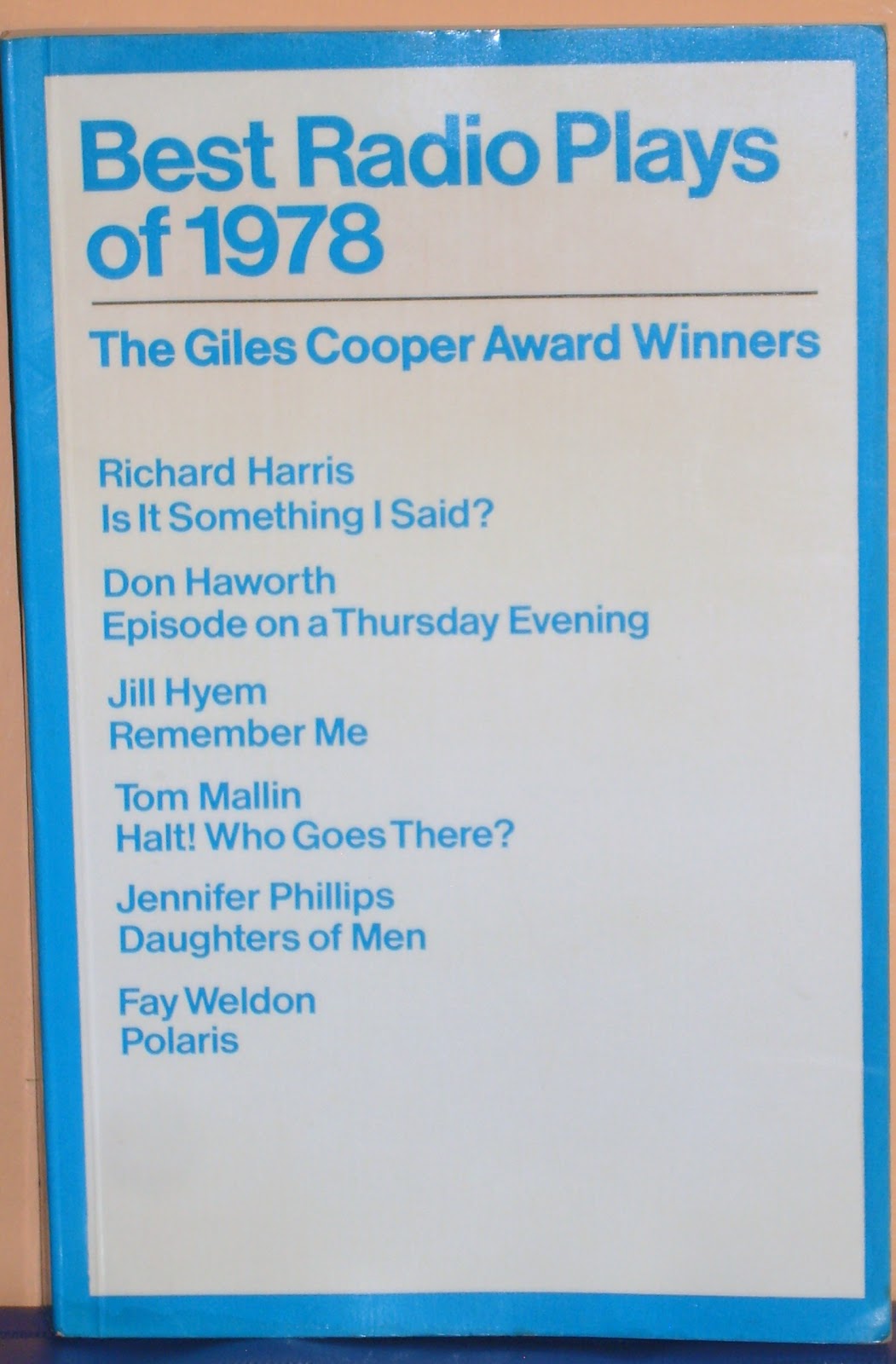
Best Radio Plays of 1978


Eyre Methuen's collections of each year's Giles Cooper Award Winners are an invaluable source of quality British radio scripts, often by major writers of the period.  Fay Weldon, of course, is a major writer of any period.  Her play Polaris for the Afternoon Theatre slot on Radio 4, about the pressures of service on a newly-married couple, is brilliantly done.  The submarine captain, endlessly banging on about his food, is deftly characterised in a few lines.

Richard Harris's Is it Something I Said?  struck me as a fairly cynical twist on John Mortimer's celebrated Lunch Hour.  Don Haworth, born in the same as I was, was a radio drama master.  His plays are always interesting, often slightly off-beam, as this one is, and invariably surprising. 

Tom Mallin was a fascinating character; primarily a visual artist, he scored a major hit with his stage play Curtains (1970).  Halt! Who Goes There?, the Mallin play given here and orginally broadcast in the cutting-edge Drama Now slot, was his sixth and final radio original.  It's about Arnold, marooned in a fascistic convalescent home after his cancer op.  Tom Mallin died of cancer in 1977, before the play was performed.  He was only 50 years old.

Jill Hyem, co-creator of the radio soap Waggoners Walk, is another prolific radio dramatist.  Remember Me is typical of the now defunct Saturday Night Theatre slot, the sort of thing that is now probably a four-hour/two-part TV mini series.  It's enjoyable and slightly daft.

Jennifer Phillips wrote Daughters of Men for the Monday Play, another key slot that has been callously let go.  The Friday Play, which was threatened with abandonment last year but is still clinging on, filled the gap to a certain extent.  Daughters, certainly, could be played there.  To my mind it was the most stimulating play in this collection.  It is about the social worker preparing court reports in a child custody battle.  The denouement is truly shocking, even today.  A stage version followed at the Hampstead Theatre Club in 1979.

Wednesday, 30 May 2012

A Man of Parts - David Lodge


I have developed a liking for Lodge's fiction over the last decade.  The British Museum is Falling Down is one of those novels that is somehow forever with you; the university novels are uniformly amusing.  Being a H G Wells buff, I couldn't wait to get this book home.  I wish I had.

It is not a bad book.  It is some way from being a good book and - hard as it is to believe it when it's a biographical novel about someone so active, in all senses, as Wells - it is dull, dull, dull.

When Lodge realises his text is tending towards the industrial and/or superficial, he introduces an imaginary interlocutor who interviews Well about his actions and emotions.  This is a cracking idea and does renew interest for a while.  But everything else is so thoroughly quotidian...  Wells had an olympic sex life but do we ever learn anything about emotion or sensation while he's at it?  Wells was involved with all the great writers of his age - Henry James, Conrad, Shaw, Bennett - but on this account they were even duller than he was.

The experience of reading this book won't put me off Lodge's work - it was a mistake, David, please don't repeat it - and it has certainly had one of the desired effects on me.  It's sent me off in search of more Wells books - and something by Rebecca West, who was definitely more interesting that the talented but demanding flibbertigibbet depicted here.