Total Pageviews

Showing posts with label New York. Show all posts

Thursday, 21 August 2025

Requiem for a Dream - Hubert Selby Jr


 Requiem for a Dream takes us straight into the rotting heart of New York in the disaster years when heroin ruined everything.   Harry Goldfarb and his buddy Tyrone C Love dream of one big score.   Harry's mother Sara sits in her apartment and dreams of being on a TV show.   Harry and Tyrone do indeed score.   Tyrone's contact has some dynamite dope which, even when cut, gives good bag.   But the boys can't resist a taste of their own product.   It is only right to share with their ladies, Marion and Alice.

Harry is a good Jewish boy.   When he is in funds he splashes out on a giant TV for his mother, the best Macy's has on offer.   He finds his mother changed.   She's lost a lot of weight.   She's twitchy and grinds her teeth.   It turns out Sara has been cold-called by a guy claiming to discover contestants for TV quiz shows.   Naturally Sara applies - and immediately starts creating the persona she wants to the viewing public to see.   She especially wants to be able to fit into the red dress she wore for Harry's bar mitzvah.   A friend recommends a doctor, the doctor prescribes weight-loss pills and before you know it Sara is hooked.

At the same time Harry and Tyrone's contact runs out of dope.   There's no decent heroin to be had.   The friends find themselves hustling the streets like the runny-nosed dope fiends they once looked down on.   Things get really bad, really quick.   No one does grim like Selby.   

Selby writes free-form, a sort of bridge between the Beats and the likes of James Ellroy.   It takes a moment to get used to - and he isn't always consistent - but it works brilliantly.   Any other approach and I don't believe readers would stick with it.   As it is, Selby's characters are fully rounded from the moment we meet them.   We empathise with their dreams even though we hopefully don't share them.   Somehow our empathy enables us to bear the horror.   A masterpiece of a very bleak genre.

Thursday, 15 August 2024

The Mobster's Lament - Ray Celestin


 Book Three of the City Blues Quartet, the setting is New York, late 1947.   The mobster in question is Gabriel Levenson, manager of the Copacabana nightspot and fixer of choice for Frank Costello, the boss of all bosses in New York.   Gabriel has been on the take for some time, syphoning off cash to fund his escape from New York.   He has good reason for corruption: he is sole career for his young niece since his sister's suicide and wants to be able to give her a good, mob-free future.   There is also his own skin to be considered.   Swindling Frank Costello is bad enough - but Gabriel's business partner at the Saratoga racetrack is Albert Anastasia, of Murder Inc.   Gabriel has two weeks before his accounts will be presented to both business partners and the deficit will become clear.

Meanwhile, Costello has a job for Gabriel.   The late Benny Seigel, founder of the nightclub scene in Vegas, seems to have raised two million from various senior gangsters to bail out the floundering Flamingo, but the money never made it to his account.   Costello wants Gabriel to find the money.   Gabriel is also keen to find the money, given it's just about the same amount he has syphoned off.   Substitute one for the other and ... who knows?

Gabriel asks around.   Apparently Benny was talking about a jazz type called Gene Cleveland.

Meanwhile there has been an awful killing in a flophouse in Harlem.   A black guy, a white guy and the female deputy manager.   Even the famously corrupt NYPD have no trouble finding a culprit.  He was standing over the bodies clutching a bloody cleaver when they arrived.   He is a young black doctor with a drug habit, called Tom Talbot.   He is now on Riker's Island, being pressed to do a deal by his attorney.

Tom's father Michael is not convinced of his son's guilt.   Michael Talbot is a retired gent from Chicago.  He is also a former cops and former Pinkerton's agent.   He has come to New York to save his son.  He is joined there by his former protegee Ida Parker, a recently widowed private detective with a bureau all her own, who has been head-hunted for a secret but lucrative new job in LA.   But first...     Michael and Ida investigate the crime scene which turns out to have been the room of a black guy now missing.   A jazz type called Gene Cleveland.

That is a basic summary of the beginnings of just one of the plotlines.   There are several others.   Celestin's debut novel was the first of the Quartet yet he has marshalled his storylines with masterly technique.   There are dozens of characters, not all of whom are around for long, yet we never lose track or become confused.   Information is given us piecemeal across 500+ pages, so that the denouement, when it comes, makes perfect sense.   The denouement also happens to be a shootout in the dead of night of the frozen Hudson River, which is prettty damn impressive.

Celestin is great.   I shall be reading more.

Monday, 10 June 2024

Harlem Shuffle - Colson Whitehead


 Harlem Shuffle is a cracking read.   It more than makes up for any disappointment I felt on finishing The Underground Railroad (see below).   Ray Carney and his cousin Freddie are like brothers growing up in postwar Harlem.   Freddie's father Pedro has slunk off to Florida.   Ray's mother has died and his old man is back.   Old Carney is a crook and a heavy.   Ray puts himself through college to avoid following his father's trade.   He opens a furniture store, initially selling previously loved items, then adding a few new bits.   He marries above his station, the beautiful Elizabeth, who has a big future in travel agenting for black folks.   Ray dreams of getting ahead of the game.   An upmarket property, on Riverside Drive, maybe.

Then cousin Freddie rolls around and gets him involved in a heist at Harlem's top hotel.   It's Ray's job to fence the proceeds, which brings him in contact with serious local hoods, bent cops.   All in all it adds up to five years of stress.   Still, Ray is a worker, and an employer now.   He makes a good side income as a fence.   His furniture store expands.   But he can't get accepted into the local trade club for black entrepreneurs.   Maybe he's just too black.   And then there's Freddie...   So Ray comes up with a scheme of his own - to get revenge on the black guy who took his money and failed to deliver.

Finally, Freddie goes too far.   He's smoking dope and copping a snort or two of the good stuff with a white dude called Linus van Wyke.   The van Wyke's are old New York.   An ancestor was the first mayor.   Now, in the early 1960s, they're building skyscrapers next to where the World Trade Centre is due to be built.   Linus ODs.   Freddie brings a fancy briefcase for Ray to keep in his safe at the store.   It's Linus's briefcase, not stolen goods in itself.   What can possibly go wrong.

Beautifully written, note-perfect, with a fantastic pace and superb characters.   It won't win as many prizes as The Underground Railway or The Nickel Boys.   Not because it's too black.   Because it's too damn funny.

Sunday, 2 June 2024

The Shot - Philip Kerr


 What a range Philip Kerr had!   The best 'good Nazi' series ever, with Bernie Gunther, supernatural, sci fi, and, with The Shot (1999), perhaps the best Kennedy conspiracy thriller of all time.

Sam Jefferson is an assassin, America's finest.   He has carried out hits for the CIA, FBI and even the Mafia, but he doesn't work for any of them.   He is independent.   Or perhaps, after being a POW in the Korean War, he answers to different masters.

In late 1960 the mob brings him down to Miami to take out Castro and enable them to recoup their Cuban assets.   Sam Giancana and Johnny Rosselli are collaborating, informally, with the CIA.   Giancana has just delivered the crucial Chicago vote which enabled John F Kennedy to defeat Nixon in the presidential election.   Sam's deal with Kennedy's crooked father Joe is that the Kennedy administration will lay off the Mob.

Sam Jefferson heads for Havana and scopes out the Castro hit.   He has no problem moving around the city because he is half Cuban himself.   He delivers the feasability study to Johnny Rosselli and promptly absconds with Sam Giancana's money.   Giancana therefore hires local FBI man Jimmy Nimmo to track Jefferson down.

Sam meanwhile is working with another Miami FBI staffer Alex Goldman.   Together, they are planning to assassinate the president-elect.   Why? - I'm not going to say.   However, one suggestion is that Sam wants to kill JFK because a mob guy 'accidentally' played him a tape of Kennedy having sex with Sam's wife, who is one of his election staffers.   Mary ends up dead soon after.   Sam has disappeared, emptying the house of clues.

But Sam has other residences, other names.   Franklin Pierce is one of the names he goes by in New York.   Sometimes he's Marty van Buren.   He has other women in his life, women from Central America.

Attention moves to Jimmy Nimmo's investigation.   Nimmo is a likeable character.  He tracks down Jefferson's NY apartment.   He figures out that Sam is planning to take out Kennedy before the swearing-in on January 20 1961.   The question inevitably arises for the reader: We all know when Kennedy was actually taken out, November 22 1963; so how can this fictional version be satisfactorily resolved?   BY the supremely capable Philip Kerr, that's how.   I didn't fully twig even as it played out on the page in front of me.   And I absolutely love it.

Sunday, 28 January 2024

Brainquake - Samuel Fuller


 Samuel Fuller had a long and controversial career as a Hollywood scriptwriter, director and, ultimately, auteur.   He had an even longer career, almost sixty years, as a novelist.   Brainquake is his last novel, written and published in France in the early 1990s but never published in English until Sam's widow suggested it to Hard Case Crime in 2014.

What a triumph it is, brimming over with Fuller tropes: crime, of course; racism; calculating, predatory women; heroic women; and, ultimately, new life in France.

Paul Page is a bagman.   The trade is almost hereditary - his father was a bookie and bagman.   Mental illness is also hereditary.   His father suffered from brainquakes and so does Paul.   These rosy-tinged hallucinations prevent any attempt at living a normal life.   Paul's early life is so abnormal - he doesn't go to school, his parents have to patiently teach him to speak - that bagman is the only hope for him.   His father's contacts land Paul the best possible job.   For ten years he moves millions of dollars for the Mafia, posing as an independent taxi driver.

He speaks to no one.   He barely speaks at all.   He lives alone, in the house inherited from his parents.   He intereacts with no one except the female Boss and the people he passes the money to.   But then he sees Michelle Troy, a young mother wheeling her baby through the park.   And becomes obsessed.   He is watching Michelle in the park one day - the first time he has seen her with her husband - when, somehow or other, the father is shot dead from inside the pram.

"Sixtyseconds before the baby shot its father..."   That is how you start a thriller of the darkest shade of noir.   And Fuller keeps up that standard for 300+ pages.   And let us not forget that he was well into his eighties when he did so.   The supporting characters are masterfully drawn - the six-foot-plus Black homicide detective Zara, Father Flanagan, the mob hitman who poses as a Catholic priest and has an appropriate method of murder, the Cody brothers, Al and Eddie.   Fuller creates them lovingly but is always prepared to sacrifice them, brutally, where the plot demands it.   Story is everything to Fuller but he doesn't stint on the nuts and bolts of literary craftsmanship.   The prose is crisp, the dialogue punchy.

A fascinating read - rounded off with an excellent afterword from publisher Charles Ardai.   Highly recommended.

Friday, 5 May 2023

Marilyn the Wild - Jerome Charyn


 Marilyn the Wild is the first of the Isaac Quartet but was the second to be written.   Marilyn is the daughter of the colossus that is Isaac Sidel, Chief Inspector of the NYPD and undisputed king of the East Side.   Marilyn, as the title suggests, is a little wild.  She has just abandoned her third husband and is now shacked up with Manfred 'Blue Eyes' Coen, who happens to be Isaac's fool, the arch amid Isaac's Angels.

Isaac was once one of a trio of young High School chess prodigies.   Now all three men are in their forties, separated or divorced, and each plagued with a single more or less grown child.   Mordecai's daughter Honey is on the streets, pimped by black dudes.   Philip's teenage son Rupert has run away with an exotic Sephardic girl.

Isaac is off to Paris for an international cop conference.  Whilst there he tracks down his long-absent faher Joel, who ran off to be an artist and now lives happily in the Jewish quarter with his Vietnamese girlfriend.   Isaac's family is a constant source of stress.   His brother Leo is in the civil lock-up for unpaid alimony.   Their mother Sophie keeps a junk shop on Essex Street.   While Isaac is in Paris, he gets a call: Sophie has been attacked in her shop and is in a coma.

Isaac descends on the Easr Side like a typhoon.   He quickly establishes that a bizarre teenage gang ('lollipops) is responsible for the attack and a bunch of seemingly random, not to say pointless, petty crimes.   The gang consists of a very young male, a slightly older female, and a stocky oriental guy.   What is more, Isaac comes to realise that their crime wave is somehow focused on him personally.

It's a crime novel.   It reflects the Seventies in which it was written.   But Marilyn the Wild is much more than that.   It is a deep dive into the world of Jews in mid-century New York.   The NYPD is either Jewish or Irish (Isaac's estranged wife Kathleen is Irish, thus Marilyn's wildness is deemed inevitable), but Isaac is very aware of black and hispanic inroads being made into his domain - two of the most memorable characters are the Peruvian brothers Jorge and Zorro.   The world Charyn conjures is a racial kaliedoscope, albeit anchored in the Jewish world which is both his and Isaac's point of origin.   The prose fizzes, the dialogue zings.   The story romps along but it is the characters who stay with the reader.

I am hugely impressed.   So glad I bought the collected quartet from 1984.

Tuesday, 20 September 2022

Dylan Thomas - Paul Ferris


 Originally published in 1977 and revised several times since, Ferris's biography has become definitive.  He has seen the original documents and was able to talk to many of the key players, most notably Dylan's wife Caitlin, of whom he also wrote a biography.  More than a decade on from the biography of Caitlin, this 2006 edition is likely to be Ferris's final word on the subject.

He quashes many myths whilst accepting that Dylan himself was a master myth-maker.  Dylan, he says, didn't die of eighteen straight whiskeys but of a morphine overdose administered by a fashionable New York quack.  Dylan, he recognises, was a terrible scrounger, but at least he gave attention to some of the rather hopeless people he scrounged off.  Ferris excels in the New York trips, which seem to be his main interest from the off.  He is especially thorough in establishing who was a reliable witness and who wasn't - and he gives his reasons.  The childhood is also very well done, albeit the only potentially reliable witnesses to what went on inside 5 Cymdonkin Drive - Thomas's father and sister - left no testimony, dying before Dylan did.

What I missed, and what Ferris was presumably denied, was any clues into Dylan's relationship with his three children.  They seem to have chosen to say nothing, which is of course their absolute right.

The commentary on the poetry and prose are well considered and the amount quoted is well judged.  Personal letters are quoted rather more than I felt necessary, because they tend to be much the same; however, these are always subjective judgments.

I haven't yet read the 'official' biography of Thomas by Constantine FitzGibbon.  Other than that, I have read most of the key texts and can therefore state with confidence that Ferris is by far the best.

Thursday, 25 August 2022

Every Dead Thing - John Connolly


 Every Dead Thing  (1999) is the first Charlie Parker thriller and Connolly's first book.  Parker is a former NYPD detective who let the job get to him.  He took to drink and neglected his wife and daughter.  Then, one night, he staggered home to find his wife and daughter monstrously butchered.

Two years on, having left the force, Parker is completely sober and 100% forcused on capturing the killer.  He contacts his old partner and gets an informal gig hunting for a missing woman.  This leads him to a philanthropist widow, a local mobster, and the person responsible for a chain of serial murders - but not his serial murders.  So Parker moves on to New Orleans and hooks up with FBI contacts and local NOPD in another chain of murders.

The problem, ostensibly, is that Every Dead Thing is actually two novels, one set and solved in New York, the other likewise in New Orleans.  Even more problematic, they are in many ways the same novel done twice - mob links, serial killers, Parker allowed more access to police and FBI than would ever be allowed.  It is also very long.  And yet, for all that, it works.  It works very well indeed.  The overarching story of Parker's quest links the two main storylines sufficiently to keep us going.  The characters, especially Parker, are deeply drawn and engaging.  The narrative tone - first person Parker - is pitch perfect.  He is never a man in control, always a man in recovery.  Side characters, the New York killer couple Angel and Louis, the voodoo momma in deepest Louisiana, even the mobsters and their lead assassins, draw us in.  I didn't work out who the killer was in either North or South, and especially not both, which is always a good thing.

There are now twenty Parker novels.  I enjoyed Connolly's non-Parker novel He (see review below) so much that I decided to try Parker and now I'm hooked.

Wednesday, 29 September 2021

The Hunger - Whitley Strieber


I enjoyed The Hunger much more than expected.  I expected a typical horror story of the era - sub-Stephen King with lots of sex and gore.  Actually, Strieber never uses the word 'vampire' at all but argues for a separate yet twinned species descended from the Lamia (see Keats and Apollonius of Tyre).  Miriam Blaylock may just be that Lamia, a child during the fall of Troy, now resident in New York City in a specially reinforced townhouse.

Sarah Roberts, meanwhile, is a specialist sleep researcher at the Riverside Centre.  She is currently seeking a cure for ageing, in non-scientific terms, the elixir of life.  Her experiments with Rhesus monkeys has spectacularly failed, and her programme may be shut down - until Miriam Blaylock walks in complaining of night terrors.

Miriam and Sarah both have problematic male partners.  John is an 18th century gentleman converted by Miriam who is facing up to the uncomfortable reality that whilst Miriam might be to all intents and purposes immortal, her converts are not.  They age visibly by the minute, consumed by the Hunger but suddenly denied the restorative Sleep. Sarah's partner Tom Havers is a business-oriented medic whose ambition is to rise to the top of the medical world.  Like John, he genuinely loves his woman but also like John he cannot understand the passion that drives her.

The upshot is truly compelling, genuinely thrilling at all the right times.

Strieber's contribution to the vampire studies is the concept of vampiric blood (it is the blood itself which makes the change), which must have been genuinely terrifying during the decade of HIV.  Secondly, he confronts the question of what happens to an immortal being denied of nourishment.  They don't die because they can't and yet they are beyond the point of recovery either through being deprived of sustenance or dismemberment and dispersal.  Fascinating.

Monday, 3 February 2020

A Cold Case - Philip Gourevitch


Philip Gourevitch writes for the New Yorker because he is a master of long-form journalism. And that's essentially what A Cold Case is - a long piece of journalism in big print with a few photos thrown in. It doesn't really amount to a book, largely because the subject isn't big enough.

In itself, the subject is fine. Frankie Koehler, a killer as a juvenile and violent armed robber in his twenties, killed two men in New York in February 1970 and vanished. Almost thirty years later a cold case investigator for the Manhattan DA picked up the case just prior to retirement. It turned out Koehler had ostensibly been living a more-or-less respectable life in California. There was, however, a suspicion that he might have been visiting New York every now and then to do favours for former gangland chums - in other words, killing people. So the police where waiting when Frankie was suckered into returning. They found him armed but cooperative.

It's a good story, as far as it goes. The problem is, Gourevitch doesn't really get enough insight into the life Frankie was living for the missing 30 years. Frankie fully admits the 1970 murders as part of his plea bargain, but nothing else. He seems to be revealing information to the cops and to Gourevitch himself, but it all amounts to nothing.

Interesting. That's about as far as I can go.

Wednesday, 18 December 2019

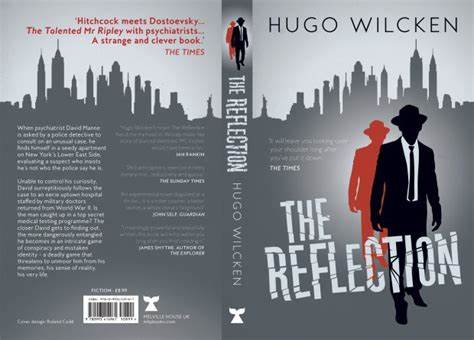
The Reflection - Hugo Wilcken


A cracking little twist on a noir meme, this. Taking his cue from John Franklin Bardin's The Deadly Percheron, which I must re-read, Wilcken conjures up a Kafka-esque nightmare in which Manhattan psychiatrist David Manne finds himself with the identity of a man he himself has committed to the mental hospital. Is he the victim of a conspiracy or is one - or both - identity a delusion? Wilcken tangles his web brilliantly, leaving us with no real answers, only questions. I loved it.

Monday, 21 October 2019

Laura - Vera Caspary


Laura was Caspary's break into the big time. It came out in 1943, having previously been serialised in a magazine, became a Otto Preminger movie in 1944 and a stage play the year after. It is a hard-boiled crime of passion novel with all the qualities of the best literary fiction.

Waldo Lydecker is a New York writer of literary fiction. He is fat, snobbish and affected, with a silly beard and an ebony cane. He is our first story-teller, for Caspary has emulated the Moonstone device of multiple first-person narration. Lydecker is besotted with Laura, as is every man she ever met. Lydecker was seeking to introduce her to art and society, so when she is found dead in her apartment, shot in the bewitching face, Lydecker is the second person Detective Mark McPherson calls on, after Laura's fiance, Shelby Carpenter. Laura and Shelby were due to be married the next week. She had planned a final solo holiday but before she left was due to dine with Lydecker.

The plot is astonishing. My jaw genuinely dropped at the big twist. Caspary drip-feeds the clues like a research scientist breeding bacteria. Everything you need to know is there, none of it apparent without hindsight. The novel is short, exquisitely so, but every word is loaded with meaning. And the style, like the cover art on this Vintage edition, is superb. The following is from Detective McPherson, the fish out of water in the refined circle inhabited by Lydecker, Laura and Carpenter:
Even professionally I've never been inside a night club with leopard-skin covers on the chairs. When these people want to insult one another, they say darling, and when they get affectionate they throw around words that a Jefferson Market bailiff wouldn't use to a pimp. [...] It takes a college education to teach a man that he can put on paper what he used to write on a fence.

Wednesday, 5 August 2015

Homer and Langley - E L Doctorow


Doctorow, the arch-manipulator of modern American history, produced this atypical short novel in 2009.  It is atypical in the sense that whereas in novels like Ragtime and Billy Bathgate he goes in for panoramic sweep of a particular era with multiple protagonists, Homer and Langley covers an immense period (roughly 1900 to 1970) and has only two significant characters, the eponymous Collyer brothers.  I didn't know when reading the novel that the Collyers were real and every bit as bizarrely behaved as Doctorow shows them to be - the ultimate compulsive hoarders who dressed in rags but who were immensely rich.  Doctorow swaps their identities and I think I can see why. In reality Homer was the elder brother who didn't go blind until middle age and Langley was the pianist.  But Langley was the one who died first and fell victim to his own hoarding, and Doctorow makes that more impactful on Homer because - in the story - he has been reliant on his 'older' brother for almost his entire life.  The novel is about withdrawal from normal society and therefore Doctorow chooses to make Homer deaf rather than paralyzed as he became in real life.  What I can't understand, and what I think undermines the book, is the decision to add thirty years to their lives.  The brothers actually died in 1947, and the opening up of their Fifth Avenue brownstone mansion was a press sensation.  Surely the interest was on account of how much the brothers had when the general population had gone without of recent years as their contribution to the war effort.  Also, I feel that Doctorow was much better at capturing the flavour of the first half of the Twentieth Century than he is at tackling the second.  He really doesn't get the hippies which seem to be the main reason for stretching the timescale - they rather conveniently take to the elderly brothers as fellow drop-outs, which is lame and predictable.  The end is also predictable but that matters less, because Doctorow handles it so well.  The idea of Jacqueline, for whom Homer is typing out his life story on a Braille typewriter scavenged by his brother, strikes me as pointless.

I know I'm being picky but it's only because Ragtime is one of my Desert Island books.  For all its flaws what we have in Homer and Langley is an autumnal display of Doctorow's huge literary skills, quirky imagination and skewed take on the society which bred him.  For most of his rivals, that would count as a major achievement.

For those who want to read Homer and Langley reviewed by one of Doctorow's most eminent peers, here is the link to Joyce Carol Oates in the New Yorker.

Sunday, 29 December 2013

The Scent of Death - Andrew Taylor


Andrew Taylor has to be one of the best writers of historical crime.  His strengths lie in the unusual choice of setting - in this case New York City in the limbo period when it was briefly the last British outpost in post revolutionary America - brilliant characterisation, intricate plotting and, above all perhaps, scrupulous research.  When a writer includes a period map, you can be confident he knows what he's talking about.

Edward Savill is a middling English civil servant who has landed himself a prestigious post in the American Department by marrying his patron's unlovely niece.  The only downside of the post is that involves being in America.  Thus we arrive in New York with our hero.  He has barely stepped ashore when he discovers his first murder victim in the Canvas Town shanty that has sprung up to provide some sort of shelter for loyalist refugees without friends or funds, tumbled in with the usual human flotsam and jetsam of shanties worldwide since the beginning of civilisation.

During his stay Savill is billeted with the Wintour family, loyalist gentry who are sliding gently towards hard times.  In Warren Street live Judge Wintour, his gently senile wife, the beautiful Mrs Arabella Wintour (wife or perhaps widow of the missing Captain Wintour) and their various slaves.  Savill's associates in official business include Major Marryot, who has a fondness for Mrs Arabella, and Mr Townley, a genteel local fixer and social gadfly with a stay-at-home wife and a growing fortune founded on the vicissitudes of a city under effective siege.

More murders ensue, Savill's fortunes rise and fall (there is a marvellous twist concerning his wife), he travels through the Disputed Lands (now upstate New York) and resolves crime and his own fate out on the frozen River Hudson.

A marvellous book, a worthy winner of the CWA Ellis Peters Historical Dagger 2013, and as good an introduction as any to Taylor's extensive oeuvre.  Personally I began with the captivating Anatomy of Ghosts (another winner of the Peters Dagger) and followed that with Bleeding Heart Square.  I gather The American Boy is one to look out for.  So I shall.