Total Pageviews

Showing posts with label Dublin. Show all posts

Friday, 18 April 2025

The Lock-Up - John Banville


 Banville used to write the Dublin Quirke series as Benjamin Black.   DI St John Strafford was always written as Banville (see Snow, reviewed below).   Apparently the two came together in April in Spain, with significant consequences.   Hence we have The Lock-Up, by John Banville, as the second Strafford & Quirke mystery.

To be honest, it's not that much of a mystery.   The villain of the piece is evident quite early on.   I don't much enjoy Strafford as a character either, though Banville does make him more likeable during the course of the book.   I also miss old Hackett, now DCI Hackett and looking forward to retirement.   Despite these reservations, and the odd quibble plotwise, I thoroughly enjoyed The Lock-Up.   Banville's skill as a writer of the very highest quality shines through in the characterisation, the interplay, the psychological insights.   

There's one scene, in which Tommy McEvoy, Hackett's onetime school friend, now Bishop Tom, summons the DCI "for a jar over at rhe HQ."  HQ, queries Hackett.   "Wynn's Hotel - don't you know that's where the clergy congregrate.   On a Saturday night you'd think you were in the penguin house up at rhe zoo."   His purpose is put jovial ecclesiastical pressure on the Guards to look elsewhere for a culprit.   It's as good as anything I've read by Banville.   And Molly Jacobs makes a convincing love interest for Quirke.

It's all high quality entertainment and a fitting development of the Quirke strand.

Friday, 9 September 2022

Ghost Light - Joseph O'Connor


 I enjoyed Shadowplay, O'Connor's novel about Bram Stoker and Henry Irving, but Ghost Lights is even better.  It"s an evocation of the affair between the dying genius of the Irish National Theatre, J M Synge, and his street urchin muse Molly Allgood, who starred, under her stage name Maire O'Neill, as Pegeen in his subversive masterwork Playboy of the Western World.

Forty-five years on from Synge's death and Molly is living alone in London, only her cat and the drink for company.  Today, however, in late October 1952, she has a gig - an old admirer has booked her for a BBC radio play, and Molly has the entire day to ensure she gets there on time.  As she walks through autumnal London she polishes her memories of better times, as a teenage actress in Dublin, of Synge and his eccentric courtship.

It is all beautifully done.  The tragedy that strikes at the end is so masterfully handled that I was almost overwhelmed.  Dublin, London and New York are all vibrantly conjured.  I recognised the foyer of Old Broadcasting House; the same for Molly as it was for me a quarter-century later.  It is only more recently that I have come to realise how important the Abbey Players and the Playboy were to the emergence of a radical arts theatre around the world.  I think I read the Playboy for the first time around the time Joseph O'Connor was writing Ghost Light.  What took me so long, I wonder?  Don't know that I would have appreciated it properly had I been any younger.  By God, I get it now - and I loved Ghost Light for reminding me.

Monday, 10 February 2020

A Star Called Henry - Roddy Doyle


A Star Called Henry (1999) is the first part of The Last Roundup trilogy (the others being Oh Play That Thing and The Dead Republic). Our hero is Henry Smart, son of Henry Smart and brother of the titular Henry Smart. Henry Senior is the one-legged bouncer for a Dublin brothel at the turn of the century. Henry who is now a star was the first child of Henry Senior and his wife Melody Nash who, much-loved, died in infancy. Henry our hero was the next son to be born, in 1901. Henry Senior automatically gave the boy his own name, which caused a rift with Melody that never healed. By the time he's 8 our Henry is on the street. He is big and handsome, even as a child. His father literally resurfaces one time to save his son from certain death, then vanishes, leaving his signature weapon behind, his wooden leg.

Soon Henry is wielding the lethal leg, initially as a gang assassin. Then he survives the Easter Rising 1916, a gunman inside the Dublin Post Office, and becomes a righteous murderer, slaying spies and traitors to the Cause. He also trains up the next generation of lads for the IRA. He marries his lady-love, his former teacher Miss O'Shea and is enjoying family life when the Civil War erupts. Henry is no longer the coming lad. He is twenty and already a semi-mythical hero. The lads he trained have now outgrown him. They are worse than murderers, they are politicians. Henry makes one last appearance, and then escapes from Dublin using the same method favoured by his father - the underground water courses of the city.

A Star Called Henry is a magnificent achievement, all the characteristics of Doyle at his best, anchored to a story of great things. Doyle is too much of a humanist to allow Henry to kill without question. He rightly insists on there being consequences. The characters are astonishingly well drawn, from the amiable Latvian Jew Climanis to Piano Annie and her sad, one-armed husband. Best of all is Henry himself, a force of nature who cannot be constrained by rules, political beliefs, or really anything approaching civilisation. I've got my eye open for Oh Play That Thing and fingers crossed that Doyle manages to maintain this quality.

Friday, 29 September 2017

Even the Dead - Benjamin Black

I was so appalled by The Lemur that I have avoided anything by Black over the last couple of years. I was in two minds when I saw this on the library shelf. Had he cheapened or otherwise banjaxed Quirke, one of the best crime series of recent years? Mercifully not. If anything, I am heartily relieved to say, Quirke continues to get better.


Quirke's drinking has finally caught up with him. He is cloistered at Mal and Rose's house, wondering if he will ever go back to the pathology lab, when his assistant and prospective son-in-law David Sinclair pops in for a second opinion. Leon Corless, son of a notorious Irish communist, has been found dead in a burning car. David thinks young Corless was dead before the car hit the tree. So does Quirke. So does Inspector Hackett.


So the story gets under way. It is full of all the usual tropes - conspiracy, the Church, baby-farming, dark deeds of the recent past, and Joe Costigan, Quirke's equivalent of Professor Moriarty. But as ever with the best of Benjamin Black, it is the storytelling rather than the story that keeps us hooked. The gentle friction between long-established characters, the Byzantine interconnections of the tiny upper middleclass of 1950s Dublin, the steady plod of life's wheel. Malachy is ailing, David is restless, Quirke has a new woman in his life. Evelyn Blake is the perfect match for Quirke because she exemplifies everything familiar about his tight little world: she might be an Austrian psychiatrist but Quirke knew her late husband, a drunken doctor who worked at Quirke's hospital, and Quirke used that connection to get his daughter Phoebe a job as Evelyn's receptionist.


As ever, there is great pleasure to be had in characters who are only passing through: Leon's father Sam, whose politics have cost him everything including perhaps his only child, and the loathsome rent-collector/enforcer Abercrombie. Both men, one of them a widower, the other surely never married, live in ghastly rooms above shabby shops. Black takes obvious glee in forensically detailing the grot.

Monday, 28 November 2016

Mad Weekend - Roddy Doyle


Open Door has published at least five series of short novellas by Irish authors, the Irish profits of which are donated to a charity of the author's choice. Open Door is a subset of New Island, Ireland's leading independent publisher, who have some enticing books on their list.

Mad Weekend is really a long short story, a shaggy dog narrative joke about three Dublin lads who go to Liverpool to watch a match, losing one of their number along the way. The ending is improbable - but who cares? You read Roddy Doyle because being in his company is fun. He writes like a dream, seemingly without effort but doubtless polished over and over. Everybody in his fiction is a bit of an eejit but essentially a decent sort.

It's a half-hour, forty minutes read. Can't think of a better use of my time. And I'm definitely signing up for New Island emails.

Wednesday, 16 December 2015

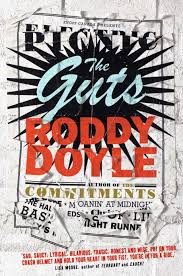
The Guts - Roddy Doyle

The Guts (awful title) is Roddy Doyle's return to Barrytown and Jimmy Rabbitte, quondam manager of the Commitments.


Jimmy is middleaged now but still in the music business, having sold his nostalgia website just before the Irish Tiger was shot dead in the Crash of 2008.  Jimmy and Aoife retain an interest in the business, though, because it is their passion.  At the start of the novel Jimmy is diagnosed with early stage bowel cancer, hence the horrible title.  Doyle, however, neither dwells nor delivers on the premise.  Jimmy seems to sail through his gruelling treatment, hence we do not get the full impact of his 're-birth' as he rediscovers the cutting edge of proto-punk Irish folk music from the early Republic and, this being a very effective comedy, composes and records the key song he just can't find for the album.

Just as Jimmy rediscovers his musical soul, so he reunites with his long-lost brother Les. Again, a promising storyline which Doyle fails to deliver on.  When Les visits Ireland and joins Jimmy at the festival where the fake song (which has, of course, become a YouTube sensation with the young) has to be performed, there is no surprise, no revelation.

The Guts came out in 2013 and completely passed me by.  I fancy it didn't get much publicity because of the shortcomings outlined above.  Nonetheless Doyle is one of the top Irish novelists of a pretty good generation.  No one says so much with monosyllabic dialogue.  The Guts might be technically flawed but it is nevertheless a joyous, hilarious, life-affirming read.

Tuesday, 25 August 2015

Christine Falls - Benjamin Black


You have to start a series somewhere; I just wish Banville/Black hadn't started the Quirke series here. This opener is by some distance the least interesting of the series and if I hadn't read all the others before finding Christine Falls my involvement would have ended here.  Of course there has to be a certain amount of exposition when you set up the series, and the minimal amount offered here merely proves my point.  The problem throughout Quirke is the rather preposterous domestic arrangements of Quirke, his adoptive brother Mal and the Crawford sisters (and, in later volumes, the sisters' stepmother Rose).  Couple that with an overheated transatlantic Catholic conspiracy and you are on sticky ground.  It is a tribute to Banville's measured writing style that he manages to keep us involved to the end.  But he does.  Personally, I'd recommend new readers start with one of the others, all of which I liked.

Sunday, 23 March 2014

The Black Eyed Blonde - Benjamin Black


Black's latest book stays in the post-war decades but switched from Dublin to Los Angeles and revives Raymond Chandler's legendary private dick, Philip Marlowe (and also, apparently, uses a projected title from Chandler's notebooks).  Chandler's books were never about plot, other than that it should be impenetrable, and all about tone.  Black manages to capture both.  Oddly, given John Banville's eminence as a writer of literary fiction, he seems to miss out on the zing of Chandler's prose.  Observations on twinkling streetlights are all very well but they don't come near "Down these mean streets".  With that single reservation, though, this book is a joy.  I wouldn't like to see Black abandon Quirke altogether but I would relish another trip to LA land.

Tuesday, 10 September 2013

Holy Orders - Benjamin Black


The latest Quirke mystery shows Black on top form.  The last, Vengeance, was a bit of a dud as a mystery, albeit the quality of the writing was as superlative as ever.  This time the story is also up to the mark.  What at first sight is taken for the body of a naked boy is pulled out of the canal.  On closer inspection the body turns out to be an adult male, albeit a scrawny one.  Inevitably, the dead man ends up on Quirke's autopsy table.  "Jesus Christ," Quirke cries, "I know him."

And we're off.  All the regular characters are involved to a greater or lesser extent.  Hackett and Phoebe, of course;  Isabel, back from touring Ibsen to the provinces;  Malachy Griffin and Rose; and, omnipresent, the mystery and horror of Quirke's childhood, embodied in the present by the ghostly presence of the enigmatic Costigan.  There are new characters, some of whom I expect will return, notably the tinker king Packie the Pike.

Quirke has a new demon this time round.  He seems to be hallucinating.  We end with him about to receive his diagnosis.  I suspect I know what it is, having had something similar myself, so I certainly empathised wholeheartedly.  But I'll probably have to wait till next year to find out for sure.

Slowly but surely Banville/Black is building a classic canon.

Saturday, 17 August 2013

Vengeance - Benjamin Black


Vengeance (2012) is the fifth of the Quirke Dublin novels, now rebranded Quirke Mysteries, presumably to tie in with the forthcoming TV series.  Banville-Black writes as beautifully as ever and his distillation of period is flawless - but he does tend to forget that these are supposed to be a) mysteries and b) thrillers.  There is no mystery here - I still have no idea why a suicide needs a witness - and zero thrills.  It's a sort of Agatha Christie, dirty-deeds amid the middleclass, without the plotting but with greatly enhanced literary ability.

I don't mind the lack of plot; Black could write a shopping list and I'd still read it.  The continuing characters are developed further, the one-off characters, by and large, are distinct and well-drawn, if a little devoid of purpose.  I do wish Black had avoided the twins trap.  The same cheap trick ruined Colin Dexter for me and Monsignor Knox was making a rule forbidding it.  It's just lazy.

None of these quibbles will prevent me reading more.  The sixth Quirke Mystery, out now in hardback, is Holy Orders.  Can't wait.

Monday, 25 February 2013

A Death in Summer - Benjamin Black


The fourth of Black/Banville's Quirk Dublin series and the successor to Elegy for April, reviewed below (October 2012).  The standard is every bit as high and I admire the subtlety with which BB uses the Fifties to reflect on the present.  It would be giving too much away to say how in this instance, save to say it is Ireland's perennial problem.  As the indomitable Inspector Hackett puts it on the penultimate page, "It's the times, Doctor Quirke, and the place.  We haven't grown up yet, here on this tight little island.  But we do what we can, you and I.  That's all we can do."

The plotting is so superbly done in this novel - tightly integrated like a Swiss watch movement - that I find it impossible to comment specifically without giving the game away.  As it happens, I did guess whodunit for once.  Did it matter?  Not a jot.  The crime is merely the frame in which the artist develops his canvas.  The best period detective series around.   The latest Quirke is Vengeance, and between A Death in Summer and Vengeance came The Lemur, which apparently links Fifties Dublin with modern Manhattan.  Can't wait.

Thursday, 25 October 2012

Elegy for April - Benjamin Black

It's no secret - it says it on the cover - 'Benjamin Black' is feted Irish novelist John Banville.  His series character Quirke (no first name, naturally) is an alcoholic Dublin pathologist.  The twist or signature of the Quirke novels is the timeframe - Ireland in the 1950s, depressed, priest-haunted, drink-sodden.  What makes the novels very special indeed is the depth of characterisation so effortlessly rolled out by the author; even walk-ons who exist solely to plant the clues are enlivened and distinguished with little tics and traits.  Take for example decrepit old catwoman Miss Leetch:  "Gradually it became clear, if that was the word, that in the chaotic lumber-room that was Miss StJohn Leetch's understanding, the fellow that April might have gone off with was not one but many."  Classy stuff.

Essentially this a story about disfunctional families - Quirke's own (surprisingly complex for a foundling) and the Latimer family whose daughter is the missing April and whose father was the poster boy for the General Post Office siege of 1916.  The writing is deft but deeply layered, the plotting clever without ever being mechanical.  Not all loose ends are tied up, which increases our involvement.  Who was it spying on Phoebe in her flat?  Maybe we find out in a subsequent book.  I shall certainly be laying hands on another Quirke a.s.a.p.

Black has a great website.  The big news, apparently, is that Quirke is the BBC's next big literary detective.  Gabriel Byrne plays our hero.  Could be great - Byrne in Usual Suspects or Miller's Crossing form - or it could be eyewateringly dull like that psychiatrist thing he did for subscription TV.  I'll have read the books by the time it airs, anyway.  I strongly suspect I shall also be trying one of Banville's 'straight' novels.