Total Pageviews

Showing posts with label 1950s. Show all posts

Tuesday, 26 August 2014

Who Killed Palomino Molero? - Mario Vargas Llosa


Mario Vargas Llosa dips his toe into the whodunnit genre.  Obviously it's not as simple as that.  That the bolero singer turned volunteer airman Palomino Molero has been horribly, ritually killed is not in doubt, but even at the end who exactly did it and why is open to question.  And the cops are not exactly Scotland Yard or NYPD - just two unexceptional flatfoots from the local Guardia Civil in the rural middle of nowhere, which in Peru in the 1950s is pretty remote.

Why the 1950s?  I suspect the core of what is actually a novella was written back in the 50s, then rescued from the bottom drawer when Llosa got famous and heavily reworked.  I say reworked because all of the mature techniques are there: the elegant elision between past and present, memory and reality; the politics that underpin everyday life, even this far out in the backwoods; class prejudice; and, of course, the exploration of complex characters.  What, for example, is Alicia Mindreau's true state of mind?

Given the slim format, which feels just right for the subject, there is just one subplot - the comic infatuation of Lieutenant Silva for his Amazonian chubby Dona Adriana.  And the outcome of that is just as unexpected as the outcome of the main mystery.

Because it is very much centred in the landscape, there is far more description than in citybound Llosa novels.  I especially enjoyed the juxtaposition of the ocean and the blazing hot desert.  Only in Peru...

Saturday, 11 January 2014

The Long Glasgow Kiss - Craig Russell


The second novel in Russell's 'Lennox' series sees the eponymous Canadian gumshoe chasing a Vietnamese Dragon (as opposed to a Maltese Falcon) round the extremely mean streets of early 1950s Glasgow.  Lennox is a brilliant idea - modern Tartan Noir with a hero straight out of 1940s US cinema noir.  One criticism: not having read the first, I was some way in before I realised it was supposed to be 1953-4.  Once I realised, though, I was hooked.  Russell works all the classic tropes - rival gangs, women of dubious virtue, boxing - and comes up trumps.  I didn't guess the final twist and that's all you really need from a detective plot.  There are now four in the series, and I'll be reading them all.

Tuesday, 10 September 2013

Holy Orders - Benjamin Black


The latest Quirke mystery shows Black on top form.  The last, Vengeance, was a bit of a dud as a mystery, albeit the quality of the writing was as superlative as ever.  This time the story is also up to the mark.  What at first sight is taken for the body of a naked boy is pulled out of the canal.  On closer inspection the body turns out to be an adult male, albeit a scrawny one.  Inevitably, the dead man ends up on Quirke's autopsy table.  "Jesus Christ," Quirke cries, "I know him."

And we're off.  All the regular characters are involved to a greater or lesser extent.  Hackett and Phoebe, of course;  Isabel, back from touring Ibsen to the provinces;  Malachy Griffin and Rose; and, omnipresent, the mystery and horror of Quirke's childhood, embodied in the present by the ghostly presence of the enigmatic Costigan.  There are new characters, some of whom I expect will return, notably the tinker king Packie the Pike.

Quirke has a new demon this time round.  He seems to be hallucinating.  We end with him about to receive his diagnosis.  I suspect I know what it is, having had something similar myself, so I certainly empathised wholeheartedly.  But I'll probably have to wait till next year to find out for sure.

Slowly but surely Banville/Black is building a classic canon.

Monday, 9 September 2013

Revolutionary Road - Richard Yates


Yates wrote his masterpiece in 1961, when he was thirty-five years old.  The novel is set in 1955 when Yates, like his hero Frank Wheeler, was 29.  The year was an obvious hook for me and it inevitably made me think of my parents, who, like so many of the war generation, wanted to make something worthwhile and different of the peace, only to succumb to grinding normality with the arrival of kids.

There are only five characters of any real relevance, Frank and his wife April, their slightly more conservative friends and neighbours the Campbells, and local realtor and busybody Mrs Givings, a reminder that earlier generations also had their ambitions and also made sacrifices.  Yet across more than 300 pages Yates never once lets the pace slacken and only once - an ill-advised sortie into April's childhood - does he lose focus.  The characters are put under microscopic scrutiny yet retain many of their secrets.

I am not usually one for the roman style, the novel of character and emotion.  I much prefer the English comic novel, preferably with an element of the picaresque.  But I absolutely adored this book.  Whenever I forced myself to put it down, I couldn't wait to get back to it.  In literature as in all arts it doesn't really matter what form a masterpiece takes, it remains a masterpiece.

Monday, 25 February 2013

A Death in Summer - Benjamin Black


The fourth of Black/Banville's Quirk Dublin series and the successor to Elegy for April, reviewed below (October 2012).  The standard is every bit as high and I admire the subtlety with which BB uses the Fifties to reflect on the present.  It would be giving too much away to say how in this instance, save to say it is Ireland's perennial problem.  As the indomitable Inspector Hackett puts it on the penultimate page, "It's the times, Doctor Quirke, and the place.  We haven't grown up yet, here on this tight little island.  But we do what we can, you and I.  That's all we can do."

The plotting is so superbly done in this novel - tightly integrated like a Swiss watch movement - that I find it impossible to comment specifically without giving the game away.  As it happens, I did guess whodunit for once.  Did it matter?  Not a jot.  The crime is merely the frame in which the artist develops his canvas.  The best period detective series around.   The latest Quirke is Vengeance, and between A Death in Summer and Vengeance came The Lemur, which apparently links Fifties Dublin with modern Manhattan.  Can't wait.

Sunday, 24 February 2013

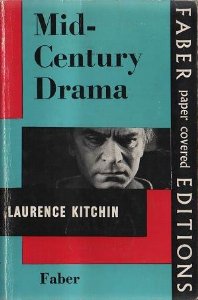
Mid-Century Drama - Laurence Kitchin


I was browsing the might Skoob in London's Brunswick Centre when I found this.  One key aspect of my research is the role of radio drama in developing British theatre in the 1950s and early 60s.  One contention of my thesis is that only the patronage of BBC radio brought Beckett, Pinter and Arden to audiences sufficiently large to warrant commercial management (and it was all commercial in those days) risking them on the London stage.  Note, I do not claim that radio was the only way for the angry generation; for example Osborne and Wesker went straight to the stage.

Anyway, I was disappointed.  I should have known I would be when I realised that Laurence Kitchin was the drama critic of the Times, which has naturally scorned the most democratic of performance media since Day One.  Instead what we get here is a tour of everything that alienated audiences from the clique that was London theatre circa 1955 - the tedious, impenetrable visits from the Moscow Art Theatre and the Comedie Francaise - with a sort of baffled consideration of why anyone might think television could contribute to art.  In that sense the book was useful to me - as a launch pad for why I and my generation rebelled against this highhanded elitist guff.

The second part of the book is cheap and nasty - reverential interviews with the theatrical great and good of the day lifted straight from the pages of the Times where they first appeared.  The interest here was thin: Peter O'Toole before Lawrence, the realisation how early Ashcroft was made a dame.  I was interested in the interview with Peter Holmes, who seems to have been seen as a star of the future whilst at Oxford, unusually combining the roles of actor, student and road navvy; it seems he later became a respected teacher and died in 2010.

My favourite of these interviews was the last, with Stella Adler (1901-1992) whose long career meant that she worked with Stanislavsky, the Group Theatre, Marlon Brando and Robert de Niro.  She lectured at Yale and founded her own acting school.  I find this much more impressive and appealing than Kitchin evidently did.

Here is a thoughtful review from John Wyver, to whom the book was more useful since his research is into stage plays on television.

NOTE: This review also appears on my Media & Culture blog.