Total Pageviews

Sunday, 6 March 2022

To Have and Have Not - Ernest Hemingway


This is a strange concoction - a couple of short stories bodged together into a novel with heavy padding for at least a third of it.  And yet it works - works as well as the two major novels I have previously reviewed on this blog, and a sight better than The Old Man and the Sea which I have repeatedly tried and failed to read.

The short stories tell of Harry Morgan, a 'Conch' or societal dropout in Key West, a former rum runner turned arms and people smuggler.  The padding, in an utterly different tone, revolves around the bringing home of Harry's body after his last attempt to raise some cash and the effect this has on the drunken wastrels and society homosexuals who are drawn to spend time in the lawless fleshpots of the Florida Keys.  It is a testament to Hemingway's inimitable style that you keep on reading, no matter how reprehensible Harry's actions, no matter how sordidly the rich folk behave.  Between this and the previous blog post on T C Boyle I started on a well-known modernist classic written perhaps six or seven years before To Have and Have Not, and it was so childish, so full of itself, that I gave up and reached for Hemingway.  That is how good he was and remains. 

Monday, 28 February 2022

A Friend of the Earth - T C Boyle


Boyle was the hero of my reading back in the Naughties.  Water Music, Drop City, East is East, Riven Rock - I read them and I loved them.  I wasn't so keen on The Inner Circle and Talk Talk, but even so I"m amazed that I haven't posted any Boyle reviews on this blog, which means I haven't read any Boyle in the last ten years.

A Friend of the Earth dates back to the turn of the century, though this paperback was only published in 2019.  It is set at the end of the Eighties and into the Nineties, and in 2025.  Our hero Ty Tierwater starts off as a widower raising his daughter and tending to the dilapidated shopping mall bequeathed by his developer father.  His midlife crisis comes when he meets Andrea, ecology radical and future wife, who transforms Ty and daughter Sierra into eco-warriors and, in Sierra's case, eco-martyr.

Forty years later seventy-five year-old Ty is tending endangered ugly animals on the estate of rock legend Maclovio Pulchris.  His warrior days are done.  His back aches. Then Andrea reappears with news that someone wants to write about Sierra.  Ty's passions are roused - for Andrea, anyway.  But in the post-Millennium years the climate has gone to hell in a handcart.  Even California is blasted by seemingly never=ending storms.  The eco-hippies were right all along, but it's surely too late to do anything about it now.

That's the premise with which Boyle works his characteristic anarchic carnage.  His prose is fabulous, his exploration of his characters as extensive as the stage he has set for himself.  His technique - using first person for Ty now and third person Tierwater for Ty then - is so seamlessly done that we barely notice.  Nobody, but nobody does this kind of novel better.  Boyle is of his time yet stands squarely in the ultimate literary tradition of cowed nobodies oppressed by greater towers who nevertheless find the strength within themselves to rise up and howl.

Absolutely magnificent - and disconcertingly prescient.

Saturday, 19 February 2022

Moonglow - Michael Chabon


Such a beautiful book.  I have read Michael Chabon before - Kavalier & Clay, I think - but it didn't prepare me for Moonglow.  I now understand that Chabon is a Jewish John Irving.  His richly textured narratives twist and turn over decades, seasoned with what seems to be autobiographical content but which probably isn't.

In this case it is the story of Mike's grandfather.  I'm not sure we ever get his name; he is the maternal step-grandfather, so it's not Chabon, and he is referred to throughout as simply 'my grandfather'.  He is an engineer in World War II, ultimately tasked with tracking down Werner von Braun before the Russians get him.  Along the way he discovers an abandoned V2 rocket, a discovery which changes his life, and von Braun's cache of documents.

Postwar, he marries a beautiful French emigree who already has a daughter, Mike's mother.  The wife has suffered horribly in the war (she is Jewish but was saved by nuns).  She is slightly zany - an actress - and is a late night hostess on Baltimore TV.  But she suffers from visions of a skinless horse and spends time in a mental asylum.  This coincides with her husband's brief burst of midlife madness.  He assaults his boss and is sent to jail.  This turns out to be another seminal event.  Whilst inside he works on homemade rocketry and once released earns a small fortune in partnership with Mike's uncle making models for the Space Race.

Then his wife dies - killed by HRT which restored her sanity.  The grandfather sells up and moves to a Jewish retirement community in Florida where he has one last sexual fling and tries to hunt down a snake that has eaten his partner's late husband's cat - a parallel to his hunt for Werner von Braun, which is also resolved.

Ultimately he dies in his stepdaughter's home.  At the end grandson Mike helps nurse him, prizing out the taciturn old man's story bit by bit.

As I said at the top, it is all beautifully done.  Chabon switches past and present and inbetween, all seemlessly.  We meet Mike's mother as a precocious child, uppity teen and successful career woman.  Mike's father, long estranged, appears fleetingly from time to time.  Far more real is the grandfather's younger brother Ray, rabbit, pool hall hustler, entrepreneur, lothario and huckster.  In later appearances he sports an eyepatch; apparently Mike's mother shot him but the grandfather wasn't there so it isn't in the book - in itself, a prime example of Chabon's mastery.

I was wholly involved at every stage.  The book couldn't go on long enough - and yet somehow it did.  The ending was timely, right, perfect in every way.  Contemporary American picaresque at its very best.

Friday, 11 February 2022

Robert B Parker's Payback - Mike Lupica


 Lupica has continued Parker's series about Boston PI Sunny Randall. Parker himself only wrote six of these and what was impressive to me was the depth of the backstory here.  Sunny Randall is connected to the Boston Irish mob through her ex-husband, the Boston Irish cops through her father.  Her wingman Spike is a gay restauranteur.  And the current man in her life is - yes, it's Jesse Stone, perhaps because by the time Payback came out in 2021 Mike Lupica was also writing the Jesse Stone continuation series.

I admit female PIs are not always my first choice for recreational reading, but I took to Sunny straight away.  Lupica has a way with characterisation through dialogue and internal monologue that is very persuasive.

The story here is international money-laundering, Russian mobsters, high stakes poker and frat boy hedge funds - all set against a background of the Covid 19 pandemic.  And, just in passing, while others write novels about the pandemic, Lupica has the skills to make it simply the background.  Because of the pandemic, chancers and gamblers are running out of money and have to take risks, robbing Peter to pay Paul - or, more appropriate in this case, Pyotr and Sergei.

There is bags of action, three interconnected lines of investigation and lots of vivid images of the Boston setting.  I enjoyed it hugely.

Thursday, 10 February 2022

Ungentlemanly Warfare - Howard Linskey


When I reviewed my first Linskey, The Dead, in the middle of last year, I noted how careful he was in crafting his prose and how I really must read more of his work.  Not so much now, I'm afraid.  Ungentlemanly Warfare is a pretty standard SOE yarn, though to be fair Linskey does plough relatively fresh ground by incorporating the Milice, the Vichy brownshirts, as the direct opposition to the Maquis underground resistors Harry Walsh is sent to France to organise.  His principle mission is to kill the scientist developing the Me 163 jet fighter plane which, if made operational, will threaten the upcoming D-Day landings.  So far so good - and I should also add in the plus column the nice way Linskey plays the class war within SOE.  Guerrilla warfare is ungentlemanly, therefore those who fight guerrilla wars are not gentlemen; Harry Walsh is only middle middleclass and therefore perfect to aid and abet the guerrillas, but he can never rise above the rank of captain which he earned in the field - thus by default, really - at Dunkirk.

Now for the less good.  The writing at the start of the book is really poor - overdone, unsubtle, unconsidered, unrefined.  There are some appalling proof reading failures: Scott's Guards will live with me forever.  Things certainly improved as the story progressed, either because Linskey gets more involved with the action sequences or perhaps because the first couple of chapters came from an old draft which Linskey managed to restart with an improved skill set.  Certainly I stopped thinking 'This needs editing' and ceased to notice any bloopers, and that's good enough for me.  But then--- Oh god, clever little cameos for Ian Fleming and Kim Philby.  Showing off your research.  Only your research wasn't quite deep enough, Howard.  A level deeper and you'd have found that the first hero of ungentlemanly warfare was Peter Fleming, Ian's brother, who was in charge of proposed guerrilla warfare in Kent when, as seemed certain in 1939 and 1940, Hitler invaded Britain.  See Giles Minton, Churchill's Ministry of Ungentlemanly Warfare.

The story itself is predictable - Harry has to risk his girlfriend to get to the target.  I don't want to give the game away but the point of a successful adventure story is that the hero has to personally bring down the anti-hero, and that doesn't happen here, so the story doesn't quite succeed.  And I will no longer be quite so keen to read more Linskey.

Thursday, 3 February 2022

Baby Doll - Tennessee Williams

Williams wrote several of the movie adaptations of his plays but Baby Doll is an original script for Elia Kazan and produced in 1956 with Eli Wallach, Carroll Baker and Karl Malden.  This published version followed in 1957 and proudly proclaims on the inside front cover, "We believe that the publication of Baby Doll marks the first occasion on which an original film-script has been published in book form to coincide with the showing of the film.  This in fact really is 'the book of the film'."

Cool.  I wonder how many it sold?

Anyway...  I haven't seen the film.  I was put off Tennessee Williams by the movie of Night of the Iguana and the playscripts of his late works.  But Baby Doll was the Fifties when Tennessee was in full pomp.  I was spellbound by its power.


The setting is cotton country.  Baby Doll, imminently about to turn twenty, is married to the much older Archie Lee.  She was clearly looking for a surrogate father and provider, but Archie Lee's cotton gin has been virtually put out of business by the local plantation building its own.  So all the credit-funded furniture has to go from the marital home. This threatens the long-promised consummation of the marriage when Baby Doll turns twenty tomorrow.

Archie Lee drowns his sorrow and that very night the plantation gin burns down.  Italian operator Silva Vacarro turns up at the Meighan home with dozens of trucks for Archie to gin.  But Archie needs a part and has to go out of town to get it.  Meanwhile Vacarro's men install their own in Archie's mill and take over the mill.  Vacarro stays with Baby Doll and attempts to take over Archie's wife.

The sexual game-play is off the scale.  Racist undertones are fully explored.  The ending is left wide open.  I really have to see the film.

Monday, 31 January 2022

The Accomplice - Joseph Kanon


I have reviewed several of Kanon's thrillers on this blog.  The Accomplice is as good as any.  Aaron Wiley, a desk man for the CIA, is in Hamburg in 1962, visiting his uncle Max, a Holocaust survivor who has spent the postwar years hunting senior Nazis - a sort of rival to Simon Wiesenthal.  In 1962 the Israelis have only recently tried Adolph Eichmann, the Man in the Glass Booth, having snatched him from Argentina.  Max's target is Otto Schramm, whom he studied medicine with and who picked him out of line-up at Auschwitz to serve as an unwilling assistant.  At the same time a wave of the hand from Schramm sent Max's eight-year-old son to the gas chamber.  Now, on this autumn afternoon in Hamburg, taking coffee with his nephew, Max spots Schramm strolling in the park.  Schramm, who supposedly died in a car crash in Argentina two years ago.

Max suffers a heart attack and dies - but not before passing his mission in life to Aaron, who soon finds himself in Buenos Aires, seducing Schramm's daughter and working with both the CIA and Mossad to capture Schramm.

As always, the depth of Kanon's research is profound.  You absolutely believe what he tells you, not only the history and spycraft, but also the exotic settings.  Given that two key locations are vast municipal cemeteries in different hemispheres, you have to wonder how Kanon came by his insights.  Dedication, no doubt, is the answer.  The pace is expertly handled but we wouldn't care about the story if we didn't care about the characters, and we do, even the Nazis.  Another great achievement, a worthy addition to Kanon's impressive list.

Friday, 28 January 2022

In the Absence of Men - Philippe Besson

It's unfortunate that I read the Radiguet so recently because this is a homage written 85 years later with the sole twist being that the illicit love is a gay one.  Instead of betraying the trust of a soldier at the front, 16 year old Vincent sleeps with one.  Meanwhile Vincent is flirting with the celebrated novelist Marcel P, who doesn't take a lot of identifying.

That said, it is a beautifully written novel which truly honours Radiguet's daringly frank style.  Every sentence is expertly crafted.  The deployment of tense and person is brilliant; the characterisation good but not really anything new.  I must say I didn't like the epistolary section in the middle.  Another quibble: the war never really convinced me.  I appreciate that Besson presents Paris as a bubble but surely it can't have been totally cut off?

So - yes, I enjoyed In the Absence of Men, but I don't feel enlightened by it.  Unless Besson's other works offer more originality (and judging by the outline of Lie With Me in the endpapers, it doesn't seem likely) I shan't be reading any more.

Saturday, 22 January 2022

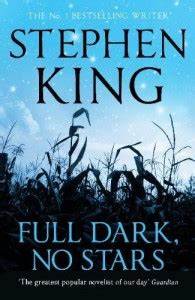
Full Dark, No Stars - Stephen King


A collection of short fiction, one of which I'd already read.  But Stephen King is to my mind the Number One living writer in English.  No one else has come anywhere near his output of hits across a surprising number of lengths, forms and genres.

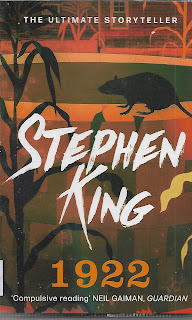
Full Dark, No Stars is essentially a book about marriage. '1922', which I read as a standalone novella last year and which is therefore reviewed earlier on this blog, is about a poisoned relationship.  'A Good Marriage' is what it says on the tin, with a killer twist.  'Big Driver' is a revenge tale in which the ill-starred union which resulted in the 'Big Driver' is the nexus - and again it's the twists that make it.  'Fair Exchange' is perhaps the weakest of the four feature stories - a Faustian deal to make a marriage better by sabotaging the marriage of another.  A bonus short story, 'Under the Weather', is in keeping with the marital theme.  All would be hunky dory with the Franklins on the fifth floor, if only the other tenants hadn't started to complain...

OK, not the master's finest work, although I would argue that '1922' comes close.  Nevertheless, thoroughly engrossing and far better than anyone else is offering.


Monday, 17 January 2022

The Power of the Dog - Thomas Savage

The original 1967 book of the hit Netflix movie that's currently making all the running in the early stages of awards season.


It is 1924 and the end of the cowboy era in Montana.  The Burbank brothers, Phil and George, had taken over running the ranch since their parents retired to a hotel in Utah.  Phil is the traditional cowpoke, skilled in all the traditional western handcrafts, a man who pointedly disdains to wear gloves.  And yet he is a millionaire and something of an autodidact genius.  Younger brother George is plump and quiet and handles the business side of things.  The brothers live together, even sleep in the same bed, but George is a modern man who loves automobiles and who hankers after a normal life.

In what passes for a town is the widow Rose Gordon, whose husband came west to be a doctor but ended up a drunk who did the unforgivable and hanged himself.  Rose keeps a boarding house and devotes herself to her son Pete, a strange youth who wants to be a famous surgeon.  George Burbank, in his gentle, quiet way, courts Rose and marries her - which comes as a blow to Phil, confronted with an aspect of life that is alien and repugnant to him.

Phil sneakily undermines Rose, makes her life hell.  He is automatically antagonistic to sissy Pete when he comes to stay on the ranch during the school holidays.  But something about the boy - his solitary self-reliance, his way of learning, and yes, his courage - strikes a chord and wins Phil over.  He passes on his lore to the boy.  In his way, he loves him.  But years ago - the year before Johnny Gordon killed himself - Phil Burbank shamed him, broke him.  That's a grudge Johnny's son has kept and nurtured.  There is a price to be paid.

It really is a stunning feat of storytelling.  Yes, there are notes of True Grit and the novels of Larry McMurtry, but that was the era in which Savage wrote.  The way he handles the storylines, the dignity he gives his characters, even the minor ones, is very different.  His prose is magnificent, his sense of history shines in every line of description.  I loved it.