Total Pageviews

Monday, 31 January 2022

The Accomplice - Joseph Kanon


I have reviewed several of Kanon's thrillers on this blog.  The Accomplice is as good as any.  Aaron Wiley, a desk man for the CIA, is in Hamburg in 1962, visiting his uncle Max, a Holocaust survivor who has spent the postwar years hunting senior Nazis - a sort of rival to Simon Wiesenthal.  In 1962 the Israelis have only recently tried Adolph Eichmann, the Man in the Glass Booth, having snatched him from Argentina.  Max's target is Otto Schramm, whom he studied medicine with and who picked him out of line-up at Auschwitz to serve as an unwilling assistant.  At the same time a wave of the hand from Schramm sent Max's eight-year-old son to the gas chamber.  Now, on this autumn afternoon in Hamburg, taking coffee with his nephew, Max spots Schramm strolling in the park.  Schramm, who supposedly died in a car crash in Argentina two years ago.

Max suffers a heart attack and dies - but not before passing his mission in life to Aaron, who soon finds himself in Buenos Aires, seducing Schramm's daughter and working with both the CIA and Mossad to capture Schramm.

As always, the depth of Kanon's research is profound.  You absolutely believe what he tells you, not only the history and spycraft, but also the exotic settings.  Given that two key locations are vast municipal cemeteries in different hemispheres, you have to wonder how Kanon came by his insights.  Dedication, no doubt, is the answer.  The pace is expertly handled but we wouldn't care about the story if we didn't care about the characters, and we do, even the Nazis.  Another great achievement, a worthy addition to Kanon's impressive list.

Friday, 28 January 2022

In the Absence of Men - Philippe Besson

It's unfortunate that I read the Radiguet so recently because this is a homage written 85 years later with the sole twist being that the illicit love is a gay one.  Instead of betraying the trust of a soldier at the front, 16 year old Vincent sleeps with one.  Meanwhile Vincent is flirting with the celebrated novelist Marcel P, who doesn't take a lot of identifying.

That said, it is a beautifully written novel which truly honours Radiguet's daringly frank style.  Every sentence is expertly crafted.  The deployment of tense and person is brilliant; the characterisation good but not really anything new.  I must say I didn't like the epistolary section in the middle.  Another quibble: the war never really convinced me.  I appreciate that Besson presents Paris as a bubble but surely it can't have been totally cut off?

So - yes, I enjoyed In the Absence of Men, but I don't feel enlightened by it.  Unless Besson's other works offer more originality (and judging by the outline of Lie With Me in the endpapers, it doesn't seem likely) I shan't be reading any more.

Saturday, 22 January 2022

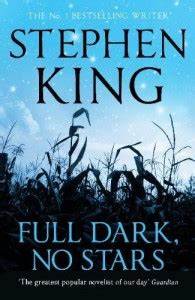
Full Dark, No Stars - Stephen King


A collection of short fiction, one of which I'd already read.  But Stephen King is to my mind the Number One living writer in English.  No one else has come anywhere near his output of hits across a surprising number of lengths, forms and genres.

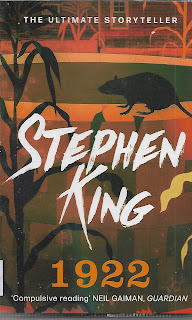
Full Dark, No Stars is essentially a book about marriage. '1922', which I read as a standalone novella last year and which is therefore reviewed earlier on this blog, is about a poisoned relationship.  'A Good Marriage' is what it says on the tin, with a killer twist.  'Big Driver' is a revenge tale in which the ill-starred union which resulted in the 'Big Driver' is the nexus - and again it's the twists that make it.  'Fair Exchange' is perhaps the weakest of the four feature stories - a Faustian deal to make a marriage better by sabotaging the marriage of another.  A bonus short story, 'Under the Weather', is in keeping with the marital theme.  All would be hunky dory with the Franklins on the fifth floor, if only the other tenants hadn't started to complain...

OK, not the master's finest work, although I would argue that '1922' comes close.  Nevertheless, thoroughly engrossing and far better than anyone else is offering.


Monday, 17 January 2022

The Power of the Dog - Thomas Savage

The original 1967 book of the hit Netflix movie that's currently making all the running in the early stages of awards season.


It is 1924 and the end of the cowboy era in Montana.  The Burbank brothers, Phil and George, had taken over running the ranch since their parents retired to a hotel in Utah.  Phil is the traditional cowpoke, skilled in all the traditional western handcrafts, a man who pointedly disdains to wear gloves.  And yet he is a millionaire and something of an autodidact genius.  Younger brother George is plump and quiet and handles the business side of things.  The brothers live together, even sleep in the same bed, but George is a modern man who loves automobiles and who hankers after a normal life.

In what passes for a town is the widow Rose Gordon, whose husband came west to be a doctor but ended up a drunk who did the unforgivable and hanged himself.  Rose keeps a boarding house and devotes herself to her son Pete, a strange youth who wants to be a famous surgeon.  George Burbank, in his gentle, quiet way, courts Rose and marries her - which comes as a blow to Phil, confronted with an aspect of life that is alien and repugnant to him.

Phil sneakily undermines Rose, makes her life hell.  He is automatically antagonistic to sissy Pete when he comes to stay on the ranch during the school holidays.  But something about the boy - his solitary self-reliance, his way of learning, and yes, his courage - strikes a chord and wins Phil over.  He passes on his lore to the boy.  In his way, he loves him.  But years ago - the year before Johnny Gordon killed himself - Phil Burbank shamed him, broke him.  That's a grudge Johnny's son has kept and nurtured.  There is a price to be paid.

It really is a stunning feat of storytelling.  Yes, there are notes of True Grit and the novels of Larry McMurtry, but that was the era in which Savage wrote.  The way he handles the storylines, the dignity he gives his characters, even the minor ones, is very different.  His prose is magnificent, his sense of history shines in every line of description.  I loved it.

Wednesday, 12 January 2022

The Devil in the Flesh - Raymond Radiguet

The ultimate, the original enfant terrible and muse to Jean Cocteau, Raymond Radiguet published this roman a clef when he was still a teenager.  His hero in the book (unnamed) is fifteen years old when he seduces nineteen-year-old Marthe.  Marthe is engaged to a soldier on the Front (this is the last year or so of World War I), and the protagonist lets the marriage go ahead.  But as soon as Jacques is back on the front line our 'hero' is spending his nights and much of his days at the marital home.  Marthe loves him dearly.  He is too young for such considerations.  For him, it is all about the coup, the exercise of control over a lesser being.  The book came out in 1923, around the time Radiguet turned twenty.  It was a scandal and a sensation.  Of course everyone assumed it was autobiographical, which it may well have been; of course Radiguet did nothing to clear up the matter.  The outcry was not so much the seduction as the implication that the wives of France's heroes might not have been entirely faithful during their long absence.

Radiguet wrote a play and one more novel - Count Orgel's Ball, which is much harder to get hold of. He was still only twenty when he died in December 1923.  Cocteau was inconsolable - for a while.  Nina Hamnett (see below), who knew them both from Bohemian nights at the Boeuf sur le toit, attended the funeral.

The book remains extraordinarily powerful.  The translation in the Penguin Classic version, by A M Sheridan Smith, is extremely readable.

Monday, 10 January 2022

The Painted Veil - Somerset Maugham


In this novel from 1925 Maugham's theme is coming to terms with adulthood and the development of empathy.  Kitty Garstin is a pretty, middleclass girl, favoured by her parents because she's prettier than her younger sister Dorothy.  But plain Dorothy gets engaged first, which Kitty takes as something of a slur on her, so she accepts the first proposal that comes along - from a talented, decent-looking young bacteriologist called Walter Fane.  She barely knows him, doesn't really like him let alone love him, but he does have the advantage of a posting in Hong Kong.

Once in the colony Kitty soon gets bored and plunges into an affair with Charlie Townsend, the Colonial Secretary.  He's an older man, horribly vain and self-centred, but Kitty is infatuated and, at the same time, relishes betraying her dull husband.  Walter finds out and, icy-cold, issues an ultimatum.  Either she comes with him to a cholera-ridden city up-country or he'll divorce her, ruin her reputation and, more importantly, Townsend's prospects of ever becoming governor.  Kitty assumes Townsend will throw up his career and run away with her.  Of course he won't.  He loves his life and is deeply attached to his plain, undemanding wife.

So Kitty goes with Walter, not caring if she lives or dies.  The city really is hell - the dead lie in the streets, the military is trying to organise things, and the only functioning healthcare centre is a French nunnery.  Kitty meets a strange, prematurely bald little man called Waddington, the deputy commissioner in the area.  He is deeply immersed in the community and knows everything about everyone.  He introduces Kitty to the nuns who absolutely revere Walter for his work and effort.  Kitty has no education and no real talent, but she can help out by looking after the abandoned Chinese girls.  Initially they are ugly little monsters to her, but then she recognises their humanity.  She visits Waddington at home and finds out he lives, unmarried, with a Mandarin noblewoman - a double outsider in Southern China - who is utterly devoted to him.  As Kitty discovers the humanity in others, so she finds it within herself.  She realises she is pregnant.  Is it Townsend's or is it Walter's?  Townsend doesn't matter to her any more.  Having seen Walter with babies dying of cholera she knows he will accept the child (she's convinced it will be a girl) and love it.  She aches to tell him - but Walter catches the cholera (he may have been experimenting on himself) and dies.

Kitty has to return to Hong Kong, where she is met by Dorothy Townsend, who is every bit as caring and charitable as everyone says she is.  For a time, at Dorothy's insistence, Kitty lives in the Townsend home.  Charlie tries it on, of course, but gets his come-uppance.  Kitty finally takes control of her life and goes home to London.  Her father, whom she has never really appreciated, has accepted a post in the West Indies.  His wife has died while Kitty was en route home.  Kitty, now properly adult, pledges to go with him.

A delightful book, written in eighty very short chapters yet deeply incisive, with wonderfully rounded, compulsive characters.  I enjoyed The Magician more, because it's my kind of story, but The Painted Veil is a much better book - on a par with The Moon and Sixpence.

'

Wednesday, 5 January 2022

Mexico Set - Len Deighton


 The second novel of the first Bernard Samson trilogy, Mexico Set is a straight follow-on from Berlin Game.  The dust from the shock ending of the first novel is still settling.  Bernie has been cleared of suspicion - officially, at least - but he still feels he's on probation.  He's in Mexico City with Dicky Cruyer, who has got the Berlin Desk at London Central which should, by rights, have been Bernie's.  They are there because there's a disgruntled KGB operative called Erich Stinnes, who might just be ready to defect.  He approached Werner Volkmann and his young wife Zena in a German club.  Stinnes said he'd mistaken her for a famous beauty (whose brother Bernie and Werner just happened to know, growing up in Berlin).  A genuine mistake or a coded message?

Ultimately, Bernie gets the job of enrolling Stinnes.  He knows this is his only chance to recover his career.  But what if it's all a con?  What if Stinnes is actually out to enrol Bernie?  And why is everyone, friend or foe, apparently dead set on banjaxing Bernie's operation?

It all ends in a genuine Mexican stand-off, which is truly thrilling - and also multilayered.  Deighton's mastery shows in the way he ends the novel.  No what-happened-next, no analysis and absolutely no unravelling or regathering of loose ends.  He always knew he had a third novel for that.  And a second trilogy... maybe a third.

A second instalment, then, that is every bit as good as the first.

Tuesday, 28 December 2021

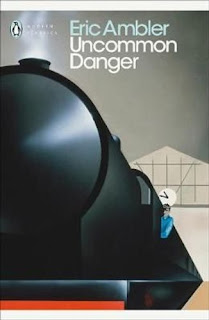
Uncommon Danger - Eric Ambler

Uncommon Danger (1937) was Ambler's second novel.  The setting is contemporary.  Fascist governments are rising all over Europe and challenging the dreadful divisions imposed by the Versailles conference after World War I.  Russia and Romania are the main claimants for oil-rich Bessarabia, but plutocrats worldwide are desperate to get their hands on the black gloop worth almost as much as gold.  Key Russian documents are stolen.

Our hero is a freelance journalist called Kenton who has lost all his ready money on poker dice.  Then, out of the blue, the only other passenger in his railway compartment, who claims to be a commercial traveller called Sachs, offers him a tidy sum to smuggle a package through customs for him.  Kenton is in no position to refuse.  He is an honest fellow and goes to the hotel Sachs nominated, to return the package and collect the other half of his fee.  Only to find Sachs murdered and Kenton himself the only suspect.

The rest of the book is a series of adventures which reminded me of The Thirty-Nine Steps - Ambler is in many ways the bridge between Buchan and Bond.  The Russian agents, Andreas Zaleshoff and his sister Tamara, are by and large the good guys, Colonel Robinson and Captain Maitland, operating on behalf of the London capitalists, are very much the baddies.  Smedoff, the ageing femme fatale, who appears right at the end, is a magnificent character.

Excellent fun.


Friday, 24 December 2021

Laughing Torso - Nina Hamnett


Nina Hamnett was a wild child of the nineteens and twenties.  Posh but not rich, she escaped from rural Wales to London where she studied, on and off, to be a painter - and from London to Paris before and after the War, where she slept with a variety of painters, did a lot of drawing, and sold the odd painting to keep the wolf from the door.

They are all here - Modigliani looms large, Brancusi, Cocteau and Radiguet,  Hamnett drops the big names like small bombs.  She introduces Valentino to James Joyce.  Some names are evidently so big that she has to refer to them as A or Countess B.  It's a whirlwind of parties and balls and cabarets, liberally sprinkled with nude dancing.  Hamnett does not judge and doesn't care how you might judge her.

There is no real structure to the narrative.  She tries to be chronological but frequently fails.  It doesn't matter.  This is gossip and tittletattle in a breathless rush.  And she's really good at it.  She brings exotic scenes alive and makes highly-strung artists instantly human.  Laughing Torso provoked outrage and glee when it was published in 1932.  Aleister Crowley tried to sue; he failed but he needed publicity more than he needed cash.

There is a sequel, Is She a Lady?, which came out in 1955, the year before she fell (or threw herself) out of the window of her flat in Paddington.  I will have to track it down.

There is no better account than Hamnett's of Bohemianism of the period on both sides of the Channel.  As a painter, there is no better portrait of W H Davies, the 'Supertramp', than hers.

Robert B Parker's The Devil Wins - Reed Farrel Coleman

Robert B Parker was a massively successful writer of moderately hardboiled crime fiction series, notably the Spenser series.  His second string, with nine novels, was Jesse Stone.  Doubtless somebody was hired to continue the Spenser series when Parker died in 2010.  Reed Farrel Coleman was the second writer hired to continue the casefiles of Jesse Stone.  This is the second of six continuations thus far.

Coleman is himself the author of successful series.  He has also collaborated with others, including Ulster's own Ken Bruen.  He is, in short, a professional.  He knows what he is doing.

So, Jesse Stone is a former LAPD homicide detective who lost his job because of his drinking.  He moved crosscountry to become local police chief in Paradise, Mass., a commuter town for Boston.  In The Devil Wins an autumn wind reveals three bodies in an abandoned building, two young girls who went missing 25 years earlier, and a fresh John Doe.  A side of Paradise and its history is revealed that Stone knew nothing about.  His righthand woman, Officer Molly Crane, was friends with these girls.  There's a lot of pressure on Stone to solve the case, particularly from the town's elected leaders.  The national media is interested, especially when the mother of one of the girls, a noted sexpot in her day and now married to an elderly millionaire, goes off a cliff minus her panties.

The story really is well done.  The town comes alive with its friendships, alliances, rivalries.  The characters, too, are three-dimensional, expertly layered.  But it's the steady revelation of the mystery that Coleman does so well.  I shall certainly keep my eye out for more of his work.  Who knows, I might even try one of Parker's originals.