Total Pageviews

Showing posts with label eric ambler. Show all posts

Tuesday, 28 December 2021

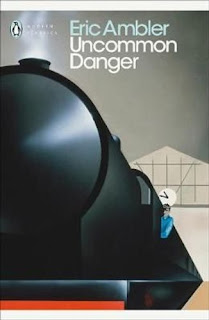
Uncommon Danger - Eric Ambler

Uncommon Danger (1937) was Ambler's second novel.  The setting is contemporary.  Fascist governments are rising all over Europe and challenging the dreadful divisions imposed by the Versailles conference after World War I.  Russia and Romania are the main claimants for oil-rich Bessarabia, but plutocrats worldwide are desperate to get their hands on the black gloop worth almost as much as gold.  Key Russian documents are stolen.

Our hero is a freelance journalist called Kenton who has lost all his ready money on poker dice.  Then, out of the blue, the only other passenger in his railway compartment, who claims to be a commercial traveller called Sachs, offers him a tidy sum to smuggle a package through customs for him.  Kenton is in no position to refuse.  He is an honest fellow and goes to the hotel Sachs nominated, to return the package and collect the other half of his fee.  Only to find Sachs murdered and Kenton himself the only suspect.

The rest of the book is a series of adventures which reminded me of The Thirty-Nine Steps - Ambler is in many ways the bridge between Buchan and Bond.  The Russian agents, Andreas Zaleshoff and his sister Tamara, are by and large the good guys, Colonel Robinson and Captain Maitland, operating on behalf of the London capitalists, are very much the baddies.  Smedoff, the ageing femme fatale, who appears right at the end, is a magnificent character.

Excellent fun.


Tuesday, 26 November 2019

The Sun Chemist - Lionel Davidson


How on earth do you make a thriller out of writing footnotes for the letters of Israel's first president? Lionel Davidson shows how. Igor Druyanov, a historian of Russian descent, is commissioned to prepare a couple of installments of the massive multi-volume Letters of Chaim Weizmann (1874-1952). The years in question were Weizmann's wilderness years - like Churchill, these were the Twenties and Thirties - when he was ousted from the Zionist movement and had to revert to his original profession as a research chemist.
The key to the tension here is that the book dates from 1976 and begins a couple of years earlier, in 1974. This is when OPEC jacked up oil prices, creating a crisis in the West and making the polite, ever-smiling Sheikh Ahmed Zaki Yamani a hate figure. At rhe time it seemed as if the greedy, ungrateful Arabs were threatening the developed world with a new stone age. Indeed, the West has spent the last fifty years developing alternative power sources to avoid a repeat, whilst the Arab world has taken a more moderate line in exploiting what is, after all, their only real resource, and a finite one at that.

But Davidson's book is firmly anchored in 1974-6 and the Israel of that time, a year or so after the first Arab-Israeli war. Davidson might have been born in Hull but at this time he was living in Israel. In the story, it emerges from Igor's research that Weizmann and his research associates might have hit upon a way of synthesizing combustible fuel from root vegetables. It isn't quite so simple, and Davidson spares us none of the science, but that is essentially it: an infinite supply of fuel to a power-hungry world; a windfall beyond price to a state just establishing itself in the deserts of Palestine and the end of time to their near neighbours in the Gulf.

It's a great book and an astonishing feat of writing from Davidson. He was never a scientist, always a journalist but, by God, he does his research. Every part of the book, from the history that drives Druyanov, to the world of international science and petrochemicals, is utterly convincing. Davidson, to be fair, was a peripatetic journalist and, as I say above, lived in Israel - but I've never read anything, fact or fiction, that brings that raw state so alive. Davidson, in my view, is even better than Ambler, better than Greene, and so unusual in his choice of subjects. He deserves to be better remembered than he is. As for this book, is there a thriller in print today that is more topical?
Wednesday, 10 October 2018

Journey into Fear - Eric Ambler


Eric Ambler (1909-1998) was the master of spy fiction. Before him there was John Buchan and whoever it was created Bulldog Drummond; after came James Bond. Without Ambler there would have been no Bond. Fleming absolutely stuck with Ambler's formula for success, though in my view his writing was never as good. Where Fleming outshone Ambler, however, was in having the continuing hero. Each of Ambler's major thrillers has a different hero and they tend to be middling men of no particular significance who by chance become embroiled in the machinations of nations. They are more like real spies in that sense and, given that we know they will not recur in the next book, we cannot be sure they will survive, which adds suspense utterly lacking in Bond.


Here, for example, Mr Graham, who lacks even a forename, works in a senior capacity for an international arms manufacturer. This being 1940, the firm's products are in great demand and Mr Graham - having survived an assassination attempt in Istanbul - is trying to get home to England on a cut-price ocean steamer. His fellow passengers are few in number. Any or none of them might be in league with the assassin, who also manages to slip aboard. That, in essence, is the story.


It is down to Ambler's skill as a storyteller that we remain enthralled. His characterisation is excellent, his writing strong. He uses narrative devices well beyond his successor Fleming. For example the first couple of chapters unfold in flashback. We are aware of Mr Graham's amended plan to sail aboard the scruffy steamer, then find out why he has agreed to give up his original plan to travel first class by rail. This gets excitement in good and early (the attempt on his life), introduces the femme fatale (the glamorous nightclub dancer Josette) and reveals the involvement of professional spies in Colonel Haki of the Turkish secret service.


Journey into Fear made an excellent film with Orson Welles as Haki. After the war Ambler moved to Hollywood to write and produce movies. He was extremely successful - I had no idea until I looked him up. He wrote the screenplays for The Cruel Sea and the best of all Titanic movies, A Night to Remember. That is how good he was. Better than Buchan, better than Fleming. The best.

Sunday, 24 May 2015

Dead Man Running - John Blackburn


Blackburn was incredibly popular when I was a child.  I remember exactly the shelf where his books were ranged in my local library.  I remember aspiring to be as successful when I grew up,  Yet he was largely forgotten even before his death in 1993, and since then he has vanished entirely.  I cannot for the life of me think why that is.

In the main, and certainly to start with, Blackburn wrote in two genres, John Wyndham style sci-fi horror and Eric Ambler style thrillers.  It seems unfair to suggest that he copied two better known writers; it is better to say he worked in similar fields.  Like Wyndham, his sci-fi tends to be set in the immediate tomorrow, so similar to now that it might as well be today.  Like Ambler, his world of subterfuge is European, his protagonists ordinary men cast adrift from normality.  In both forms Blackburn anchors his narrative with a whodunnit structure.  He is very good indeed at the mystery element,

Dead Man Running is the first of his thrillers, written in 1960, before the Berlin Wall but at a time when Russia was the deadly enemy of the West.  On the face of it, it is a murder mystery: Who killed Peter Carlin's wife and where is Peter Carlin?  Carlin, it turns out, is being interrogated by KGB thugs in Moscow.  The British authorities know exactly where he is.  To the great British public Carlin is both a killer and a traitor.

The rest of the story is Carlin's attempt to prove he is neither.  The conspiracy is incredibly murky.  The cast of characters is varied and colourful - the snobbish ex-maid, the last of his line aristocrat and philanthropist, and best of all the mad man-of-action adventurer J Moldon Mott.

OK, it's old-fashioned, but it is written with great skill, admirable economy (a modern equivalent would be a padded 350 pages whereas Dead Man Running is a well-honed 158) and a healthy humanity.  Nobody here is a total villain, no hero without fault.  Blackburn is every bit as good as I assumed he was back when I was a lad.