Total Pageviews
Tuesday, 28 July 2015
Running Dog - Don DeLillo
Running Dog (1978) is a relatively early DeLillo novel. It is redolent with post-Watergate paranoia in which mysterious corporations war with alternative entrepreneurs but both, fundamentally, seek the same thing, control of assets. The nature of the assets matter little. Everyone and everything is corruptible, which DeLillo demonstrates by anchoring his story on an asset which, in itself, could not be more corrupt or corrupting: a film believed to feature footage of Hitler and his entourage having orgies in the Berlin bunker as the Russians close in.
DeLillo deploys a number of principal characters, all of whom pay a price for their involvement in the quest. The second rank characters, corruptors all, pay no price whatsoever. This is their world and in it they flourish. Albeit Running Dog sounds like a polemic, the characterisation is so accomplished that the message never supplants the medium.
I've had a long but sporadic relationship with the novels of Don DeLillo. I always enjoy them but never seem to seek them out. This was the same. I picked it up by chance and enjoyed it on every level. I commend it to you.
Monday, 20 July 2015
Richard III and the Bosworth Campaign - Peter Hammond
Written in 2010, that is to say before the discovery of the body in the car park, Hammond writes in the belief that nothing the likes of Thomas More, the Croyland Chronicler, and indeed every single contemporary chronicler said about Richard III was true. Of course the undoubted body demonstrates that everything they said about his appearance and death was absolutely true, which logically suggests that everything they said about his usurpation was true too. Hammond is a dyed in the wool Ricardian, a former research officer of the Richard III Society. As such he seems reluctant to accept that Richard's seizing of the throne was a usurpation, and no mention is made here of the fact that he had his nephews murdered. Instead we have a long and unnecessary passage about how he didn't really want to marry his niece, Elizabeth of York, albeit, according to Hammond, Elizabeth was mad keen on marrying Richard. This is piffle and our author is wearing blinkers.
We know where he starts from by his use of the works of Ashdown Hill, who has won awards for his genealogical research but who labours under the belief that everybody in the 15th century was either illegitimate, responsible for whole tribes of illegitimate offspring, or preferably both. Here we are given two Ricardian bastards, John and Katherine, both of whom seem to have been teenagers, albeit their putative father was only 32 when he died. It is of course perfectly possible for Richard to have fathered children when he was himself an early teen but let us not forget (what Hammond and Ashdown Hill didn't know in 2010) that Richard's puberty was much worse than most with his spine curving by the day. It had to hurt and it had to have had psychological impact. Still, perhaps his response to the trauma was to go out and get bastards.
The main problem with this book, though, is that it doesn't tell me anything I didn't already know about the battle. Surely A L Rowse did a better job back in 1966? Funnily enough, Hammond doesn't cite Rowse in his bibliography. He does, however, make extensive use of the Mancini text, and the second continuation of Croyland, which both have the merit of being contemporary. I'm sure everything Hammond says about the battle is true so far as it can be, but in a book of only 116 pages, specifically about a battle and written for a specialist military publisher (Pen & Sword), less than ten pages of actual battle is not enough.
Friday, 17 July 2015
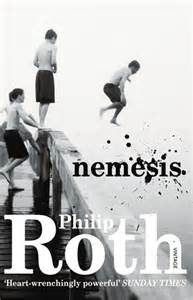
Nemesis - Philip Roth
Here we have late Roth, great Roth, superlative Roth. Set in Newark, New Jersey, in the furnace-hot summer of 1944, our hero is Bucky Cantor, 23 year-old athletic star who has been rejected for military service because of his appalling eyesight. Bucky is nevertheless a local hero. All the young boys want to be like Bucky, all the girls adore him. Bucky is embarrassed not to be in the army with his friends but here in Newark he does his duty. As a newly-qualified sports teacher he does summer work running his local playground. Then he finds his personal battle.
Polio starts its annual rampage. A bunch of Italian youths make mischief at Bucky's playground. Soon after the first of Bucky's young charges - a promising young lad very much in the Bucky Cantor mould - falls ill and, shockingly, dies. The Jewish parents (this is a wholly Jewish part of town) blame the Italian layabouts for bringing the infection up from the slums. Some blame Bucky. Bucky certainly blames Bucky. For a time he fights then, at the urging of his fiancee Marcia, he does the unthinkable - the one thing no one ever expected Bucky to do - he runs away. He takes up a cushy job at a summer camp for better off Jewish kids. The consequences are obvious. This is not a complex story. What it is, though, is a powerful, thoroughgoing examination of the all-American local hero. Roth spares us nothing. He is as scientific in his dissection of character as he is in his polishing of prose.
I'm in two minds about the ending. Is it too long (the final section, not the book itself)? Is it necessary at all? I didn't like the ending, but I suspect that's Roth's point. It got me thinking, reading at deeper than normal level. And that, I fancy, is what makes a masterpiece. Check it out - now! See what you think.
Labels:
1944,
America,
Bucky Cantor,
nemesis,
New Jersey,
Newark,
Philip Roth,
polio
Thursday, 16 July 2015
Watchman - Ian Rankin
Watchman is Rankin's third novel, after Flood, which I loved, and the first Inspector Rebus novel, Knots and Crosses, which I bought when it first came out in paperback and thought was very poor. Watchman, reasonably enough, sits somewhere between the two. Like Knots it is genre fiction and thus does not aim as high as Flood. In this instance it is spy fiction, written very much in the aftermath of watching the Smiley adaptations on TV. Miles Flint is a silly name, but no sillier than George Smiley, and as with Smiley the name is the direct opposite of the man. Smiley never smiled - or, at least, not as if he meant it - and Miles Flint is neither well-travelled nor especially hard.
Flint is a watchman, an organiser of surveillance. One of his key operations goes horribly wrong. He seems to have been forgiven but soon realises he hasn't. Machinations are in progress for the top job at MI5, as they always seem to be in sub le Carre fiction, and Miles finds himself caught in the crosshairs. He is despatched to Ulster, still - in 1988 - embroiled in the Troubles, betrayed and left to fend for himself. Can he rise to the occasion? That is the nub of the book but it is far too long in coming. Really what we have here is three stories rather crudely bolted together. It cries out for depth and knowledge of the human condition that sets le Carre apart.
It's an immature work by a young writer still trying to find his voice. There's nothing wrong in that - on these foundations Rankin built one of the great literary careers. It's well worth reading and judging on its own merits. But you wouldn't want to read it twice.
Thursday, 9 July 2015
Ghost Stories - M R James
Why is it I didn't take to the stories of Thomas Ligotti (see below) but fell instantly under the spell of M R James? They have much in common - James is obviously a key influence on Ligotti. Both writers tend to use the same type of narrator - learned, single, often a writer - and both use distancing devices such as "this is the story as someone told it to me." I have thought about it for some days now, and have concluded that the difference is the attitude of the narrator/protagonist. Ligotti's are inert, accepting, and thus alienate us; James's academic old buffers, on the other hand, rebel against their disturbing experiences and strive to put the world back in order. That makes them appealing. They do what we would hope to do in their position.
This selection, for Vintage Classics, includes an introduction by Ruth Rendell. I like Rendell but hate it when publishers feel they need to add a 'name' to a classic. This introduction is amiable enough but in the end it is piffle. It tells us nothing about James and even less about his works.
On to the stories themselves, there are thirteen of them, naturally, and the best for me was the story "Number 13". Can I say why I preferred it? Well, to an extent. It is odd, as hotel rooms tend to be odd, especially old hotels which have been converted from something else. Hotel rooms strive to be comfortable, to be a temporary home from home, but they always fail because most of us can never be truly comfortable away from home. We never fully have our bearings because there's always somewhere else, staff areas and other people's rooms, which we cannot access.
As always with ghost stories, it depends what you find frightening. If you have a problem with spiders, then James is definitely the boy for you. Personally, it's the oddness rather than the apparition which unsettles me. The flapping sheet on the beach in "Oh Whistle and I'll Come to You My Lad" is, for me, much scarier than the attack on Parkins by his bedsheets. But even if the thing itself in a particular story doesn't raise your gooseflesh you can always enjoy the sheer mastery of James's writing. James, of course, was far more learned than any of his protagonists; that means he does not need to show off, and he doesn't. Instead his pen flows like Picasso's line, effortless and yet magnificent.
Monday, 29 June 2015
Teatro Grottesco - Thomas Ligotti
Thomas Ligotti has become a cult writer since the millennium. People liken him to Lovecraft, Poe, and M R James. I like all those authors so naturally I was keen to try Ligotti. My conclusion? He's not like the aforementioned. He's not scary, though he does successfully get under your skin, and for all the very obvious work that goes into crafting his stories, he ends up being a bit dull. For me, the problem is that his first-person narrator has always the same characteristics - reclusive, obsessive, an outsider with a bad stomach - no matter whether he is a creative artist or a drudge in a slave-labour town. The towns, likewise, are always in the north, on the border, and he has usually left by the time he comes to write down his experience. There are other regular tropes - other recluses, bizarre modern artworks, and carnival performers (carnies are much scarier in America, apparently, than they are in the UK). Frankly, some of the long pieces are distinctly over-wrought - by the time I've got to the end of some of his paragraphs I've forgotten what he began with. I admire the work, the commitment to form. I own Ligotti has created a fictional world almost as real as Lovecraft's Arkham. But he's not adventurous enough for my taste.
The King in the North - Max Adams
I've got one problem with this book, and that's the title. It's not really about Oswald, king of Northumbria and, very soon after that, a saint. He is just one of the many kings covered here, some of them (for example his brother Oswy) at much greater length. OK, the subtitle "Life and Times" is supposed to deal with the problem but it doesn't because Oswald's reign was only eight years in the middle of a timescale of close on two centuries.
I understand Adams feeling the need to individualise his narrative but it doesn't work. What we really have here is the story of the foundation of the late Saxon kingdom of Northumbria from two earlier kingdoms, Bernicia and Deira. We have two royal dynasties coming together in Oswald and Oswy, their unity forged on early conversion to Christianity. Their lasting achievement was probably the Synod of Whitby presided over by Hilda, a member of the royal house. But Oswy called the synod, not Oswald. In fact, Oswy was much more successful a king than his shortlived brother, not least by becoming the first king in the region to die in his bed. Oswald was supposedly lucky, but not lucky enough to avoid being hacked to pieces on the battlefield. Indeed Adams devotes almost as much narrative to the travels of the various body parts as he does to Oswald himself. And again, it was Oswy who decided which head on a pole belonged to Oswald and thus began the cult which, four hundred years on, led to the relic being buried in Durham Cathedral alongside the uncorrupted remains of St Cuthbert.
Within the terms of what is, as opposed to what it claims to be, The King is the North is fascinating. Adams knows his Anglo Saxons, he knows his Bede back to front, and he is a native of the region he describes so beautifully. He has produced a major work of scholarship which has the added bonus of being eminently readable.
Wednesday, 24 June 2015
The Man in the High Castle - Philip K Dick
I have long been aware of Philip K Dick, but the only book of his I had hitherto tried was complete and utter rubbish. Unfortunately I cannot remember what it was called. All I know is, it read like it had been knocked up late at night on an unhelpful cocktail of caffeine and amphetamines.
Yet I was still interested enough to give The Man in the High Castle a try. It seemed a safer bet, having been written early in Dick's career and having won the Hugo Award in 1963. The cover art on this Roc paperback was also an inducement.
And how taking the chance paid off. This is not only a good dystopian novel, it is a good novel, many-layered with rounded characters and a cunningly contrived writing style. The action is set in San Francisco in 1962, but California is the Japanese part of North America, the East Coast being part of Germany. Thus Japanese people are high status and the indigenous population converse with them in a form of pidgin shorthand. Yes, the Axis of Japan and Nazi Germany won World War 2. Baldur von Shirach has drained the Mediterranean to provide extra farmland and Lufthansa runs a rocket service that can cross the Atlantic in under an hour.
The Japanese are much more easy-going than the Nazis. The Reich is run by Bormann, Goebbels, Goering and Heydrich are all still active, though Adolf himself is in an asylum. Genocide is still very much the order of the day (presently concentrated on the African continent) but the Japanese consider such policies subhuman. The Japanese collect prewar American artifacts, like Colt pistols and Mickey Mouse watches. Rickshaws ("pedecabs") thread their way through downtown traffic. The Nazis meanwhile are exploring space.
The current bestseller on the Pacific Coast (it's banned in the Reich) is The Grasshopper Lies Heavy by Hawthorne Abendsen, a dystopian novel in which the Allies overcame the Axis in 1945. It is said the Nazis hate it so much that Abendsen has to live in a fortified tower to protect himself and his family. He is the Man in the High Castle.
The book which everyone on the West Coast is obsessed with is the I Ching. Everyone, irrespective of race or status, is casting hexagrams at every opportunity.
There are various narrative strands, loosely linked: the retailer of high-end Americana Robert Childan; Frank Frink, the secret Jew who actually makes some of the so-called antiques Childan sells; Frinks estranged wife Juliana, a judo instructor who takes up with an Italian trucker and sets off in a quest to find the man in the castle; Tagomi, who heads up the Home Islands trade mission in San Fransisco; the mysterious Baynes, who purports to be a Swedish businessman. Everyone seems to have a position, but everyone has to review their position - usually in consultation with the yarrow stalks of I Ching - when the third Fuhrer, Martin Bormann, unexpectedly dies.
Unlike the other Dick book I tried, The Man in the High Castle is brilliantly constructed, the writing polished without ever toppling over into bland. If the author of the first novel was fried with stimulants, this one has the focus and clarity of Sherlock Holmes on cocaine. I am now willing to give any Dick novel a try. Apparently The Three Stigmata of Palmer Eldritch is also available in Roc paperback (a Penguin imprint I had never previously heard of), so that seems like the perfect next step.
Yet I was still interested enough to give The Man in the High Castle a try. It seemed a safer bet, having been written early in Dick's career and having won the Hugo Award in 1963. The cover art on this Roc paperback was also an inducement.
And how taking the chance paid off. This is not only a good dystopian novel, it is a good novel, many-layered with rounded characters and a cunningly contrived writing style. The action is set in San Francisco in 1962, but California is the Japanese part of North America, the East Coast being part of Germany. Thus Japanese people are high status and the indigenous population converse with them in a form of pidgin shorthand. Yes, the Axis of Japan and Nazi Germany won World War 2. Baldur von Shirach has drained the Mediterranean to provide extra farmland and Lufthansa runs a rocket service that can cross the Atlantic in under an hour.
The Japanese are much more easy-going than the Nazis. The Reich is run by Bormann, Goebbels, Goering and Heydrich are all still active, though Adolf himself is in an asylum. Genocide is still very much the order of the day (presently concentrated on the African continent) but the Japanese consider such policies subhuman. The Japanese collect prewar American artifacts, like Colt pistols and Mickey Mouse watches. Rickshaws ("pedecabs") thread their way through downtown traffic. The Nazis meanwhile are exploring space.
The current bestseller on the Pacific Coast (it's banned in the Reich) is The Grasshopper Lies Heavy by Hawthorne Abendsen, a dystopian novel in which the Allies overcame the Axis in 1945. It is said the Nazis hate it so much that Abendsen has to live in a fortified tower to protect himself and his family. He is the Man in the High Castle.
The book which everyone on the West Coast is obsessed with is the I Ching. Everyone, irrespective of race or status, is casting hexagrams at every opportunity.
There are various narrative strands, loosely linked: the retailer of high-end Americana Robert Childan; Frank Frink, the secret Jew who actually makes some of the so-called antiques Childan sells; Frinks estranged wife Juliana, a judo instructor who takes up with an Italian trucker and sets off in a quest to find the man in the castle; Tagomi, who heads up the Home Islands trade mission in San Fransisco; the mysterious Baynes, who purports to be a Swedish businessman. Everyone seems to have a position, but everyone has to review their position - usually in consultation with the yarrow stalks of I Ching - when the third Fuhrer, Martin Bormann, unexpectedly dies.
Unlike the other Dick book I tried, The Man in the High Castle is brilliantly constructed, the writing polished without ever toppling over into bland. If the author of the first novel was fried with stimulants, this one has the focus and clarity of Sherlock Holmes on cocaine. I am now willing to give any Dick novel a try. Apparently The Three Stigmata of Palmer Eldritch is also available in Roc paperback (a Penguin imprint I had never previously heard of), so that seems like the perfect next step.
Thursday, 18 June 2015
The Other Log of Phileas Fogg - Philip Jose Farmer
The title says it all: there is another log, other than the one Jules Verne edited for publication, containing the real, intergalactic context of Fogg's round-the-world journey. It is crossover literature to a certain extent, in that Verne was of course for many people the father of science fiction, but Around the World in Eighty Days was not one of his science fiction works. Twenty Thousand Leagues Under the Sea was, however, pure sci fi, and Farmer imports Nemo here as his criminal mastermind.
Farmer was the pioneer of this form, which is one I love and try to write myself. He began with Tarzan, then Fogg, and on to create an entire world - the world of Wold Newton, in which all the heroes of fantastical pulp fiction coexist. The Other Log, as I say, was his second experiment in the form. Farmer completes the illusion with editorial digressions. The result is great fun, though I would say that, as so often with Big Idea Fiction, the characterisation suffers somewhat. Finally, I must put on record how much I adore the artwork on this original 1973 Daw paperback.
Thursday, 11 June 2015
The House on the Borderland - William Hope Hodgson
Mr Hodgson is perhaps second only to Algernon Blackwood in his serious treatment of unreality. Few can equal him in adumbrating the nearness of nameless forces and monstrous besieging entities through casual hints and insignificant details, or in conveying feelings of the spectral and the abnormal in connexion with regions or buildingsThus said H P Lovecraft in his rolling survey of the form, "Supernatural Horror in Literature", written between 1925 and 1934.
Well the object here is very much the building, and what happens there is abnormal to the ultimate degree. Those who know Hodgson only for the Carnacki stories or his innumerable tales of the Sargasso, are missing out. Borderland prefigures his final novel, The Night Land, which even Lovecraft and Clark Ashton Smith felt 'went a bit too far'. It might have been written in 1907 (see 'the editor's' introduction) but in many ways it could easily have come from the acid-ridden 1960s.
It starts traditionally enough. Two Victorian chaps take a holiday in the far West of Ireland. There they stumble upon the ruined, abandoned house, perched precariously on an unstable rock platform over a huge bottomless abyss. In the rubble inside the house they find a damaged manuscript written by the last owner, a nameless recluse. We do not know when the manuscript was written or when the house was abandoned, and very soon the issue of time becomes irrelevant.
The recluse describes how he was sitting in his study late one night when he felt himself being borne up and away by invisible forces, into space and out of the solar system. In another part of the galaxy he visits a planet where he finds a massive replica of his house hewn out of green stone, standing on the border of the Silence. He wakes back in his study and finds that nothing has changed. Or has it?
Part of his garden is carried away in a landslip. The pit begins to form. Creatures emerge and attack the house, which the recluse now realises stands on the border between dimensions.
A good third of the book is taken up with a second out-of-body experience in which he seems to live forever, so long that he sees and survives the death of the sun itself. He seems to wake, but---
Unique for its day and very much a precursor of modern visionary sci fi, this book essentially defines the term 'fantastic fiction'. A must-read for any student of the genre.
And what, for the record, did Lovecraft think of The House on the Borderland? Why, this---
The House on the Borderland (1908) - perhaps the greatest of all Mr Hodgson's works - tells of a lonely and evilly regarded house in Ireland which forms the focus for hideous other-world forces and sustains a siege by blasphemous hybrid anomalies from a hidden abyss below. The wanderings of the narrator's spirit through limitless light-years of cosmic space and kalpas of eternity, and its witnessing of the solar system's final destruction, constitute something almost unique in standard literature. And everywhere there is manifest the author's power to suggest vague, ambushed horrors in natural scenery. But for a few touches of commonplace sentimentality this book would be a classic of the first water.I'd quibble with the last sentence - Lovecraft, understandably, had no knowledge of Hodgson's love life, which I see mirrored in the recluse's reunion with his lost love in the second vision - but otherwise, I think he pretty much covers all the bases. And I'd forgive him almost anything in return for the word kalpas, albeit Lovecraft borrows it from Hodgson's book.
Subscribe to:
Comments (Atom)