Total Pageviews

Tuesday, 5 May 2015

Lightning Bug - Donald Harington

Luddites can say what they want, but there's no way I would have encountered Donald Harington without my Kindle.  And what a loss that would have been.

Some people call him the best unknown American writer of his era (he started in the sixties and died in the noughties).  There are worse fates.  Anyhow, he will be appearing a lot in this blog because there are half-a-dozen novels in Volume 1 alone, and I shall be reading the lot.

To begin at the beginning...  Well not quite the beginning...  There was another novel, a first novel, The Cherry Pit (1965) which sits outside his main canon and is the reason this collection is called The Nearly Complete Works.  Everything else, from Lightning Bug (1970) to Enduring (2009) is set in the fictional Arkansas hamlet of Stay More in the Ozark Mountains.  The people are simple folk who live a simple life - but who have rich and imaginative inner lives.  And Harington shares those lives with us in radical ways.  He starts and ends Lightning Bug like a film script; he slips from past to narrative present (actually 1939); he takes us into their fantasies; he uses tenses like nobody else I have ever read.  And because he is not showing off, because he is so immersed in the truth of his characters, his tricks only enhance the reader's experience.

The titular bug is Latha Bourne, postmistress and sexual siren of Stay More, knocking forty.  Like a real lightning bug Harington tells us, she flashes to attract a mate then changes her mind when a better prospect wanders into view.  She is a woman with a past, which Harington gradually reveals.  The mountain folk would supposedly be scandalised by her secrets but they only make us, the reader, love her more.  The contending beaux in this episode are Every Dill, her childhood sweetheart, a rapscallion, army deserter, pretend rapist and suspected bank robber turned revivalist preacher, and Dolph Rivett, a farmer from another settlement a ways off.  But the real love of her Latha's life, Harington tells us, is four-year-old 'Dawnie', actually Harington himself, which completes the illusion of actuality.

A truly wonderous book.  Can't wait to read the next instalment, Some Other Place, The Right Place.

Tuesday, 28 April 2015

The Second Son - Jonathan Rabb


Rabb is one of many contemporary crime novelists exploring the Nazification of Germany from the point of view of non-Nazi policemen.  Philip Kerr is by far the best of these.  In this, the third of his Berlin Trilogy, Rabb takes us to civil war Spain at the time of the alternative Olympics in 1936.  Again this is not new (see Alan Furst, Midnight in Europe, and Jack Ludlow, A Broken Land) and would have been better had he told us something worth knowing about the event.  The alternative Olympics would be a great theme for a novel but it is not the theme of this one.  Quite what is, I'm not sure. Perhaps I'm in the dark because this is the third of a trilogy and I haven't read the other two.  It shouldn't be the case - you can read Smiley's People, for example, without having read The Spy Who Came In From the Cold.  I certainly did.

Forcibly-retired Police Inspector Nikolai Hoffner takes himself off to Spain in search of his second son, Georg, a newsreel cameraman who has gone missing.  Previous novels presumably deal with his estrangement from his older son, Sasha.  Hoffner has cryptic clues to follow in a telegram that is nowhere near as implausible as the later revelation of where it came from.  He meets a female doctor, Mila, much younger than himself, and they (again slightly implausibly) become lovers and set off on a cross-country quest.

That's pretty much it.  Rabb clearly knows his subject matter but does not feel the urge to share it adequately with those of us who don't.  He writes well, his style crisp, well-paced and authoritative.  I'm sorry, but whilst the narrative kept me interested, I found I couldn't care less about the characters.

Disunited Kingdom - Ian MacWhirter


The story of "how Westminster won a referendum but lost Scotland" from a distinguished Scottish journalist tells us everything we weren't allowed to know south of the Border.  We all knew, for instance, that Cameron's instant backtrack on devo-max the morning after the vote was so callous that it almost certainly lost him next week's General Election and equally surely guaranteed that Scotland's disassociation will lead to a federal Britain in the coming decade.  My view of that possibility?  Good.  Can't happen soon enough, provided England is divided into regions too.

What MacWhirter tells me which I didn't know is how many community groups sprang up spontaneously in Scotland to take the campaign out of the hands of the professional politicians and, more importantly, bypass the lies and smears of Britain's poisonous rightwing Press.  MacWhirter became drawn into this alternative movement and found himself moving from an instinctive unionist to a sceptical nationalist.  His personal story mirrors the national narrative.

This is how a political campaign should be run.  There are lessons for us all here.  I cannot recommend this beautifully written and deeply insightful book strongly enough.  It should be on the school curriculum both sides of the Border.

Thursday, 23 April 2015

High-Rise - J G Ballard

Reading J G Ballard’s High-Rise (1975) quickly put me in mind of Golding’s Lord of the Flies from 1954.  The resemblance goes beyond mere dystopia.  Both are about civilised man’s predilection to run wild when deprived of his creature comforts.  For both Ballard and Golding, the veneer of social cooperation is tissue-thin.


I don’t want to labour the point because there are obvious differences between the books.  Golding wafts his schoolboys off to a tropical island whereas Ballard maroons his adult male protagonists in a suburban London tower block.  To begin with at least, both locations smack of the paradisiacal.  But, just as Eden had its serpent, so Ballard’s suburbia houses an underlying menace: 

The spectacular view always made Laing aware of his ambivalent feelings for this concrete landscape.  Part of its appeal lay all too clearly in the fact that this was an environment built, not for man, but for man’s absence....  The cluster of auditorium roofs, curving roadway embankments and rectilinear curtain walling formed an intriguing medley of geometrics - less a habitable architecture, he reflected, than the unconscious diagram of a mysterious psychic event. [Ballard 1975: 34-5][1]

For me, massive high-rise developments bring to mind the disastrous social experiments of the 1960s in northern cities like Sheffield and Manchester.  Streets of slums wiped away in favour of jerry-built slums in the sky.  Ballard’s London high-rise is very different.  This new-built development of a thousand apartments is for affluent buyers only; professionals at the very least (Laing, for example, is a lecturer at a medical school), preferably stockbrokers and above.  It remains a social experiment, though.  The size of the apartments, and naturally their cost, increases the higher up you go.  The architect himself, Anthony Royal, occupies the penthouse.  The utopian idea was for the residents at all level to come together in the communal areas like the shopping mall, the swimming pool, and the Royal’s rooftop sculpture garden.  In practice, even as the last of the residents moves in, the middleclass has subdivided itself into three - lower, middle, and upper - and never shall the twentieth floor, let alone the ground floor, aspire to the fortieth.  What was meant to be a single community has become an amalgam of a thousand islands.

These people were the first to master a new kind of late twentieth century life.  They thrived on the rapid turnover of acquaintances, the lack of involvement with others, and the total self-sufficiency of lives which, needing nothing, were never disappointed. [Ballard 1975: 46]

Royal has built himself a vertical kingdom, with courtiers and even courtesans.  To be able to be the top of the pile means that someone must be at the bottom, and the lower orders always have the potential to become unruly.

In many ways, the high-rise was a model of all that technology had done to make possible the expression of a truly ‘free’ psychopathology. [Ballard 1975: 47]

It begins with a fifteen-minute blackout on just three floors.  Residents isolated on the tenth floor concourse stampede.  Some are briefly marooned in the lift between floors.  Somebody, for reasons unknown, drowns a dog in the communal swimming pool.  From that point the veneer cracks, faultlines spreading from the centre like a spider’s web.  Inhibitions slip, the garbage disposal shutes become clogged, people smear dog shit, parties run on for days, a man dies.

Class turns against class, floor against floor.  People defend their territory to the death.  No one leaves the high rise.  No one calls the police.  Their world turns in on itself, becomes self-contained.

The true light of the high-rise was the metallic flash of the polaroid camera, that intermittent radiation which recorded a moment of hoped-for violence for some later voyeuristic pleasure. [Ballard 1975: 133]

Tuesday, 14 April 2015

Neverwhere - Neil Gaiman


I remember Neverwhere the original TV series back in 1996.  I remember quite liking it, but those were busy times for me, long before any sort of recording equipment in my house, and I don't think I watched everything.  Recently, Neil Gaiman has been cropping up a lot in my reading.  When I saw this in Hunt's bookshop in Rugby I thought, why not?

There are two versions of the Neverwhere novel, the TV tie-in from 1997 and this, the author's preferred text, from 2000.  What the differences are, I don't know.  Anyway, just be to clear, I am reviewing the 2000 version, which we must take as the definitive one.

I keep saying I'm not a big fan of sci-fi or fantasy, and I keep reviewing them.  Obviously, these days, I must state I am quite a fan of witty fantasy and reasonably down-to-earth sci-fi (i.e. not cowboys in space).  What I really like are fantasies set in the dark underbelly of London, the London nobody knows.  Thus William Gibson's Zero History, Kim Newman's Anno Dracula (of which I have just a acquired the second volume), the Felix Castor series by Neil Carey (like Gaiman, a renowned British practitioner of US cult comics), and - probably my favourite - Rivers of London by Ben Aaronovitch.  Neverwhere keeps good company.  The TV origins are evident but I don't find that a problem in any way.  I wonder, though, how well Nineties Visual Effects coped with the grand set pieces like the Floating Market in Harrod's basement.  As to how I will soon find out, see below.

The characters are likeable and well-drawn.  Poor old Richard, who finds himself marooned in London below simply by being a good samaritan.  Door, the recipient of his generosity and the girl with a mission.  The flamboyant Marquis de Carabas, the Morecambe and Wise of hired killers Croup and Vandemar, various rats and, of course, the Angel Islington.  The invention is unceasing, the wit flows flee and I really enjoyed it.  Indeed, I enjoyed it so much that I immediately laid hands on a DVD of the BBC series, which I will ultimately be reviewing and comparing on my Media & Culture blog.

Friday, 3 April 2015

The Red Road - Denise Mina


Tartan Noir, I suppose, really began with Val McDermid, who in turn built on the work of Ian Rankin and especially William McIlvanney.  There are so many practitioners now - MacBride, Black, Ferris - that there even sub-genres.  But Denise Mina has to be up there with the very best, purely because she manages to maintain such a high standard.

I have to confess that my heart sank when I realised that The Red Road was going to keep switching the narrative between 1997 and the present day.  But the writing was so good, so clever, that it kept me reading, and then when I came upon the central hook (which I obviously can't reveal here) I was well and truly caught.  The mark of a writer not trapped by genre is the roundedness of characters.  Do they live or do they just perform.  Agatha Christie and many more rely entirely on their protagonists in this regard.  Mina's protagonist, DI Alex Morrow, on the other hand, is a bit dull, even prosaic.  Mina turns this to advantage by making the transitory characters Morrow comes in contact with vivid, even spectacular.  For example in The Red Road we have the drunken peer and barrister Anton Atholl, and the superannuated hippy Simon.  Even her scrotes are three-dimensional.  Take Michael Brown, the dying lifer, whose entire existence has been stolen from him.  To make us empathise with him takes writing of the very highest order.

Highly recommended.

Monday, 30 March 2015

The Black Echo - Michael Connolly


I remember reading the early Connolly novels back in the 90s.  I loved The Last Coyote  and Blood Work and Trunk Music and can't remember why I stopped buying or borrowing them.  I read The Lincoln Lawyer a couple of years ago and thought it mediocre.  Presumably I read something else earlier and thought the same.  Anyway, The Black Echo is not only an early Connolly, it's the very first, published in 1992.  It features Harry Bosch, which is another plus.

It is more than a crime novel - and Connolly's best always rise above genre.  In many ways it's a Vietnam novel.  Harry and the murder victim, Billy Meadows, were tunnel rats back in 'Nam - they went blind into the network of tunnels the Viet Cong had spent decades digging, and there they encountered the Black Echo.

I liked this a lot.  I liked the way Harry already has a back story, an earlier case which led to him being reassigned to Hollywood and which incurred the undying hatred of Internal Affairs.  He's already therefore a rogue, an outsider - 'not one of the police family'.  And his alienation gets deeper with every chapter.  Connolly's style is effective, the dialogue has the tang of authenticity without being overwrought or over-simple, and his descriptions are frequently skewed from the norm.  I guess the solution to my Connolly problem is to start again at the beginning - or, this being the beginning, continue in time order - and see what happens.  So it's The Black Ice next, then!

Sunday, 22 March 2015

The Savage Altar - Asa Larsson


"If you like Steig Larsson," says the hideous yellow blurb bubble, "you'll love Asa Larsson." Well, yes I did and No I didn't.  I loved The Girl With The Dragon Tattoo when I read it back in the day, but my enthusiasm dimmed as the trilogy progressed.  And I really came to dislike this other Larsson's debut.  Of course, in the first wave of the original Larsson's success, every Nordic crime novel in creation got snapped up by British publishers.  Rushed and clumsy translations poured from the presses.  How tempting it must have been to sign up another Larsson, irrespective of merit.  The need was to get it out as quick as possible.  Translator Marlaine Delargy was either under colossal time constraints and brought in a very basic rendition, or Larsson herself writes in a clumsy simplistic manner.  Either way, it's very unsatisfactory.  The title, too, has been sexed up for the British audience.  Originally, and in America, it was Sun Storm, which has even less to do with the plot.

The plot - ah yes, the plot.  A charismatic young preacher is gruesomely murdered in the church his writings paid for.  His gormless sister is arrested but no one seriously believes she did it.  Meanwhile Rebecka Martinsson, childhood friend of Sanna and Viktor, now a rising star of the legal profession in Stockholm (for which we see no evidence whatsoever) feels obliged to rush home and embroil herself with the very people she fled a decade earlier.  Throw in the pregnant police woman from Fargo and you just have it.  There is no mystery - the killer is simply announced when it dawns on our author that she hasn't set one up.  The killer, unsurprisingly, smacks strongly of Buffalo Bill in The Silence of the Lambs.

Trivial, trite, underwritten and formulaic.  Penguin ought to be ashamed of themselves.

Thursday, 19 March 2015

Stamboul Train - Graham Greene


Predating Brighton Rock by six years, Stamboul Train (1932) is an early Greene 'entertainment'.  It predates Murder on the Orient Express by two years but comes four years after Christie's Murder on the Blue Train.  Thus neither author can be said to have emulated the other, though they may have influenced each other to some extent.  In any event, murders on trains had been a staple sub-genre of crime fiction since William Huskisson MP was run down and killed on the opening day of the Manchester-Liverpool Railway in 1830.

Greene's fictional world is very different from that of Mrs Christie.  The journalist Mabel Warren is an overt, no-bones-about-it lesbian, whilst her lover Janet Pardoe is a self-indulgent fortune hunter.  Our heroine, Coral Musker, is a showgirl but not naturally a goodtime girl or easy lay, though Mr Myatt, the wealthy supplier of superior currants encounters no great difficulty in that regard.  The beauty of Greene, even early Greene, is that his characters are densely layered, each capable of good and bad, heroism and cowardice.  Most conflicted is Dr Czinner, the exiled revolutionary, who has hidden for years in an English prep school but is now heading home to face whatever fate awaits.  Least conflicted is the casual murderer Grunlich, who we first encounter in Vienna, halfway through the book and serves as the polar opposite of Czinner but who, even so, is not without courage, as he demonstrates in the wonderfully-evocative Subotica.

Greene's smartest trick is to get his characters off the train every now and then, notably in Subotica but with various other excursions along the way.  By doing so, he raises his novel above genre and frees it from convention.  All train crime novels are essentially locked-room murders, which necessitates every character lying about his or her involvement.  The murder in Stamboul Train doesn't take place aboard the train and is peripheral to the main suspense.

The book, ahead of its time in terms of lesbianism and casual sex, is sadly very much of its time in its treatment of the Jewish Mr Myatt.  He dresses as a caricature Jew - fur coat and shiny suit - and is so Jewish that apparently everyone recognises his race at first glance.  Everyone despises him, even Coral to begin with, purely because he is a Jew.  More unpleasantly, he seems to despise himself because he is a Jew.

We must make allowances for attitudes of the past but it has to be said the Myatt problem did limit my enjoyment.  Everything else, though, was great fun and I especially warmed to the amoral Grunlich, who brings an extra dimension to the novel at the halfway point.  And I love Paul Hogarth's cover art on this classic Penguin.

Sunday, 15 March 2015

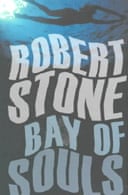
Bay of Souls - Robert Stone

Bay of Souls by Robert Stone

Bay of Souls is the seventh and last novel by the late American master Robert Stone, who died earlier this year.  There are echoes here of other US masters - Hemingway in the love of hot exotic climes, James Dickey in the dissonance between man and nature - but Stone nevertheless conjures up something unique.  He adds the trope of academia, previously ploughed by Roth and Bellow, but again Stone's is different - a backwater university of no great account.  It is not our hero, Michael, who is the fish out of water here - far from it, we get the impression that this is the best he could have hoped for.  No, the fish out of water is Lara the Caribbean temptress, who is definitely slumming it.

Inexplicably, we think, she and Michael start an affair.  Michael cannot believe his luck and is prepared to abandon his wife, his son, his reputation such as it is - anything to keep Lara onside.  Lara, of course, has an ulterior motive, which is to get Michael to come with her back to her home island.  Michael, you see, is an accomplished diver and Lara desperately needs something retrieved from the deep.  That is a physical something; while Michael is coerced into going after it, Lara abandons learning, sophistication, worldly achievement to perform the ancient voodoo-esque ritual to free the soul of her dead brother.

This is where Stone truly demonstrates his difference, treating the fantastical with as much consideration and probity as he treats the campus back in America.  Lara is not mocked or despaired over; Michael is not disdained or judged.  Instead, both principal characters judge themselves.

Unusual, accomplished, and well worth reading.