Total Pageviews

Showing posts with label 1937. Show all posts

Monday, 26 September 2022

Procession - to Prison - Donald Henderson


 Donald Henderson was an interesting fellow.  Born in London in 1945 he was successively a stockbroker, actor, BBC staffer and pioneer of British noir crime.  He died of lung cancer, far too soon, in 1947.

I say noir because that is precisely what the poorly titled Procession - to Prison (1937) is.  I have read and reviewed a couple of novels written twenty years later by my fellow Nelsonian Maurice Proctor, credited by many as the initiator of the genre, and they are nowhere near as black as this.

To start with, it's not a whodunnit.  We know from the outset who is on his way to be hanged.  The question for about two-thirds of the book is, who did he kill?  Even when we know that Henderson pulls the rug out from under us when body parts are found and the garden dug up.  It's very clever, very tightly focused.

Alfred Willibur is a middleaged shopkeeper whose wife Mill has turned bitter with disappointment and whose daughter Megsy is about to marry car mechanic Eric Lord and flee the nest.  Everything comes to the boil when the Williburs' landlord sells the premises to an ambitious local farmer who turns it into a dairy outlet and installs a young woman to help Alfred in the shop.

Mill will have nothing to do with the new business.  She takes in a lodger, an eccentric old biddy, and lets bitterness eat at her health.  Ultimately Eric and Megsy take Mill away for a seaside break at Margate.  Alfred stays behind with the shop help and the demanding old woman upstairs.  As the week goes on, he finds himself with decisions to make.

Henderson has a choppy style and some irritating habits (three dots to start a sentence? what's that about?).  But the novel has really interesting psychological depth.  Essentially it's a study about ordinary people trying to find fulfillment in life.  What is especially diverting is the way characters deal with the trauma of the murder act.  Procession - to Prison is by no means Henderson's best known novel - that's probably Mr Bowling Buys a Newspaper, and the one I really want is the BBC-based A Voice Like Velvet - but it has been a fascinating introduction to his work.

Tuesday, 28 December 2021

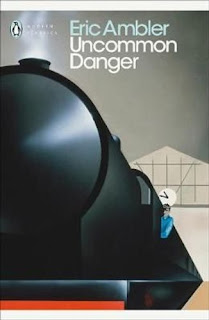
Uncommon Danger - Eric Ambler

Uncommon Danger (1937) was Ambler's second novel.  The setting is contemporary.  Fascist governments are rising all over Europe and challenging the dreadful divisions imposed by the Versailles conference after World War I.  Russia and Romania are the main claimants for oil-rich Bessarabia, but plutocrats worldwide are desperate to get their hands on the black gloop worth almost as much as gold.  Key Russian documents are stolen.

Our hero is a freelance journalist called Kenton who has lost all his ready money on poker dice.  Then, out of the blue, the only other passenger in his railway compartment, who claims to be a commercial traveller called Sachs, offers him a tidy sum to smuggle a package through customs for him.  Kenton is in no position to refuse.  He is an honest fellow and goes to the hotel Sachs nominated, to return the package and collect the other half of his fee.  Only to find Sachs murdered and Kenton himself the only suspect.

The rest of the book is a series of adventures which reminded me of The Thirty-Nine Steps - Ambler is in many ways the bridge between Buchan and Bond.  The Russian agents, Andreas Zaleshoff and his sister Tamara, are by and large the good guys, Colonel Robinson and Captain Maitland, operating on behalf of the London capitalists, are very much the baddies.  Smedoff, the ageing femme fatale, who appears right at the end, is a magnificent character.

Excellent fun.


Wednesday, 25 November 2020

The Great Gold Snatch - Grierson Dickson


This is the way to read your period crime thrillers - in a weekly magazine from May 1937!

I was interested in 'Jimmy' Dickson because he was a friend of Max Knight, the original M, and like Max himself and most of his friends, he wrote crime fiction.  I wanted a sample but I didn't want to pay Amazon's COVID-inflated prices.  So I found this on Ebay and eminently satisfied.

The crime itself is explained in this magnificent header page:


A truckload of gold bullion is hijacked along its route from Croydon Airfield to the Bank of England despite a fully armed police escort.  When Superintendent 'Cissie' Marlow arrives on the scene the gold has completely vanished.  How?  Well for once I spotted the clue, not that it matters.  The novella is genuinely thrilling, with high speed car chases and forensic science and close encounters of the gangster kind.  Dickson might have made a ghastly misjudgement in his hero's sobriquet, but boy, can he handle pace.

An added virtue is that it's set right on the cusp of traditional flatfoot policing and modern investigation.  There is a Flying Squad, with Q cars and a lab at Hendon, but look at the not very secure security van in the image.  It is just a van with reinforced wooden doors, because at that time no one had ever stolen such a volume of bullion, largely because of sheer weight.

I loved the cover image (signed A Jones, which is not much help) and the uncredited interior artwork.  I am on the lookout for more Dickson (but I'm still not paying Amazon's current prices).


Wednesday, 19 April 2017

Midnight in Peking - Paul French


I can't fathom why I hadn't heard of this book before stumbling upon it in my local library. Midnight in the Garden of Good and Evil was a big hit for John Berendt twenty years ago - they even went on to make a crappy movie - and this book has obvious similarities (real-life murder, cultural bubble, kinky sex and the word midnight in the title). I won't say French's book is better but it is definitely just as good.


It will come as no surprise that the setting here is Peking. The year is (just) 1937. Russian Christmas, January 7. The bubble is the expat community in what was, temporarily, China's second city. Chiang Kai Shek is losing his grip on power and the Japanese are about to invade. A young woman is found butchered in the shadow of the historic Fox Tower. She is Pamela Werner, adopted daughter of E T C Werner, former British consul and leading Sinologist, a man who has devoted his life to understanding Chinese culture.


Unfortunately for Werner, he has fallen from favour with the British Legation, which refuses to permit the Chinese police to investigate in their jurisdiction. A British inspector, Richard Dennis, ex-Scotland Yard, is seconded from another district to assist Inspector Han, but is expressly forbidden to have contact with Werner.


The British, it turns out, have secrets to hide. Pamela, a girl with problems, was still a pupil at Tientsin Grammar School, boarding with headmaster Sydney Yeates who has very recently been sent home because parents, including Werner, complained about his enthusiasm for thrashing. In Peking Pamela likes to be seen as the sophisticated young woman she ought to be - she is twenty years old, after all. She has admirers. On January 7 she goes ice skating with her girlfriends, and disappears on her way home.


The assumption is that it is a very un-Chinese murder. The killer must either be living in one of the many foreign legations or in the Badlands, a red-light district frequented by overseas riff-raff, decandent playboys and hordes of White Russian emigres fallen on hard times.


It is the Badlands, inevitably, which grab our attention. The most useful contact made by any investigator is Shura, a White Russian of indeterminate gender, who alternates as call girl and raffish pimp. One of his sidelines is providing naked girl dance groups for parties in the apartment of a seedy American dentist who also runs a nudist colony in the hills above Peking.


The hero of the book is definitely E T C Warner himself, a dry as dust scholar in his early seventies, who nobody likes. It is French's great achievement that we come to love the old man who doggedly refuses to let the authorities close the file on his dead daughter. When the official investigation runs out of steam, Werner hires his own investigators. When the Japanese come, he presses on alone. Later he is interned in a horrific prison camp. Still he persists. He survives the war - and still he goes on, not resting until he finally expires at the grand age of eighty-nine.


It is Werner's account that forms the basis of French's book but it is the demented cultural hotchpotch of prewar Peking that brings the story alive, and that is all down to French, his massive research and his storytelling flair.


Highly recommended.