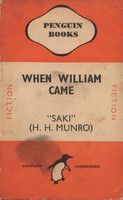
Saki (H H Munro) is best known for mordant short stories like 'Gabriel-Ernest' and 'Sredni Vashtar'. Indeed, I hadn't realised he had written any novels. In fact there are three novels of which this is the third, published in 1913.
The date says it all - the eve of World War I, the last glorious summer of imperial peace and prosperity. But in Saki's world the titular William is Kaiser Bill and Great Britain has been annexed to the Hohenzollern Empire almost by accident. The German navy and air-ships were just too advanced. Rather than resist, the king abdicated and went into exile in his personal empire of India. It was not so much an invasion as a fait accompli.
Obviously everyone in 1913 was aware that war with Germany was a possibility. Invasion literature was incredibly popular. H G Wells published The War in the Air in 1908 and William le Queux had been knocking them out since 1894. But Saki's twist is to make the invasion bloodless, thus leaving him free to be witty and, in the scenes relating to Gorla Mustelford's debut as a 'suggestive dancer'. downright hilarious.
The story is set in the first full London season since the fait accompli. Society has moved on - or perhaps remained unmoved. The upper classes have accepted the odd grafin and welcomed Prussian officers with their cheerfully coloured uniforms and resorted to the usual trivial pastimes. Cicely Yeovil is a social fulcrum, with her shiny-haired young men and Gorla's debut to oversee. So it's all a bit of nuisance when her husband Murrey shows up.
Murrey is a man who travels to stave off the boredom. When William came, Murrey was battling fever in a Finnish hospital. When he heard about the fait accompli he assumed it was a product of his fevered imagination. Now back in London, he cannot accept it. He toys with the notion of heading off to the court in exile in Delhi - either that or taking up the mastership of the hunt down in Wessex.
Saki, at heart the short story master, does not hammer out a plot. The story is more that of the various participants. Gorla's debut is counted a success and the next social highlight is a march-past of the massed ranks of Boy Scouts in the Mall - which is where Saki springs his surprise.
It's a superlative twist, the last thing I expected, both amusing and moving.
Of the author's own attitude to the German threat we need be in no doubt. When war came Hector Hugh Monro was 44 years old. He nevertheless enlisted and served on the front until he was killed by a sniper in November 1916. So he is a hero and a writer of consummate skill. He deserves be better remembered.

