Total Pageviews

Showing posts with label Knights Templar. Show all posts

Tuesday, 10 September 2024

The Templar, the Queen and her Lover - Michael Jecks


 Blimey, turns out it's twelve and a half years since I read Jecks and his Sir Baldwin series.  The last one I read, in the earliest days of this blog, King's Gold, post-dates this one, which is set in 1325, primarily in France, where Sir Baldwin and his friend Bailiff Simon Puttock, are part of Queen Isabella's security as she tries to negotiate a treaty with her brother, King Charles IV.

The stumbling block is that Charles and Isabella have not been on the best of terms since Isabella told her father Philip IV that the wives of Charles and another brother were promiscuous adulteresses, carrying on their debauches in the infamous Tour de Nesle.   Both wives were put away.   Charles's wife Blanche is still alive in 1325, a prisoner in the squalid Chateau Galliard, the marriage long since annulled.   Charles is about to marry for the third time, a child bride who is also his first cousin.

Isabella has been likewise sidelined in England, because her husband has replaced Piers Gaveston with a new and more demanding lover, Hugh le Despenser.   Despenser wants the mission to France to fail and Isabella to be discredited.   Edward II's former friend and general, Roger Mortimer, is living in Parisian exile.   He is actually not yet the Queen's lover.

As a former Templar, Baldwin himself is in danger in France, Philip IV being the king who destroyed the Temple and burned the leading Templars.   Baldwin wasn't in France at the time but still has a price on his head.   Meanwhile people in the retinue are dying: Enguerrand, Comte de Foix, is killed after an argument with Baldwin; his squire, Robert de Chatillon, is attacked and later murdered; an old soldier associated with Foix and Robert is killed in the first attack.   Before any of this, the garrison at Chateau Galliard, the prison-keepers of the woman who would have been queen, has been wiped out, Blanche herself having disappeared.  The garrison, moreover, comprised men hired by Robert de Chatillon on the orders of Comte Enguerrand.

The mystery is tantalizing and complex.   The book, however, is too long and its structure too fractured.   It would have been better to focus only on what Baldwin and Simon know, experience, or discover.  It was enjoyable enough but, being so splintered, lacked grip.

Thursday, 8 August 2024

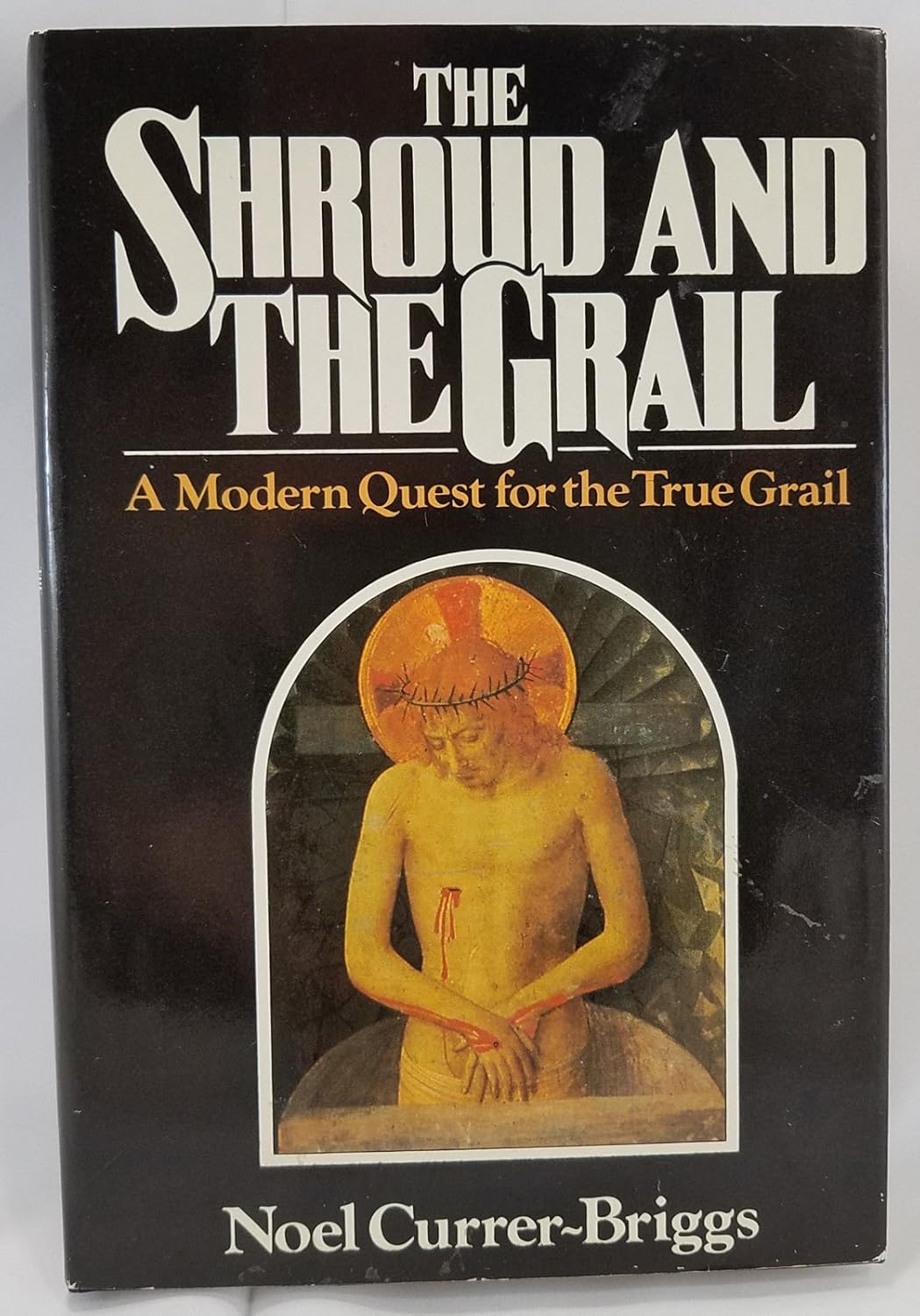
The Shroud and the Grail - Noel Currer-Briggs


 I have been fascinated by the mystery of Rennes-le-Chateau since Henry Lincoln began his Chronicle series in 1972.   I even read the book, The Holy Blood and the Holy Grail, when it came out in 1982.   I managed to steer well clear of the Dan Brown phenomenon, fortunately, and was able to remain interested if not committed.   Twenty years later, I was reading a fantasy story about magic when I stumbled over a reference to the book by Noel Currer-Briggs.   Was it real, I wondered.   If so, was it available?  Yes to both.

Noel Currer-Briggs (1919-2004) was Yorkshire-born (can't be helped), a scholar, a cryptographer at Bletchley Park during World War II, and a genealogist.   He came to the subject of the grail through Ian Wilson's books on the Turin Shroud, which I have also read.   Currer-Briggs theorised that the grail was the vessel in which the cloths that shrouded Jesus's body were kept after his resurrection.  Specifically these are the Shroud itself, now in Turin, and the face cloth which was destroyed during the French Revolution but has been recorded in countless artworks as the generally accepted face of Christ.

Currer-Briggs' aim in this book was to work out where the Shroud had been since first being seen by western eyes in Constantinople during the First Crusade, and ending up in the possession of the dethroned king of Italy, who gave it to Turin cathedral for safekeeping.   Genealogy is his tool.   He argues that the Templars spirited it away from Constantinople when the city was looted during the Third Crusade, took it to Germany, then on to France where the Templars had their western HQ.   When the Templars were suppressed in 1307 it then passed into the keeping of one particular family with extensive Templar links drawn ever tighter as their descendants married into other Templar families.   Ultimately it passed to the House of Savoy, which became the royal house of Italy.

It's all intriguing and adds to the fascination.   What I don't entirely get is how one school of thought is that the Grail was a chalice, another a bowl, when (according to Currer-Briggs) it was in fact a flat wooden box.   On the plus side, despite living in East Midlands, I had never heard of the Nottinghamshire alabaster carvings that profess to be of John the Baptist's severed head but which make much more sense as references to Christ's Resurrection. 

Essential reading, then, for those like me who are fascinated by the arcane.